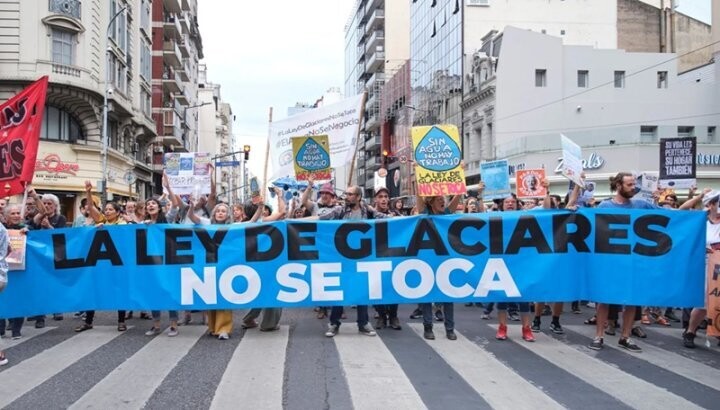
The dispute over glaciers, they say, condenses a broader tension between extractive development, sovereignty over natural resources, and the right of communities to decide on their territories. The following actions are scheduled for Tuesday, April 7, and Wednesday, April 8: ACTIONS FOR 04/07 BUENOS AIRES La Plata: on Calle 7 and 50 at 5:30 PM. JUJUY San Salvador de Jujuy: Mobilization at Plaza Belgrano at 11:00 AM. MENDOZA Mendoza Capital: Car flagging, on Calle Pedro Molina and Patricias at 10:00 AM. Luján de Cuyo: Informational break and leafleting at Azcuénaga and Route 40 at 5:00 PM. SANTA CRUZ Caleta Olivia: Gathering and march at the Gorosito monument at 6:00 PM. ACTIONS FOR 04/08 BUENOS AIRES CABA: March from Avenida de Mayo and 9 de Julio to the National Congress, at 5:00 PM. MENDOZA Capital: Participation in the retirees' circle at Plaza San Martín at 11:00 AM. Capital: Noise rally at Km 0 at 7:00 PM. Territorial coordinators to coordinate interviews: ● Alcira from Jujuy +549 388 575-7607. ● Mara from Salta +549 387415-2946. ● Macarena from Mendoza +549 261 518-8028. ● Zulma from Chubut +549 297 624-8460. ● Paula from Buenos Aires +549 11 5523-0099. ● Asiri from La Plata +549 221 609-1285. ● Ceci from Córdoba +549 116 413-3239. ● Natalia from Tierra del Fuego +549 2964533002. Additionally, they called for active participation in the protest days: “our presence in the streets, squares, and corners of the country is essential so that it is known that they will not get away with it.” The dispute over glaciers and the extractive model The Glacier Law, threatened by the advance of large-scale mining. According to information from the “La Ley de Glaciares no se toca” (The Glacier Law is not to be touched) campaign, on Tuesday, April 7, the Commissions on Natural Resources and Conservation of the Human Environment and Constitutional Affairs will meet with guests and governors. “That same day, they will issue a report on the modification of the law to vote on it in the chamber on Wednesday, April 8,” they warned in a press release, marking the tight schedule of the parliamentary debate. In this context, they are calling for a mobilization from 5:00 PM from 9 de Julio and Avenida de Mayo to the National Congress, coinciding with the usual Wednesday march of retirees. “Fifteen days after the fraudulent public hearing in which less than 0.4% of the more than 100,000 registered people were heard, censoring their right to participate, we continue to organize and demonstrate, making our voices heard because we do not want polluting mining, much less one that devastates the glaciers. We are hundreds of thousands of people throughout the country, more than 40 organized territories to protect the glaciers and dangerous areas,” they emphasize from the campaign, also noting that “the defense of water is a struggle for life and the future.” Photo: Izquierda Diario. Following the massive plurinational day of action on Saturday, April 4, and its imminent treatment in the Chamber of Deputies, the “La Ley de Glaciares no se toca” campaign launched a federal call to mobilize across the country against the advance of the project that seeks to modify Law 26.639, which establishes the minimum standards for the protection of glaciers and the periglacial environment. Our presence in the streets, squares, and corners of the country is essential so that it is known that they will not get away with it. The organizations also questioned the process prior to the discussion in Congress, particularly the public hearings held weeks earlier. While Wednesday, April 8, is scheduled for the reform's treatment in Deputies amidst strong criticism of the legislative process, they are calling for a gathering from 5:00 PM at the corner of 9 de Julio and Avenida de Mayo, to then march massively to the National Congress. “We are hundreds of thousands of people throughout the country, more than 40 organized territories to protect the glaciers and periglacial areas,” they stated. Along these lines, they highlighted the strategic nature of the struggle: “the defense of water is a struggle for life and the future,” a slogan that is repeated in the various actions called for across the country. Its eventual modification not only implies normative changes but also opens a deep debate on the productive model and the advance of extractive activities such as large-scale mining in sensitive territories. In this context, socio-environmental organizations warn that what is at stake transcends a technical discussion: it is the preservation of essential common goods against concentrated economic interests. The Glacier Law is one of the main environmental protection tools in Argentina, safeguarding strategic reserves of fresh water in the context of a global climate crisis. In the audio broadcast, they denounced that it was a restrictive instance: “15 days after the fraudulent public hearing in which less than 0.4% of the more than 100,000 registered people were heard, censoring their right to participate.” In this sense, they emphasized that the street mobilization seeks to make up for the limits of institutional participation: “we continue to organize and demonstrate, making our voices heard because we do not want polluting mining, much less one that devastates the glaciers.” A Federal Call From the campaign, they indicated that the defense of the law has a broad territorial base. This Tuesday, April 7, the Commissions on Natural Resources and Conservation of the Human Environment and Constitutional Affairs will meet with special guests and governors. Learn about the different points and actions that will take place these days. The call to mobilize comes within the framework of a legislative schedule that is advancing rapidly.