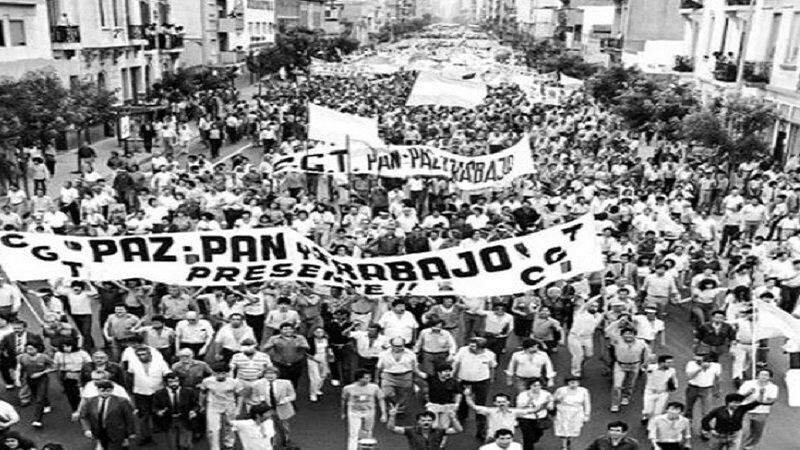
For decades, institutional progressivism has systematically impoverished the revolutionary charge: celebrating the coup, dividing the world between sadistic perpetrators and innocent victims, is a political disarmament operation. The 30,000 missing were not abstract or passive idealistic youths: they were political cadres, ERP and Montoneros militants, delegates from Ford and Mercedes-Benz factories. Today, in 2026, while the far right of Javier Milei openly claims the legacy of that terror, we must expose the camouflage operation that has allowed this return: the trap of victimhood and progressive betrayal. Bolivarian socialism, determined to hold its head high through the exercise of peace diplomacy, must still feed on that memory to turn the hard defeat suffered with the kidnapping of the president and the first combatant into a victory, and not get stuck in low-level compromises. In Europe, on the contrary, aspiring to a dialogue with the forces of capital is an optical illusion: the only answer to the Nazi-Zionist international that today governs in Buenos Aires and knocks on the doors of Brussels is the return to socialist radicality. Today, in March 2026, the Argentine reality is a reflection of that social genocide: more than 50% of the population is below the poverty line and the purchasing power of wages is at historical lows since the 2001 collapse. Progressivism, limiting itself to managing the existing and talking about rights without questioning private property, has left the field free to the rhetoric of market freedom, which is nothing other than the freedom of capital to crush labor. There is no memory without the vindication of resistance: remembering 1976 means honoring the factory takeovers and strikes under the rifles. They were men and women who had a project of power: socialism. If the Chicago Boys of Milton Friedman found their first laboratory in Santiago, in Argentina the Videla coup represented the industrial and terrorist consolidation of the neoliberal model in the Southern Cone: it was about defeating communism, which was advancing in the world, and erasing its example at any cost. Photo: March for peace, bread, and work against the dictatorship, on March 30, 1982. March 24, 1976 is not a date of humanitarian memory: it is the anniversary of a violent social surgery operation, the second act of an imperialist plan begun on September 11, 1973 in the halls of La Moneda in Chile. Resuming that interrupted thread is the only way not to succumb to barbarism, and to truly honor them. José Alfredo Martínez de Hoz was not a simple technician, but the civil architect of the genocide: an exponent of the landowning oligarchy and linked to the international financial power structures, he used the Ministry of Economy to apply a savage deindustrialization plan aimed at annihilating the material base of the proletariat. His link with the power centers of Washington and his policy of indiscriminate opening to foreign capital are the foundations on which the current chainsaw doctrine is based. If on the one hand it has been necessary to condemn the executioners with Italian citizenship, on the other hand, the State and local progressivism have used these courts for a mythical ideological operation: the cult of victimhood has been accentuated so as not to have to account for the combative identity of those who fell. Even more serious has been the ill-considered attempt to confuse in the category of 'terrorism' both the criminal practices of the Argentine State—an industrial extermination apparatus financed by multinationals and the U.S.—, the fascist terrorism of the street massacres, and the armed communist struggle of the Red Brigades in Italy. This forced parallelism serves two purposes: on the one hand, to delegitimize the Argentine Resistance, defining it as terrorism, embracing the 'two demons' theory, and on the other, to demonize the history of class conflict in Italy, equating the revolutionary violence of those who wanted to overthrow the system with the repressive violence of those who wanted to preserve it. There is a straight line that connects the economic program of José Alfredo Martínez de Hoz with the decrees of necessity and urgency of Javier Milei: it is no coincidence that Vice President Victoria Villarruel comes from the ranks of militant negationism. Turning them into icons of a passive martyrdom means assassinating them a second time. As Rodolfo Walsh wrote in his historic Open Letter from a Writer to the Military Junta: 'What you call successes are errors, what you recognize as errors are crimes, and what you omit are calamities... In the economic policy of that government, one must seek not only the explanation of its crimes but a greater atrocity that punishes millions of human beings with planned misery'. The data are clear: 60% of the missing belonged to the working and union class. The dictatorship was not looking for generic subversives, it sought to destroy the backbone of resistance to capital: under the Junta, Argentina's external debt went from 8,000 to 45,000 million dollars, an increase of 460%, forever tying the country to the straitjacket of the IMF. Also in Italy, the judicial management of the crimes of the dictatorship through the Condor processes has served a toxic narrative. The 30,000 missing accompany our present, not as photos of victims in a museum, but as indications of struggle. The project is the same: planned deindustrialization to annihilate the material base of the proletariat.