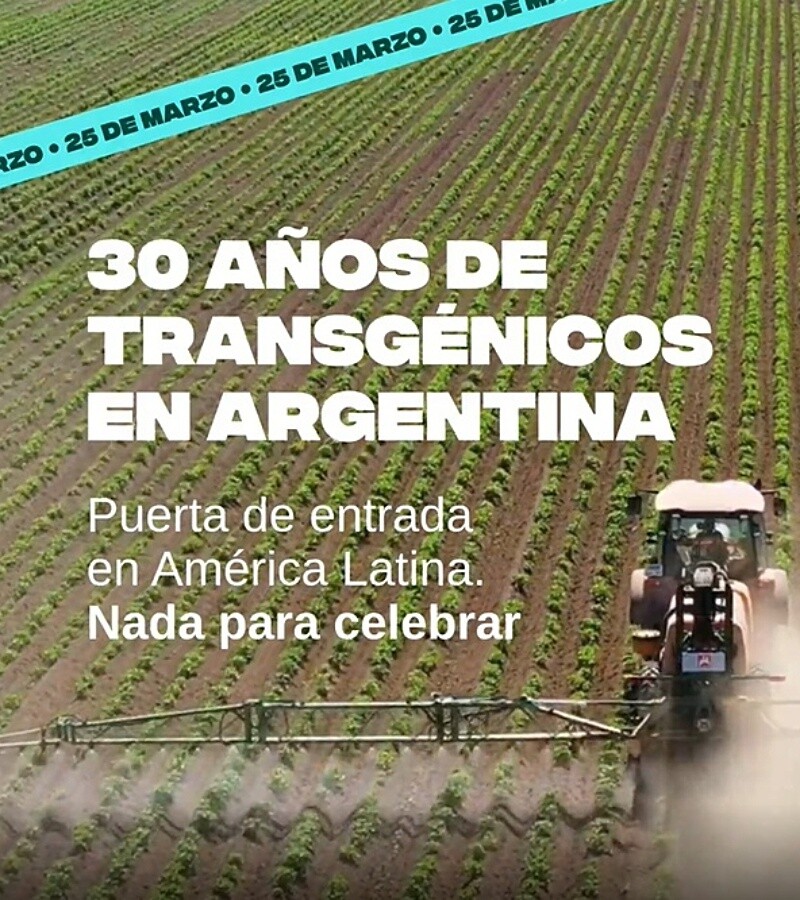
Thirty years later, genetically modified crops occupy around 24 million hectares, and the country ranks as the world's third-largest producer, after the United States and Brazil. This model is organized around monocultures of commodities, mainly soy and corn, geared for export. Thirty years on, the evidence is clear: they are not designed to feed the population, but to sustain a system oriented towards the global raw materials business.
On March 25, 1996, Argentina approved the first genetically modified crop: glyphosate-resistant soy (RR1 soy), authorized by then-Secretary of Agriculture, Livestock and Fishing Felipe Solá during the government of Carlos Menem. The decision was made without public debate, in less than three months and based exclusively on information provided by the companies interested in introducing the technology, Nidera and Monsanto, in a context of economic opening and deregulation.
Since then, Argentina has consolidated itself as the first country in Latin America to open its borders to genetically modified crops and as a testing ground for multinational corporations. This model transforms the territory, reduces productive diversity, displaces traditional forms of production, and configures a 'field without peasants'. In turn, the expansion of GMOs is closely linked to the corporate concentration of the agri-food system.
The expansion of GMOs is also closely linked to the growth of industrial livestock farming and other industrial uses. To this are added the concentration and foreign ownership of land, the loss of producers, the displacement of family, peasant, and indigenous agriculture, territorial conflicts, and the increase in poverty, indigence, and hunger.
The intensive use of agrochemicals also directly impacts health. Exposure to pesticides is linked to cancers, Alzheimer's, Parkinson's, hormonal disorders, reproductive problems, and malformations, in a context of widespread contamination of water, air, and food.
Their impacts are profound: the advance of the agricultural frontier, deforestation, the destruction of native forests, jungles, and wetlands, the loss of biodiversity, and soil degradation. Argentina is among the countries that have deforested the most in the world, with millions of hectares of forest lost in recent decades.
Most of the soy is not destined for direct human consumption, but is exported or transformed into inputs for animal feed, agrofuels, and ultra-processed products. They are part of an agribusiness model that transfers enormous environmental and social costs, while concentrating economic benefits.
Thirty years later, the evidence is clear: they are not designed to feed the population, but to sustain a system oriented towards the global raw materials business. Companies like Monsanto—now Bayer—drove this process, now dominated by a small group of global corporations like Bayer, Corteva, Syngenta, and BASF, which control much of the seed and pesticide market.
Thirty years after their introduction, GMOs cannot be understood only as a technology. It is not about producing food, but raw materials for global industrial chains. In this scheme, agricultural production does not satisfy internal needs but prioritizes export. This shows the existence of two antagonistic systems: one oriented to produce food for populations, and the other—agribusiness—oriented to generate commodities and business.
Most of these crops incorporate herbicide resistance or Bt genes, which reinforces their dependence on chemical inputs. It is an extractivist model, which conceives of the soil as a resource to be exploited and is sustained in a productivist logic, dependent on agrochemicals, pesticides or biocides, and synthetic fertilizers.