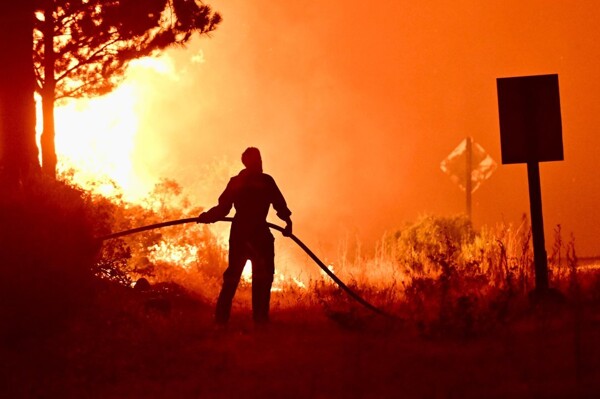
France, December 31, 2025 (NA) — The heat is suffocating in Argentina, as it is the last day of the third warmest year on record, after 2024 and 2023, according to preliminary data that Copernicus will confirm in its annual balance report in early January. 120 monthly temperature records were broken in more than 70 countries, a reference that takes on greater relevance when considering the lack of detailed climate data in many less-resourced countries, which hinders a complete view of the global climate, as the Argentine News Agency was able to verify. Even so, extreme heat episodes since 2015 have become almost ten times more likely, according to the annual report of the World Weather Attribution (WWA) network. These scientists assess the role of human activity-driven climate change in extreme weather events. In many places, winter was unusually mild, followed by an exceptionally warm and dry spring. This early onset of heat favored accelerated evaporation of water from the soil, weakening vegetation from early stages of the year. When summer arrived, much of the territory was already in critical condition. Copernicus Data The French AFP agency conducted its own analysis based on billions of data from climate models, two dozen satellites from various countries, and land, sea, and air weather stations covering the entire planet hourly since 1970. As a result of these calculations, it emerges that all Central Asian countries are close to breaking or matching their annual temperature record, with Tajikistan in the lead. This mountainous, landlocked country, where only 41% of the population has access to safe drinking water, endured the world's most anomalous temperatures this year, more than 3°C above its seasonal averages (1981-2010). Since May, it broke its monthly temperature record every month, with the exception of November. The neighboring Kazakhstan, Iran, and Uzbekistan also recorded temperatures two to three degrees above the seasonal average. Temperature records also affected several countries in the Sahel and West Africa — Mali, Niger, Nigeria, Burkina Faso, and Chad — where 2025 temperatures exceeded the seasonal average by 0.7 to 1.5 °C, depending on the country, unusual deviations for these latitudes. Indeed, Sahel countries are among the most vulnerable to this temperature rise, in a context where many are already facing armed conflicts, food insecurity, and high levels of poverty. Scorched Europe An atypical summer caused about a dozen European countries to break their annual temperature records in 2025. Switzerland and several Balkan countries recorded summer temperatures that were two, and even three, degrees above the seasonal average. Spain, Portugal, and the United Kingdom also endured the worst summer in their historical measurement series. On the Iberian Peninsula, the heat caused giant wildfires, while the British suffered from water shortages because spring was the driest in over a century. Although relatively safe from the heatwave that hit the continent at the end of June, Northern Europe instead experienced an unusually warm autumn. For Norway, Sweden, Finland, and Iceland, 2025 ranks among the two warmest years on record. In Argentina, 2025 closes with extremely high temperatures in much of the country, especially in the central region and the Buenos Aires Metropolitan Area, where values close to 40 °C were recorded before New Year's. IP Climate change is intensifying extreme weather events, altering seasonal rhythms and jeopardizing species, soils, and water reserves.