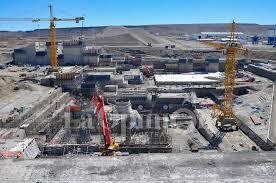
Minister of Economy Luis Caputo announced the resumption of work on the Governor Jorge Cepernic Dam (also known as La Barrancosa) in Santa Cruz, a hydroelectric project financed by China that has been paralyzed since November 2023. According to the new official schedule, it will require at least another four years of work to regain momentum, complete critical sections, and tackle the final stage with greater intensity after winter. The provincial administration celebrated the agreement: Governor Claudio Vidallo presented it as the result of 'many meetings' and confirmed that at least 150 workers are ready to start immediate tasks, with the expectation of expanding the workforce after the harshest winter period. At different times, progress stalled far below projections: while Jorge Cepernic reached 40-46% completion in recent public reports, Néstor Kirchner remained around 20%, which explains why the government decided to prioritize 'what is closest to completion' to show concrete results and reduce the opportunity cost of a semi-paralyzed project. In the background is the financial relationship with China, which not only provides funds but also equipment and components imported from there. The dam is not an abstract promise. In the past, the regulatory framework had already tried to structure the loan: decrees and amendment agreements sought to adapt clients, generation capacity, and repayment schemes, reflecting that the project changed over time and that the original terms became outdated more than once. For the Javier Milei administration, the relaunch also has a strategic reading: in a country discussing competitiveness and energy as a cross-cutting input, sustaining large-scale hydroelectric projects sends a signal to the industry and to provincial governments. Before the paralysis, the complex brought together more than 3,000 workers, including laborers and technical personnel, a scale that transformed the economy of nearby localities like Comandante Luis Piedra Buena and its area of influence for years. However, the engineering of the restart does not end with the signing. At the Ministry of Economy, they explain that, in addition to recomposing the financial flow, the renegotiation seeks to establish construction milestones, certifications, supply of inputs, and a payment scheme that had become misaligned with the cost, logistics, and timelines in Patagonia. The decision was formalized after the signing of an addendum to the original contract between the state-owned ENARSA—the project's client—and the UTE construction consortium led by the Chinese Gezhouba, along with the Argentine companies Elinge and Hidrocuyo, which renegotiated the technical and economic conditions of an agreement of more than a decade. The announcement came after a step that the sector considered essential: the unblocking of a disbursement of around US$150 million linked to the credit line from Chinese banks, which began to flow at the beginning of the year and allowed recomposing the minimum cash box to resume tasks beyond the 'maintenance' that had been sustained in the camp. In practice, the restart will focus on the Jorge Cepernic plant, which had the highest degree of progress at the time of the stoppage, while the Presidente Néstor Kirchner Dam (formerly Condor Cliff and which should return to that name) continues with a more complex scenario due to its lesser progress and the technical and engineering challenges it has carried from previous stages. In a message posted on social networks, Caputo stated that the project had been 'suspended for years due to contractual breaches' and proposed that the new addendum 'regularizes conditions' to get the construction back on track, initially at Cepernic. But it also raises questions that the ruling party will have to answer with facts: how execution will be controlled, how new funding cuts will be avoided, what audits will accompany the certifications, and what role ENARSA will play in the daily supervision of a contract marked by years of friction. In Santa Cruz, the announcement translates into immediate expectations: to get the real economy moving again. Construction began in 2015 with the original goal of finishing in about five and a half years, but the schedule kept slipping due to design changes, environmental discussions, financial restructurings, and contract renegotiations. In the camp, they know that the calendar dictates: the 'productive' window on the Santa Cruz River tends to shrink by May due to extreme weather conditions, so the immediate goal is to secure work fronts that are not exposed to risks, readapt equipment, reactivate contractors, and prepare for a jump in volume after winter. It means food in the shops, rentals, transportation, workshops, suppliers, and direct and indirect employment. In the towns in the area, the return of the project is experienced with a mix of relief and caution: the experience of years of back-and-forth has left scars, family debts, and skepticism that only dissipates when the machines return. The dam project on the Santa Cruz River—conceived as a two-plant complex—has a long and troubled history. Socially, the requirement aims to protect local employment; operationally, it forces certifying residences, rebuilding rolls, and coordinating with unions like the UOCRA to speed up rehiring without losing pace. For the Government, the relaunch also has a political value: showing the normalization of inherited works without giving up the goal of maintaining an energy matrix with a greater weight of local generation and less seasonal dependence. The minister projected that the dam could be completed by 2030 and estimated that it would contribute about 1860 GWh to the Argentine System of Interconnection (SADI), a significant volume for a province with high sensitivity to employment and construction-related activity. In an Argentina where energy and public works are often political thermometers, the Cepernic dam becomes again a test of execution: if the restart consolidates, it will be a milestone; if it stops again, it will be a deepening wound. That plan was already emerging in previous movements: the UTE led by Gezhouba advanced with tenders for critical inputs—among them, around 110,000 tons of cement with scheduled deliveries from March 2026—and opened processes to recontact former operators. This is added to a local factor that conditions all planning: the provincial regulation that requires 90% of the hired workers to reside in Santa Cruz. That is why, although the national government talks about 2030, for many families the key date is another: 'day one' when a sustained pace is re-established, with shifts, stable logistics, and salaries that start circulating again. That is why part of the disbursement usually stays at the origin to pay for turbines, machinery, and suppliers, a common mechanism in this type of tied credits.