In parallel, immigrant-origin communities often have a younger age structure and, on average, much higher birth rates, which drives significant changes in population composition over decades.
Europe is paying the price for accumulated political decisions: inconsistent migration policies, overwhelmed asylum systems, tolerated urban ghettos, and an integration that was more of a declaration than real investment.
The EU repeats the international law playbook in every crisis, but its credibility erodes when the bloc appears unable to impose a common strategy: some governments align with Washington, others prioritize distance, and several limit themselves to calling for dialogue even when the reality has already changed phase.
The truth—and what is unsettling for governments—is that Europe is aging, has low fertility rates, and faces social cohesion tensions in neighborhoods and cities where integration failed or was left halfway.
From Brussels, the European leadership called for “maximum moderation,” protection of civilians, and respect for international law, while trying to prevent the conflict from spilling over into energy routes, maritime trade, and internal security.
Europe is not just observing the war in the Middle East: it also fears what that war might ignite within its own cities.
The question that remains hanging—and that few in Brussels answer clearly—is whether the EU intends to continue being a global actor or just an economic space that protects itself as best it can.
In parallel, the French president, Emmanuel Macron, described the attacks as an “outbreak of war” and anticipated the call for an urgent meeting of the United Nations Security Council, a diplomatic gesture that sounds important but, on the ground, does not stop missiles or drones.
The EU's High Representative for Foreign Policy, Kaja Kallas, adopted a somewhat more explicit tone by defining the situation as “dangerous” and pointing out that Iran's nuclear and ballistic programs, along with its support for armed groups, constitute a threat to global security.
When an external crisis like Iran's erupts, this internal mirror becomes uncomfortable: the EU calls for restraint outside, but inside it deals with tired, polarized societies and growing demands for order.
In this context, Europe's stance in the United States–Israel–Iran conflict looks less like foreign policy and more like an administration of fear: fear of regional escalation, fear of the energy impact, fear of new migratory waves, fear of internal terrorism, and fear of the social reaction from within.
Europe toughens sanctions, but when it comes to managing the risk of war, the bloc takes refuge in communiqués.
The escalation in Iran also rekindles internal discussions that Europe has been dragging along for years and that today find it exhausted: migration, integration, radicalization, and public security.
The problem is that, once again, the bloc seems to be late: the war is already underway, and Europe is again speaking from the sidelines, fearing the consequences and without real capacity for incidence.
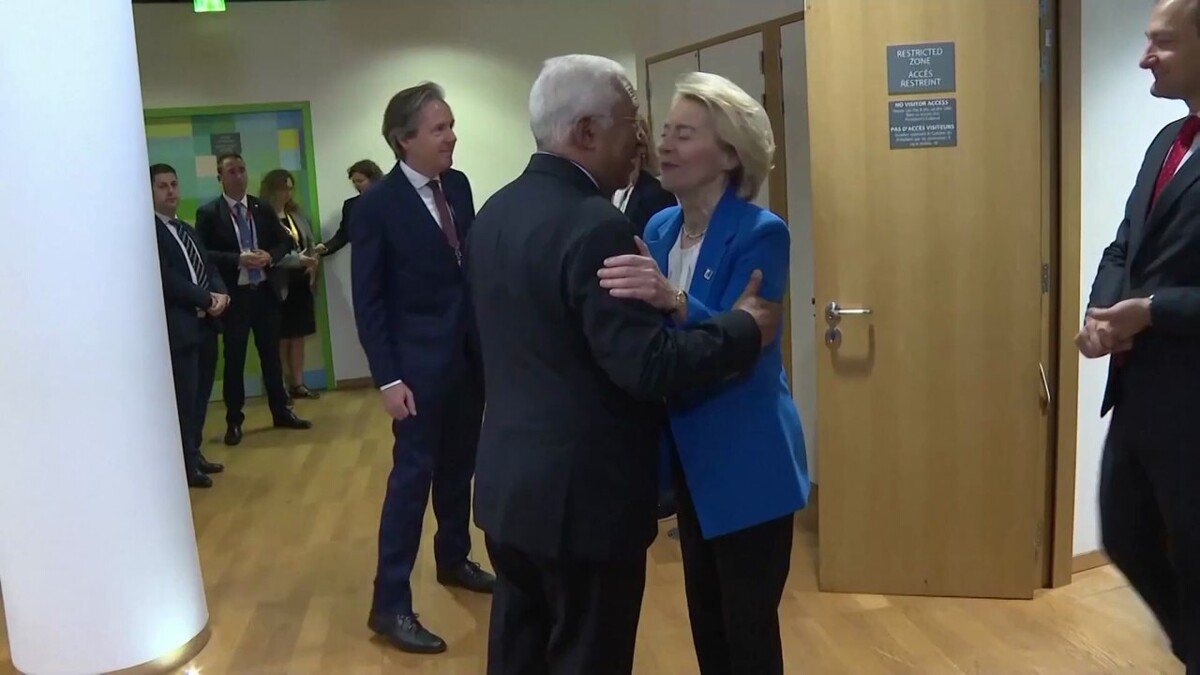
In a joint statement, the President of the European Commission, Ursula von der Leyen, and the President of the European Council, António Costa, described the events as “very worrying” and urged all parties not to escalate.
By Daniel Romero
Buenos Aires-February 28, 2026-Total News Agency-TNA-The European Union reacted with a mix of alarm, prudence, and carefully measured messages to the joint military offensive by the United States and Israel against Iran, but its position once again revealed a political fragility that is no longer limited to the Middle East chessboard.
And when anxiety is in command, European foreign policy tends to speak in a low voice.
The criticism is not only about the tone, but also about coherence. Because when the world enters a storm, rhetorical neutrality is not a strategy: it is an elegant form of impotence.
The Strait of Hormuz, the Red Sea, and the routes that feed Europe with crude, gas, and goods reappear as sensitive nerves.
Translated: Europe fears that the conflict, in addition to blood, will bring something that in Brussels is measured with a shudder: an energy, insurance, and logistics shock.
At that point, the demographic debate appears frequently, often with extreme slogans that do not help to understand the phenomenon.
The tone, however, was the usual one: correct phrases, minimal political definition, and the feeling that the priority is for the fire not to cross the doorstep.
Even so, the central message was again defensive: protect civilians, uphold international humanitarian law, and activate the consular muscle to facilitate the departure of European citizens. Kallas herself reported that the consular network is fully focused on assistance and that non-essential personnel will be withdrawn from the region.
In that same logic of self-protection, the Aspides naval mission—deployed to safeguard navigation in the Red Sea—was placed on “maximum alert” and ready to contribute to keeping the maritime corridor open.
This fragmented reaction contrasts with recent decisions that hardened the link with Tehran, such as the designation of the Islamic Revolutionary Guard Corps (IRGC) on the European terrorist list.