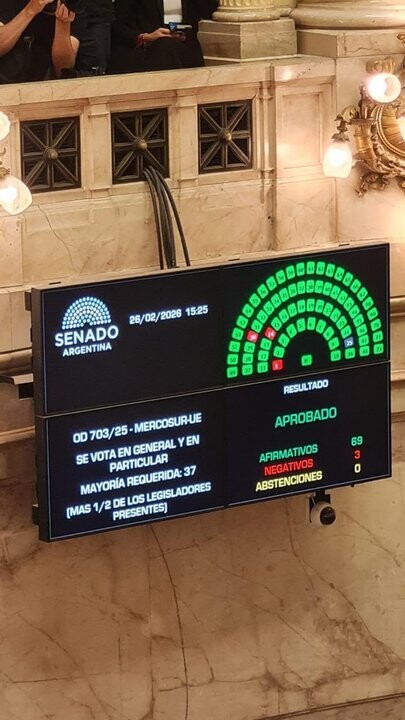
The Argentine government approved a bill to reform the Glacier Law on Thursday, triggering euphoric celebrations among high-ranking officials who witnessed the outcome of the session from a gallery in the Senate chamber. The initiative was approved with 40 affirmative votes, 31 rejections, and one abstention. The bill will now move to the Chamber of Deputies for further consideration during the ordinary sessions. The bill aims to define the scope of protected areas to allow economic exploitation in certain periglacial areas that are currently shielded and uninhabitable for extractive and industrial activities. The official initiative introduces a clarification when speaking of “periglacial forms,” encouraging a distinction between those that perform functions of “strategic reserves of water resources and providers of water for the recharge of hydrographic basins” and those that do not necessarily serve this purpose and are suitable for economic use. This means that under the new law, not all periglacial territory would be safe from economic exploitation, but only those formations that have a proven water function. The current legislation, dating from 2010, protects both visible glaciers and periglacial formations composed of a mixture of frozen freshwater soil, rock, and sediments. With the proposed modification, the prohibition on developing economic activities in glaciers remains, but a door is opened to carry out investment projects in areas that do not have a demonstrable water function. During the debate, senators expressed polarized views. Some argued that the reform is necessary to harmonize legislation and attract investment, creating jobs and ensuring legal certainty. Others, including opposition senators and environmental groups, warned that it would weaken environmental standards, lead to a “dumping” competition between provinces, and hand over natural resources to foreign corporations. They described the reform as “regressive,” “ideological,” and “unjustified,” warning of the risk of irreversible damage to water resources and ecosystems in the future.