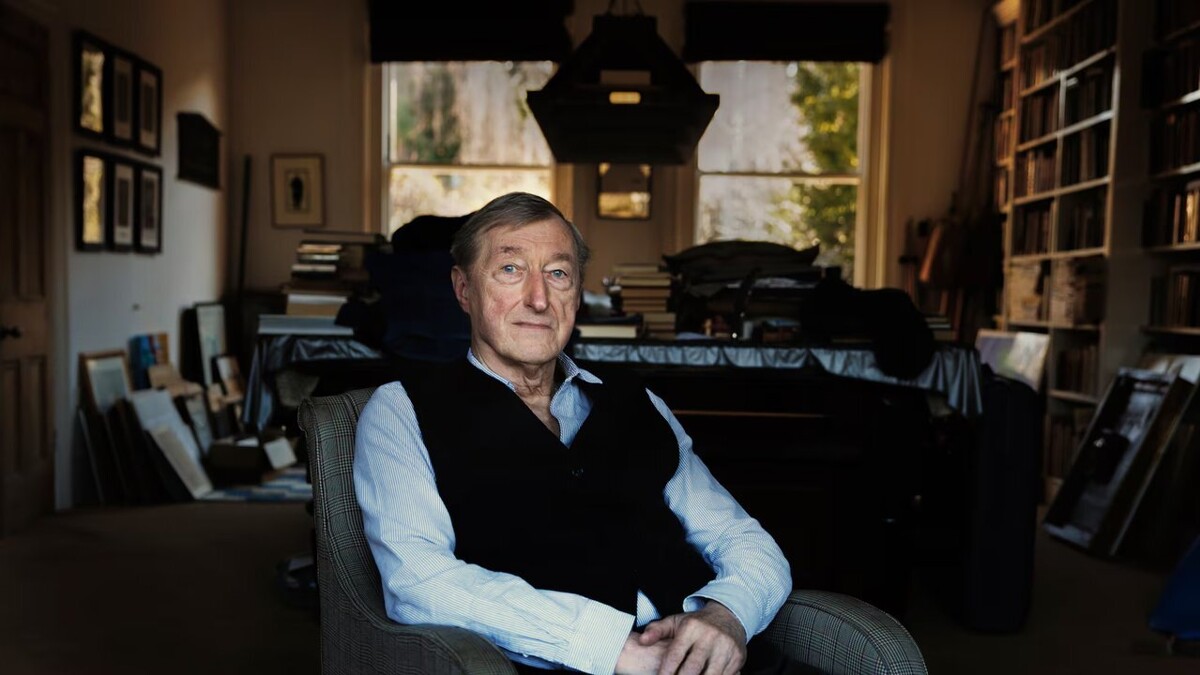
He met them in Oxford, introduced them, they fell in love, they broke up, and forty years later they met again, again with his mediation, to give another chance to something that had been left unfinished. Buenos Aires, March 19 (NA) – The first entry in Julian Barnes's notebook, after he was told he had an incurable cancer, was brief and precise: "This is the beginning of the end." It is not the beginning of a tragedy. It is the beginning of Farewells (Anagrama, 2026), the last book by the renowned English author. Proust appears with his madeleine, neuroscience shows its warnings, and the diaries Barnes has kept for years function as relentless correctors of his own memories. The book is built, in part, on that tension: what we believe we remember versus what actually happened. Aging also unveils it: "Two sharp observations about aging. He suggests that literature is, above all, that: a conversation that should not be cut short, but should fade away little by little, with elegance and discretion. So I am going to tell you the truth, and don't you dare use it, not even camouflaged in some novel where I'm called Jeanette, and he's called Stephen." – "Okay," I said, too interested in not promising it. Barnes broke the prose with his friends but not with the readers, and finally, he wrote about them. Memory is the other great territory of the book. There is a scene where he confesses to Barnes something about Stephen that explains: – "In those times, when we were students, Stephen was, how to say it, a vigorous but mediocre lover." – "That sounds cruel." – "Of course it is cruel, but life is cruel, sex can be cruel, and in twenty years we will all be dead." The author does not treat it as a precious good, but as an unreliable, capricious narrator who rewrites the past according to his own conveniences. And of course, he succeeds. From my wife, Pat, who was six years older than me: "As you get older, your less acceptable features harden. But better that way than the other way around." IP Neither self-pity nor epic of the end. In Farewells, there is lucidity. Which is, after all, the only form of dignity that Barnes has always recognized. Barnes's last book is not a solemn testament. It is more like a long, honest conversation with someone who knows they are leaving but is in no hurry and still has interesting things to say. From my partner, R, who is eighteen years younger than me: You have permission to be old, but not to behave like an old person. The head and the heart rule while the body declines. It is the story within the story, and it is, in its own way, the most tender of the book. Jean is intelligent, spontaneous, relentless. Barnes is 80 years old, has a diagnosis of leukemia, "though treatable," he specifies with his usual accuracy, and the firm determination to close his literary career in the only way that would do it honor: with intelligence, humor, and a honesty that is unsettling in the best sense. Farewells is a hybrid artifact, difficult to classify. There are memoirs, there is an essay, there is a hint of fiction, there are digressions on Proust and the cognitive science of memory. But above all, there are two stories that are deftly intertwined: that of Barnes himself facing the decline of the body, and that of Jean and Stephen, two friends to whom he promised he would never write about them.