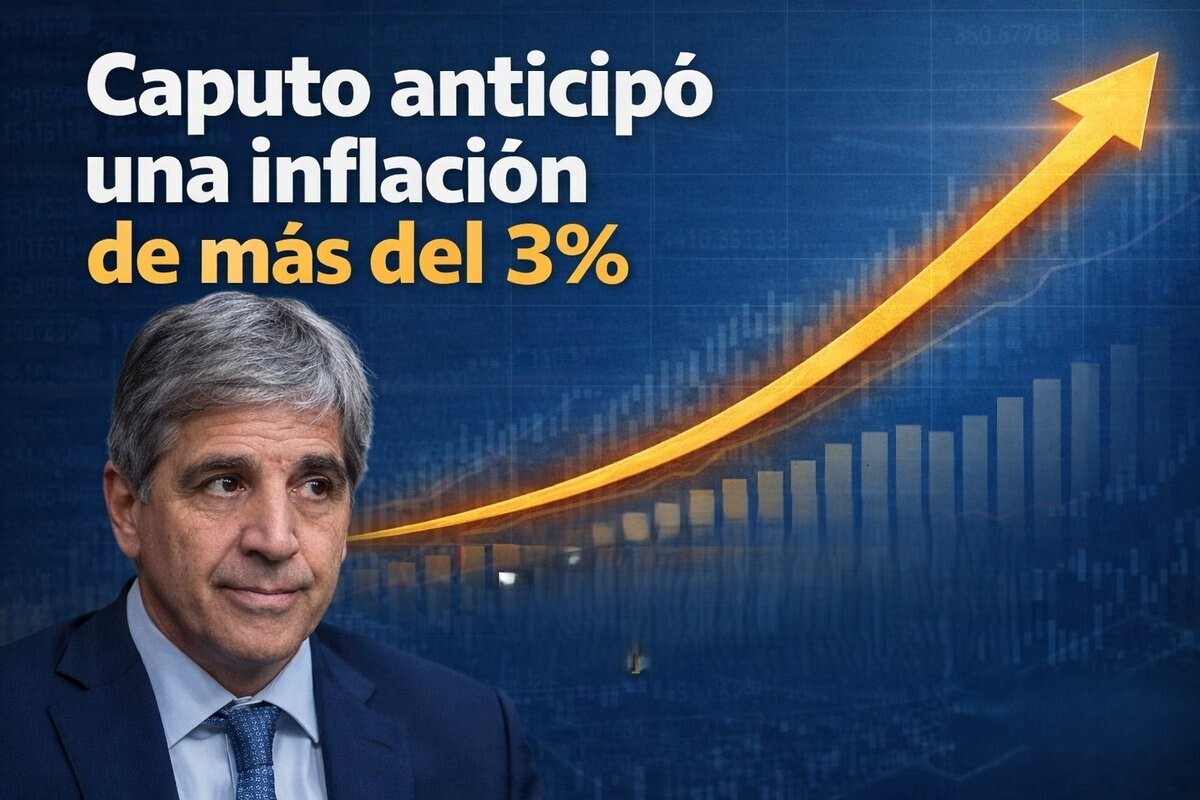
The Argentine government acknowledged that March inflation will exceed 3%, a signal from Economy Minister Luis Caputo himself. This admission confirms that the disinflation process is no longer advancing at the expected pace, a trend private analysts had already predicted. The March data marks a turning point; the discussion is no longer about inflation falling to a new low, but about its difficult-to-break floor. Caputo attributed the result to an "oil shock" affecting transportation and other sensitive sectors, as well as the seasonal effect of education. Private market surveys also placed March inflation around 3%. The government's challenge is to convince the public that this is not the start of a more uncomfortable plateau for an administration that made lowering inflation its main banner. The message is a sign that the stabilization path is alive, but it coexists with social and financial fragility. Against this backdrop, Caputo will travel to Washington for the spring meetings of the IMF and World Bank. The social tension is exacerbated by the fact that slowing inflation alone is not enough to improve public sentiment if incomes continue to lag. The rise in fuel and logistics costs remains a concrete threat to household budgets and the economic narrative. Data from Reuters also showed a median inflation forecast of 3% and a rise in household loan delinquencies to 10.6%. Gasoline and diesel prices accumulated double-digit increases in March, and the price of Brent crude surpassed $110 a barrel, reflecting the impact of the Middle East war on the domestic economy.