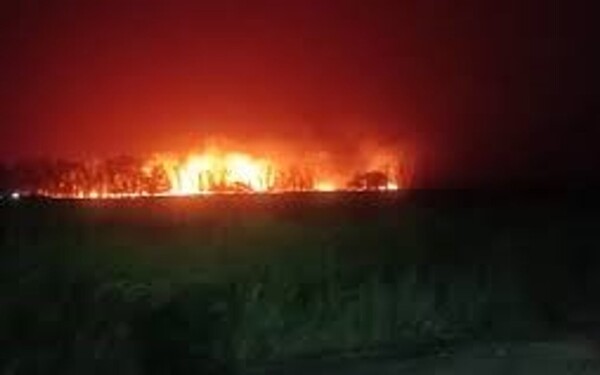
Workers who testified about the explosion in Ezeiza on November 14th reported that one of the containers had a chemical leak, including solid phosphorus, aluminum, cyanide, and other toxic and oxidizing compounds. Total News Agency gained access to metal shrapnel recovered from the site, originating from the container cylinder—described by witnesses as a “zeppelin”—that would have detonated with disproportionate force. More than seventy firefighting crews battled for hours a fire fueled by solvents, agrochemicals, and highly flammable polymeric materials, in an extensive industrial infrastructure whose lightweight architecture accelerated the spread. Meanwhile, the central question remains unanswered: what actually exploded in Ezeiza and why? The exclusive data obtained by Total News Agency—shrapnel, unpublished photographs, ignored previous failures, potentially involved aeronautical material, and technical testimonies on the ground—force a review of the initial hypothesis and demand a thorough, independent expertise with higher-level specialists. The magnitude of the damage and the chain of omissions preceding the disaster constitute a scenario that goes far beyond an industrial fire. The fire at the Ezeiza industrial park. Although the first expert reports pointed to red phosphorus as a possible origin, the magnitude of the blast wave, the depth of the crater, and the pattern of destruction suggest the presence of a much more powerful material. Argentina moves in a geopolitical context that requires superlative controls; the theft of these materials could be very simple and open Pandora's box to a new attack. In parallel, the official origin based on red phosphorus presents inconsistencies. Even though this substance can transform into white phosphorus at over 500 degrees in an inert atmosphere, experts consulted by this agency state that by itself it does not generate such a detonation: “It is evident that there was something much more powerful,” stated a specialist who requested anonymity. In the image, the thickness of the exploded container can be compared to the finger of the person writing. The investigation, led by the UFI 1 of Ezeiza, is working on recovered remains, thermal maps, residue analysis, and review of suppression systems. However, the presence of very young and inexperienced expert personnel, according to sources involved, generates concern about the technical depth of the work. In addition to the total destruction of several industrial sheds, there is a pattern of expansion that reaches Iron Mountain Argentina, Larroca Minera, Cold Storage, plastic and chemical warehouses, and other adjacent facilities. Although it is not known if such elements were present at the time of the explosion. The explosion was of such magnitude that the consulted specialists suggest that there could have been Ammonium Nitrate, which is unfortunately not yet controlled as it should be, given that, despite the AMIA bombing, these controls were relaxed. These data would indicate a possible severe structural failure or improper use of containers not suitable for storing high-energy substances. Specialists consulted by this agency at the site confirmed that the main crater reaches about three meters deep and an approximate diameter of a meter and a half, followed by a depression in the shape of a channel that extends nearly fifteen meters. The subsequent silence on that episode constitutes, according to qualified sources, an action “at least evasive” by both the plant's authorities and the police force that intervened. This is added to an unsettling fact: months ago, materials linked to the manufacture of rocket fuel for the National Commission for Space Activities (CONAE) would have been stored in the complex. Based on information collected by specialized teams present in the area and with exclusive access to unpublished photographic material, Total News Agency reconstructed technical details, critical omissions, and highly sensitive elements that could modify the course of the judicial investigation into what happened at the Spegazzini Industrial Park managed by Martín Rapallini. The preliminary toll left more than twenty injured and damage in a radius close to fifteen kilometers, with its epicenter at the Logischem S.A. plant, where flammable substances and high-capacity containers were stored. According to this assessment, the container would have acted as a “hollow charge”: upon falling into the initial hollow, it made impact and expelled the energy towards the least resistant side, generating an expansion effect that matches the observed pattern. But the anomalies do not end there. As TNA was able to confirm, the day before the disaster, a commission from the Ezeiza Fire Department went to the site following a leak alert. However, the company would not have allowed a comprehensive inspection, a report was drawn up that to this day has not appeared, and no information was provided to provincial bodies such as the Environmental Police, Environment, or Industrial Licensing. One of the analyzed pieces weighs approximately five kilos, has a visible welding seam and a thickness of about one centimeter, a measure much superior to the five or six millimeters minimum required by industrial regulations for pressurized deposits of more than 1.80 meters in diameter, that is, if the container is thicker, it means it has a larger diameter and the product contained is more complex, hence the shrapnel we show that clearly do not belong to the structure of the sheds. The prosecutor's office will have to determine if any of these materials were present and if any of the companies were operating for suppliers of the aerospace body.