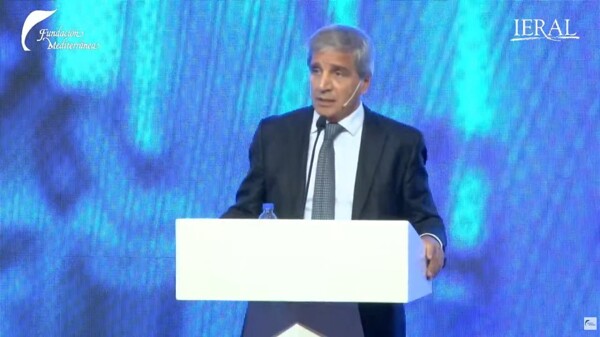
«We are moving from a scheme that was immoral, unjust, regressive and inefficient to one that we aspire to be moral, just and efficient,» he said in Córdoba. Meanwhile, the UIA, in its communiqué, reaffirmed its vocation to work together with the Government and workers to build «a productive, modern, and world-integrated economy.» What industrial model are we talking about? The Argentine Industrial Union (UIA) rejected with a historical and forceful phrase the Government's statements: «Without industry, there is no Nation» and demanded «respect» for the sector. The organization expressed «concern about the situation of various industrial sectors and different provinces» and focused on the unequal impact generated by the transition to the new economic scheme. The pronouncement came hours after the Minister of Economy, Luis Caputo, questioned the country's historical productive profile during an event at the Fundación Mediterránea. «On the contrary, during that period poverty increased,» Caputo stated to business leaders. The minister went further and affirmed that «that industrialist model to which many appeal was, in reality, a scheme based on patronage, corrupt, and inefficient.» The concern was conveyed by representatives of the industrial unions of Northern Argentina in a meeting with the UIA's Executive Committee. That region—Catamarca, Chaco, Corrientes, Formosa, Jujuy, La Rioja, Misiones, Salta, Santiago del Estero, and Tucumán—concentrates a quarter of Argentina's population and, according to the entity, exhibits «the worst purchasing power in the country» and a low level of registered private employment. The UIA also recalled the sector's specific weight in the economy. Argentina has not been an industrial power for over 20 years. We are still one of the most closed economies in the world,» he stated. He also compared with neighboring countries: «In Chile, Brazil, Peru, or Uruguay there are many more products in the supermarkets than in Argentina. That shows the degree of openness and competition that we still lack.» The minister framed the process within a broader structural change. «Respect for those who produce, invest, and generate employment throughout the country.» In total, more than 3,600,000 people depend directly or indirectly on industrial activity. «These data reflect the strategic role that industry plays in the Argentine economy due to its capacity to add value, generate exports, and contribute foreign currency. Respect is the starting point to rebuild the trust that Argentina needs, both domestically and in the world.» Meanwhile, Caputo defended the Government's commercial policy and sought to downplay criticisms of import openness. «Behind each factory, there is a social capital built by entrepreneurs and workers,» the communiqué stated. In the final stretch, the industrial federation introduced an implicit political message. «Industry produces 19% of GDP and contributes 27% of national tax revenue. It directly generates 19% of formal employment, with approximately 1,200,000 workers, and mobilizes another 2,400,000 indirect jobs. What we are looking for now is a competitive system, based on clear rules and private initiative.» In the communiqué, the entity recognized «the progress made by the national government in terms of fiscal balance» and valued «the reduction of inflation and the update of the labor framework.» However, it warned that adapting to the new scheme «implies a profound process that is not homogeneous or immediate.» The text states that «many companies, especially SMEs, are going through a critical situation, with a low level of activity, high fiscal pressure, difficulties in accessing financing, and a drop in employment.» And it left a definition that summarizes its stance in the debate opened in recent hours: «Industry is part of the solution.» «At this stage of transformation, we want to be clear: respect is a basic condition for development. We are 35% below the 2011 peak—during the supposed industrial model—and 21% below 2022. There, the official rejected what he defined as a «false dilemma» between an industrial model and a primary one. «It is a false dilemma to pose an industrial model or a 'primary' one. «There is no import boom. Four Chinese tires came in and a factory closed,» he said in reference to the Fate plant. Faced with these statements, without naming him, the UIA opted for an institutional but firm tone. «We come from a model that was immoral, unjust, regressive, and inefficient».

Argentine Industry Demands Respect from Government
The Argentine Industrial Union (UIA) strongly responded to Economy Minister Luis Caputo's statements, rejecting his criticism of the country's historical industrial model. UIA stated that «without industry there is no nation» and called for respect for the sector, while the government pushes a new economic scheme.