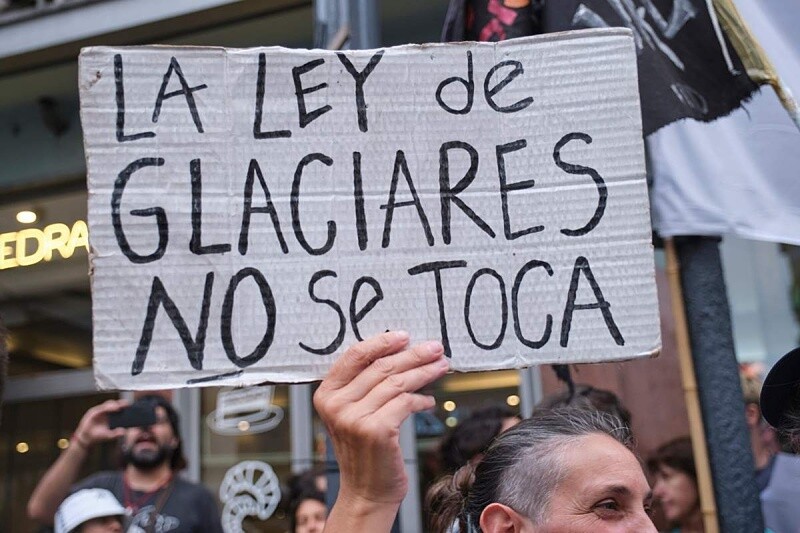
Future generations are the ones who lose. The reform, made possible by parties voting against the right to water and turning their backs on the people: La Libertad Avanza, PRO, UCR, provincial peronisms, and lawmakers from Provincias Unidas e Innovación Federal, is being pushed through. Background: In 2010, Argentina enacted Law 26.639 on minimum standards for the protection of glacial and periglacial environments as "strategic reserves of water resources." Assemblies, organizations, indigenous peoples, and citizens wanted to bring their voice to Congress to oppose the new law. Those who lose are the populations that already suffer from the water crisis caused by the thousands of liters of water used by mining companies. Globally, these ecosystems hold 70% of the world's freshwater reserves. The current glacier law prohibits activities that may affect their natural condition or hydrological functions. It also ignores the Constitution, which places the power to set minimum environmental protection standards in the hands of the national state. If this amendment is approved, activities such as large-scale mining will be enabled in these ecosystems. The glacier law reform leaves the definition of a "strategic reserve of water resources" in the hands of the governors, who are at the same time allies of mining companies. In particular, it prohibits the exploration and exploitation of mining and hydrocarbon resources in glaciers and in periglacial environments (areas with frozen or ice-saturated soils that act as a water resource regulator). Argentina's glaciers are located along 5,000 kilometers of the Andes, present in twelve provinces. Even so, the national government and its allies prioritize a handful of multinational mining companies. It does not contemplate the carrying out of cumulative impact studies (the total sum of social and environmental impacts). Source: https://agenciatierraviva.com.ar/de-que-hablamos-cuando-hablamos-de-glaciares/ This law also establishes the principle of progressiveness in environmental matters. The Argentine Institute of Nivology, Glaciology and Environmental Sciences (Ianigla) is the body in charge of monitoring the state of glaciers and the periglacial environment. With the reform, provincial authorities may order Ianigla to remove glaciers and periglacial areas from the National Inventory of Glaciers. There are 16,968 bodies of ice, covering an area of 8,484 square kilometers. The water from glaciers (meltwater) for human consumption and for the recharge of the 39 hydrographic basins depends on 1,800 localities, where more than seven million people live. The National Inventory of Glaciers in the Desert Andes region (northwest and north of San Juan) confirmed a 17% reduction in exposed ice, a 23% decrease in snow patches, and a loss of seven meters of water equivalent in a monitored glacier between 2014 and 2023. Despite the ice loss caused by global warming, the government of Javier Milei and the mining provinces (Jujuy, Salta and Catamarca, San Juan and Mendoza) are pushing for the reform of the Glacier Law. Localities like Andalgalá (in Catamarca) lose out, as they know that large-scale mining is not synonymous with employment and prosperity. The 1,800 cities that will see their access to water diminished also lose. Furthermore, the country is left without common federal criteria. The amendment contradicts the National Constitution, which establishes the right to a healthy environment and obliges the National State to set "minimum standards" to preserve it at the federal level. In the event that the body does not do so, it will not affect the validity of the authorization granted to companies interested in carrying out extractive projects. Environmental Impact Studies are also left in the hands of the provinces. Additionally: The Escazú Agreement is violated, as of the more than 100,000 people registered for the public hearing, the national government only allowed 200 to participate. Concrete numbers, proper names, and irrefutable facts that confirm how political power decides to sacrifice territories and populations. The amendment violates the human right to water, established in the International Covenant on Economic, Social and Cultural Rights, and the United Nations Declaration on the Rights of Indigenous Peoples, among other international legal instruments. Those who win from the dismantling of the law, in addition to the mining governors, are the multinationals like Glencore, BHP, Lundin, McEwen Cooper, Río Tinto and Barrick Gold, who promote extractive projects in areas protected by the Glacier Law. They feed 39 hydrographic basins and their respective sub-basins. Photo: Depositphotos – Carolina J. Seven million people depend on glacier water. The General Environment Law ratifies this federal environmental management and provides for the agreement of the provinces within the Federal Environment Council (Cofema). Numerous laws protect this human right. Glencore, BHP, Lundin, Río Tinto and Barrick Gold, some of the corporations benefiting. By Agencia Tierra Viva. The reform of the Glacier Law is rejected by all local communities near mining projects.