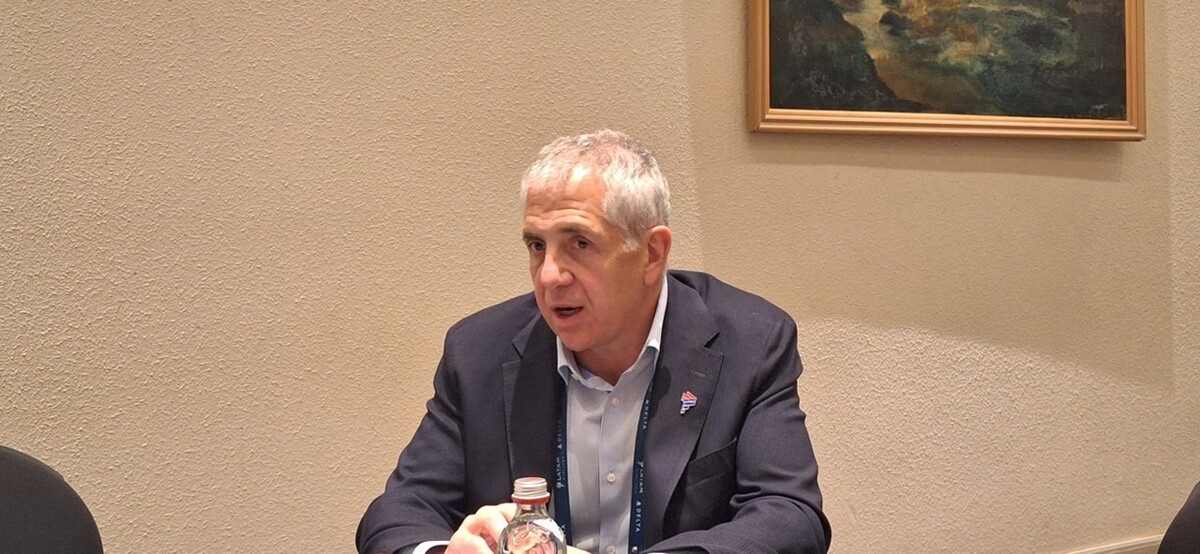
LATAM CEO Roberto Alvo stated in an interview with the Argentine News Agency that Argentina has "always been" a priority for the company and a strategic destination. "Argentina will always be geographically strategic for LATAM. I believe this is a one-way street, both in terms of traffic rights and prices." "But that doesn't mean—admitted—he that we don't have challenges. Chile started; Chile is one of the most open countries in the region. In many countries in the region, taxes are equivalent to the price of the ticket or more. In fact, a few days ago, we inaugurated the Santiago-Neuquén route, which started off quite, quite well." Alvo emphasized that "they support us very well, especially for an industry that is essential for Argentina today, which is oil, and especially Vaca Muerta now." "So that is our focus, we are going to continue doing that and I believe there are interesting opportunities to continue growing in Argentina," he asserted. Regarding the Open Skies policy implemented by the government of Javier Milei, he pointed out that, in his opinion, "the opening of the skies and deregulation is a one-way street. Other countries followed; Brazil did it ten years ago, Argentina is doing it now, and I believe the benefits are clear." "Chile has twice as many passengers per inhabitant as the rest of South America and this is due to a public policy, a state policy in aviation, because in reality Chile has a very simple state policy in aviation: it's openness, investment in infrastructure, and minimal government intervention. We have had to lower the operation a bit due to fuel circumstances at the moment due to the situation in the Middle East, but they are not structural from my point of view, and our intention is to continue connecting Argentina with the world." "We have—he said—a policy of open skies from the Argentine government that allows us to do things we didn't do before. We fly Buenos Aires-Miami with fifth freedoms, which is something we did when we had LAN Argentina, LATAM Argentina, and we are analyzing whether the options that the bilateral with Chile offers today, which are very open, make sense to develop or not develop frequencies on that route." He added that, however, "the important thing is that we do not lose focus on the importance that Argentina has for our operation and we are going to continue working on connecting. I believe that Latin America grew very strongly in the first decade of the century; in that period we were growing at levels of 10%." "The second decade of the century was worse, we had economic crises in different countries, public policies that were not so good, but we still have a quarter of the passengers per inhabitant that developed countries have. And therefore, I am still an optimist about the region and I am still an optimist about the development of transport in Latin America," he pointed out. And in that sense, he affirmed that "Latam is prepared to continue connecting South America with itself and South America with the world. And that, from my point of view, is a bad public policy because at the end of the day the value of connectivity and the value of transport is much greater than that." He emphasized that, "when I lived in Argentina, we did a study for the government where we showed that for every person the aviation industry hired, six jobs were created in all related industries: hotels, tour guides, taxi drivers, whatever you want." "So we also have the potential to develop the region's economies much more. And I believe that if there is something missing, it is to reduce the rate, the cost that countries today impose on air traffic, I think it has a very, very important impact on the ability the continent has had to develop. And therefore, for us to be able to serve Argentina internationally has always been a priority and will always be," said Alvo at the meeting with this agency during the "Wings of Changes" event, organized by IATA, which is taking place in Santiago de Chile. He detailed that "today we operate a little more than 30 flights a day. That's all," he argued. He highlighted in this regard that "that is what has allowed Chile to have double the passengers per inhabitant that Argentina has, Argentina being a country with the same per capita income as Chile. I would love for these public policies to be better understood," Alvo pointed out. Alvo explained that "I have been saying for many years that this industry is immature and has a huge growth potential, and I stand by it. I believe that for many decades we always saw this as a protectionist need. If you look at our hubs, in Lima, in São Paulo, in Santiago, the most important market behind these hubs is Argentina. I believe that today, except for very specific, perhaps populist or very dogmatic reasons, what we will continue to see is continuity in the opening of the market. We have a rugged geography, and we have important distances, and we do not necessarily have useful alternatives for transportation against this. But I am very optimistic about the potential. Today we operate four continents—the only continent we do not operate is Asia—and we have the ability to offer people who want to move around the region the best flight alternative to move within South America or to go outside." "I believe that this is still an industry with a high percentage of taxes or fees imposed on it."