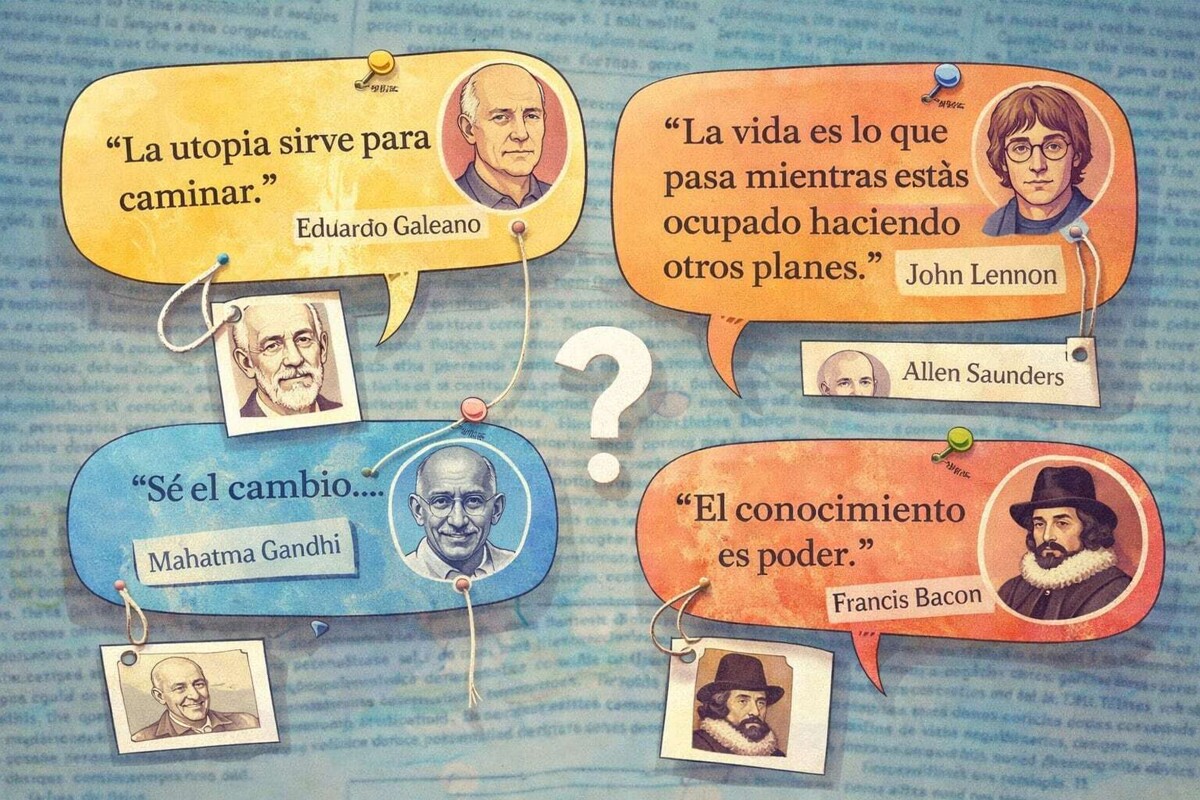
Understanding the history of these phrases makes us walk with more awareness and reminds us, as Birri said and later quoted Galeano, that utopia is not a destination we arrive at; it is the compass that pushes us to move forward. And, beyond attributions and exact quotes, what really matters is how these phrases make us feel and act. After all, as Birri and Galeano taught us, utopia is not an endpoint: it is the force that moves us to walk. The author is a doctor in education, a lawyer, and a journalist. Today, we want to shed some light on some of these phrases and acknowledge those who actually originated them, because words have weight and it's a shame for them to get lost along the way. A prime example is that oft-circulated phrase many attribute to Eduardo Galeano: 'What is utopia for?'. The answer comes from Argentine filmmaker Fernando Birri, who, during a dialogue with students, explained that utopia is not a final destination, but a guide that propels us to keep moving. Every time we repeat a powerful idea, we make it our own and we put it into action, even if its original author remains anonymous. Recognizing the origin of an idea does not take away its power; on the contrary, it allows us to appreciate it with more clarity and honesty. Many other phrases we think we know also have different stories. Galeano, as a good storyteller, adopted and popularized it, and over time it became a perfect example of how ideas can travel and take on a life of their own beyond their original author. This confusion reminds us that phrases are not static. Galeano quoted it, spread it, and turned it into a symbol of his thought, but he was not the one who originally formulated it. It also allows us to value the richness of our culture and the way words travel and shape us. In the end, misattributed phrases do not lose their power. The modern version loses the nuances of his philosophical reflection on the relationship between knowledge and action. And let's not even talk about 'The winners write history,' attributed to Winston Churchill: it has been repeated so many times that it seems like an irrefutable truth, when in reality it is a much older and more widespread concept with no concrete author. The interesting thing about all this is not to debunk for the sake of debunking, but to understand that ideas matter more than strict authorship. Recognizing the correct source invites us to read, to research, and to think more critically about what we repeat and share. Collective memory adopts them, transforms them, and without realizing it, we sign them with famous names that never pronounced them. For that: to walk'. In that sense, perhaps it's not so important who said what, but the effect words have on our way of living, dreaming, and moving forward. For years we have repeated phrases until they became part of our daily discourse, only to later discover that many do not really belong to those we usually attribute them to. They travel, change, are reinterpreted, and in the process, they often lose the signature of their creator. 'Knowledge is power,' generally attributed to Francis Bacon, is often simplified from its original intent. For example, 'Life is what happens while you are busy making other plans' is often attributed to John Lennon, but was actually written by Allen Saunders, an American writer, long before Lennon popularized it in pop culture. Another very common case is 'Be the change you want to see in the world,' frequently associated with Mahatma Gandhi, although there is no direct evidence that he said those exact words. They continue to inspire us on our way.