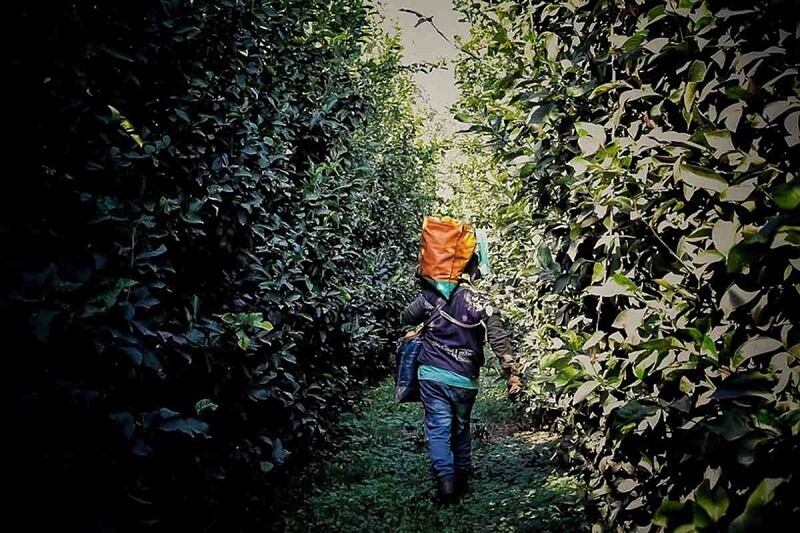
This was the era of trials like that of “Flaco Loco”, who, if he were to file his lawsuit again in Milei's Argentina, would lose it again. This neglect of the situation of two out of every three people working in the Argentine countryside — dependent workers and employees— turned into an unnecessary boomerang for Peronism itself: the majority of rural workers (who constitute two-thirds of the vote “from the countryside”) fervently opted for Javier Milei in 2023 and 2025, blaming Peronism and the State for all their ills. Most of those workers did not even know they had all those legal possibilities, let alone take advantage of them. This “Agrarian Regime of Work” excluded rural workers from the Labor Contracts Law of 1974, in which they had been included by Peronism along with urban workers, and completely deregulated the agricultural labor market and its working conditions. Thus, long before the labor flexibility of the 90s and early 2000s, rural workers operated in a completely unregulated environment. It is difficult to imagine a more ungrateful situation. The votes from provinces with a crisis in rural work. It is striking that the reform was approved thanks to the votes of some deputies who, in addition to formally belonging to Peronism, came from provinces where, like few others, rural work continues to play a fundamental role in the employment of hundreds of thousands of their “represented”: Misiones, where yerba mate pickers are escaping to Brazil due to low wages; Tucumán, one of the world's main lemon producers that demands thousands of braceros; or Salta, a center for tobacco and fruit production, also very demanding of rural labor. At the same time, as libertarian ideas garnered such important support among the lower classes of the countryside, one must ask if these representatives did not fulfill a confusing popular mandate against their own people. History of rural workers behind agribusiness. A few years ago, while researching the history of workers in the heart of agribusiness (in the Buenos Aires Aires party of Pergamino), I found a very enlightening judicial file of what remained hidden under the silence pacts of the “Argentine countryside”. Since the end of 2011, the New Agrarian Regime of Work had been in effect: Law 26.727, debated and democratically approved by the National Congress at the behest of the governing Peronism. Therefore, it is not enough to think that “politics is the same, you have to work the same anyway”: it is precisely about debating under what conditions we will carry out that daily work (if we keep it) and what we will get for it with one policy or another. The New Agrarian Regime of Work of 2011 stipulated that if a temporary worker was employed two or more times with the same employer, every year, they were no longer a mere “temporary employee” who could be dismissed without being fired. And that is what complicated the life of Héctor Sumich, alias “el Flaco Loco”, as they called him in town: a rural worker who dared to face a lawsuit against his old bosses. The argument was simple: after fifteen years of work, Héctor demanded that they pay him a severance indemnification. So, despite his lawyer's efforts to prove the unconstitutionality of the norm, “el Flaco Loco” lost his lawsuit, demonstrating to what extent the dictatorship, whose beginning is about to turn fifty, had tilted the playing field for workers even in the most minimal details for much longer than its government lasted. A right reconquered in Congress that never reached the countryside. By the time I found Héctor Sumich's judicial file, the situation was very different. On the one hand, the popular mobilization of 2001 had inaugurated a cycle of new progressive demands on public policies, while the agrarian-business mobilization of 2008 invited Kirchnerism to take measures to reconnect with the lower classes in the countryside. In this framework of cross-cutting mobilizations, the legacy of the dictatorship in relation to rural work was closed in the legal sphere, while a new stage opened for the rights of workers employed in agriculture. I never managed to find “el Flaco Loco”. And not for that reason alone: also the indemnification and the owed salaries. It had not been that long since the military had left government. He was a “permanently discontinuous” worker, a figure that accounted for cases like that of Héctor Sumich, “el Flaco Loco”, who worked fifteen years for the same bosses, but in a temporary manner. Law 26.727 recognized that that worker, who was always called upon, each new season, based on their good performance, deserved to accumulate seniority for each year worked, a proportional vacation and bonus, and, naturally, an indemnification in line with all that time worked. All this ends with the approval of the new labor reform, which again eliminates all these rights that had been available to rural workers from 2011 to the present. The labor reform pushed by Milei eliminates the figure of the Agrarian Regime of Work that recognized the employer's relationship with temporary rural workers and returns to the conditions imposed during the military dictatorship. Furthermore, the “National Reorganization Process” had left all kinds of legacies in the form of laws, economic conditioning, and irreparable wounds. In any case, the question that now arises is whether the further deterioration of working conditions in the countryside that will follow— affecting one of the main bases of support for Milei in the interior—will allow for a re-discussion of the nature of this government and the need to change course, or if we will continue to wait for the “the worse the better” to work, that sort of free market in politics that, like the economic one, never ends up functioning. After all this labyrinth, the libertarians' false “labor modernization”, instead of bringing updates that benefit workers in the face of technological or relational changes, will take the situation back to the picture left by the last civic-military dictatorship. At the time, the validity for a little more than thirty years of Decree-Law 22.228 facilitated massive dismissals in the countryside between the 1980s and the 2000s, in tune with the technological changes of those years, and without those who kept their jobs being paid more for their greater productivity and effort: for that reason, the era of the “soy boom” was one of record production, but with expulsion of the workforce, extended working days, and the lowest wages in the economy. They flatly denied that “el Flaco Loco” had been a permanent employee of theirs — something that was not actually recorded on any paper — and affirmed that they had not fired him, but simply had “stopped calling him to work”. Although it was an individual case, the document portrayed like few others the working conditions that thousands of rural workers went through between the exit of the last dictatorship and the agricultural boom of the 2000s. The lawsuit dated from the late 1980s. The same situation, and the same arguments, in that new political and legal framework, would have given him the right. No more and no less than as a monotributista of our days: if there is no employment relationship, there is no dismissal; and if there is no dismissal, there is no indemnification. The most serious problem for “el Flaco Loco” was that the law in force at that time gave the reason to his old employers. The norm was, in fact, Decree-Law 22.248 that the dictatorship had imposed in 1980, with the signature of Jorge Rafael Videla, José Alfredo Martínez de Hoz, and Jorge Zorreguieta (“the father of Máxima”, at that time Minister of Agriculture). In addition, his lawyer convinced him to also claim owed salaries for having worked all that time “in black”, earning less than he was due. And so, during the next ten years, from 2015 to 2025 — with the Front for All in between— no union or government body linked to the peronist solar system did anything important to disseminate the law that the same political space had conquered in parliament, let alone to make it comply. That is, to monitor its effectiveness. It was a legal dispute undertaken by a simple agricultural machinery operator against his ex-employers. Or rather: deliberately regulated in favor of the field bosses. Sociologist Juan Manuel Villulla describes the modification with a case that occurred in the core area of agribusiness and points out the successes and failures of the Peronist administrations. By Juan Manuel Villulla (sociologist, historian, teacher, and researcher at UNLP, UBA, and Conicet, and author of “The harvests are alien. But I always thought that if he had presented the same lawsuit after 2011, he would have won it. His former employers were producers and contractors of agricultural machinery in the northern Buenos Aires Aires. That is, unlike the Statute of the Peon of first Peronism in 1944, it was not a “reality that they regretted losing”. It happens that, shortly after the approval of the 2011 law, still riding the victory of Cambiemos in 2015, the Supreme Court of Justice ruled the unconstitutionality of the body in charge of disseminating these rights among rural workers, the National Registry of Rural Workers and Employers (Renatea). Ultimately, that was what they had come to do: to establish a lasting order.