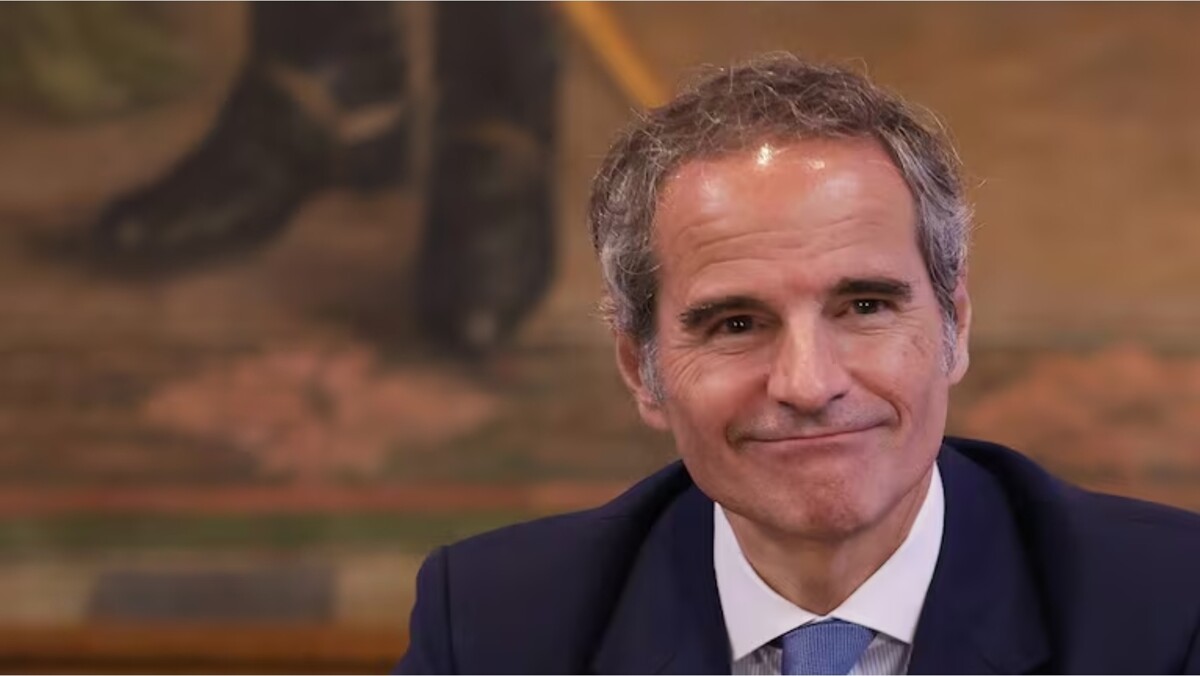
Director General of the International Atomic Energy Agency (IAEA), Rafael Grossi, distanced himself from the ideological framework that some sectors tried to attribute to him after the formal support of the government of Javier Milei for his candidacy for the Secretary-General of the United Nations. Grossi stated that it would be arrogant to claim to be anyone's candidate, while expressing his intention to obtain the support of 'all decisive countries,' in reference to the permanent members of the Security Council, whose endorsement is decisive in the final instance. With over four decades of a diplomatic career, Grossi built his international profile through technical functions and complex negotiations on nuclear matters, particularly in sensitive scenarios such as Iran and Ukraine. However, he clarified that he is not unaware of the support of the libertarian administration: 'I am Argentine and my country is the one that must present me, but that does not make me a candidate of a political current.' The competition to succeed the current Secretary-General is anticipated to be intense with a strong regional imprint. In this scenario, the building of broad consensus and the perception of independence will be central factors. Meanwhile, the Latin American definition appears to be crossed by the gender debate and the need to articulate a proposal that combines diplomatic experience, political leadership, and global management capacity. In an interview with the Brazilian newspaper Folha de S. Paulo, the Argentine diplomat assured that his candidacy 'does not represent the right' and emphasized that his trajectory defines him as 'an independent international official.' Grossi remarked that while it is natural for Argentina to push his name as an Argentine citizen, this does not imply political alignment. 'Latin America does not need that division,' he stated. Asked about the possibility of having Donald Trump's support, Grossi showed caution. In this cycle, it would be up to Latin America and the Caribbean to present a candidate. The General Assembly proposes the candidate, but the final decision depends on the Security Council, where the veto of any of the five permanent members can block aspirations. In addition to Grossi, the former Chilean president Michelle Bachelet, with the explicit support of Chile and Brazil; the Costa Rican Rebeca Grynspan, current Secretary General of the United Nations Conference on Trade and Development; the Mexican Alicia Bárcena, today at the head of her country's Environment portfolio; and the Prime Minister of Barbados, Mia Mottley, appear as aspirants. The process is governed by an unwritten diplomatic practice that promotes regional rotation of the post. Furthermore, no woman has ever held the top position, which reinforces the argument of several governments pushing for a female candidacy. In this context, Grossi regretted Brazil's support for Bachelet, although he avoided straining the bilateral relationship. 'I am not the Minister of Foreign Affairs nor a friend of the president,' he affirmed, in a phrase that sought to dispel any partisan reading of his aspiration for the top position in the multilateral system. Grossi seeks to position his candidacy as a technical and professional option, away from ideological alignments. He recalled his extensive cooperation history with the neighboring country and expressed his expectation that the process will evolve towards broader consensus. From the helm of the IAEA, he maintained dialogue with Western powers, Russia, and developing countries, which allowed him to position himself as a balancing figure in a fragmented geopolitical context. The race for the Secretary-General has just begun and will extend for months of formal and informal consultations. 'It would be a mistake to frame this election as a dispute between left and right. In the 80 years of UN history, only one Latin American held the Secretary-General position: the Peruvian Javier Pérez de Cuéllar, between 1982 and 1991.'