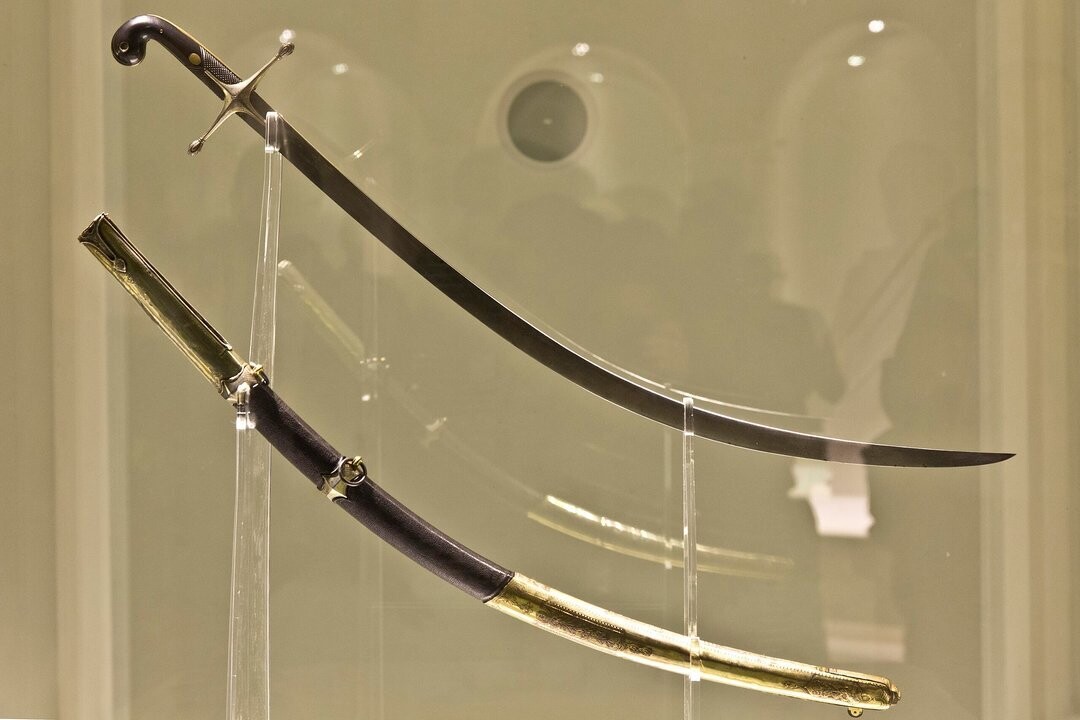
The sword of José de San Martín, the ultimate symbol of South American independence, begins a new stage in its agitated history. It is a Moorish saber with a curved blade, similar to those used by Napoleon's officers after the campaign in Egypt. It stands out for its simplicity and the absence of expensive materials. Metallurgical studies determined that it is a 'shamshir' of Damascus steel, forged in the Middle East with a pre-industrial technique, discarding the European origin of the blade. San Martín chose this model to arm his Grenadiers because he considered it ideal for cavalry charges. In his will, the Liberator bequeathed the sword to Juan Manuel de Rosas as proof of satisfaction for 'the firmness with which he has upheld the honor of the republic against the unjust pretensions of foreigners.' After Rosas's death in exile, the weapon passed to his friend Juan Nepomuceno Terrero and then to his political family. Only in 1897, at the request of the director of the National Historical Museum, Adolfo Carranza, the Terrero Rosas family agreed to donate the 'redeeming sword' to the Argentine state. The weapon arrived at the port of La Plata on February 28 of that year and was deposited in the museum. The tranquility of the museum was broken on August 12, 1963, when a group of the Peronist Youth, led by Osvaldo Agosto, stole the sword. The objective: According to its authors, the action sought to 'ridicule the regime' and the Armed Forces, as well as 'lift the spirits of the boys' after the political defeats of Peronism, which was proscribed. Frustrated destination: The intention was to deliver it to Juan Domingo Perón in his exile in Madrid, but after negotiations with the Peronist resistance, it was returned to the Army to curb political persecution. The sword was stolen again in 1965 and recovered a year later. After these episodes, it remained under the custody of the Grenadiers in a bulletproof pavilion until 2015, when Cristina Kirchner ordered its return to the National Historical Museum, where it remained until this new transfer decreed by the current government. After being exhibited at the National Historical Museum since 2015, the weapon was transferred to the Regiment of Mounted Grenadiers for its custody, as established in Decree 88/2026. According to what Argentine News Agency learned, the public will be able to visit the relic starting this Sunday, February 8, at the historic Barracks of Palermo. However, the transfer awakens a legal controversy: the original cession by the heirs was exclusive to the National Historical Museum, so the change of destination could imply that the ownership of the object must return to the family, a point on which the Justice has not yet ruled.