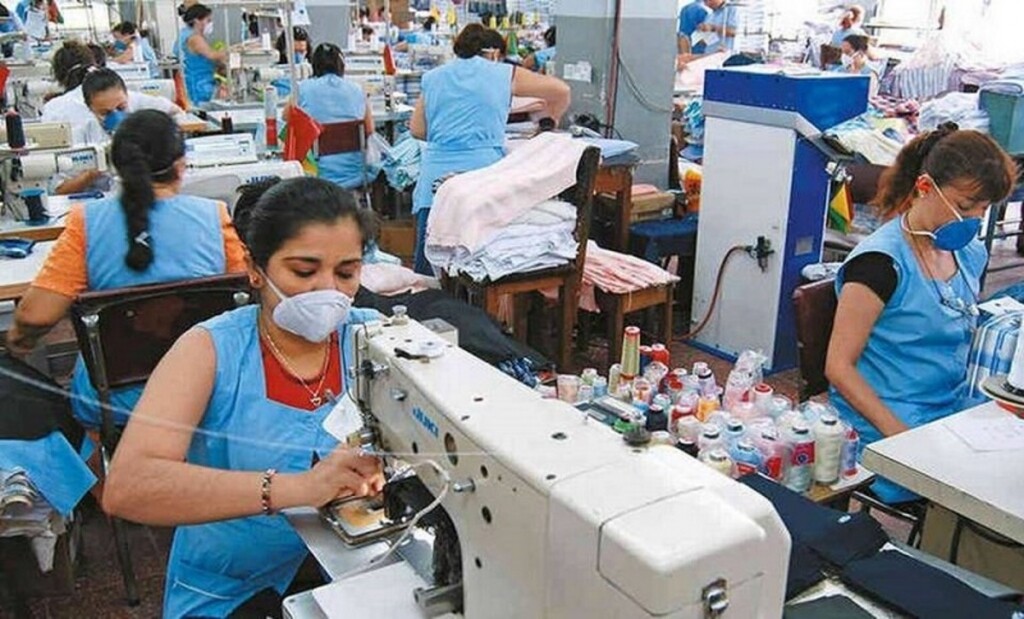
Argentina's textile industry has been in a deep crisis for the last two years, according to a recent report by the consultancy firm Analytica. Falling consumption, a surge in imports, and the government's inaction under Javier Milei summarize the situation. The industry employs 250,000 workers, and in some segments, production has fallen by almost 50% year-on-year. Installed capacity is operating at only 29%. Recent statements by high-ranking libertarian officials, such as Economy Minister Luis Caputo and former Security Minister Patricia Bullrich, have shown the government's disregard for the industry's fate. They spoke disparagingly of the national industry and praised imported clothing. Actress Marixa Balli publicly criticized Caputo, calling his words offensive to a population facing basic economic difficulties. Designer Benito Fernández also rejected the notion that local producers are responsible for high prices. According to the Analytica report, since November 2023, prices in the sector have increased by 149.4%, well below the cumulative general inflation rate (259.4%). In relative terms, clothing has become 30.6% cheaper compared to the economic average, reaching its lowest level since 2016. Although it accounts for only 9.9% of the Consumer Price Index, the sector has significantly contributed to the slowdown in inflation, unlike services—less exposed to external competition—which have maintained greater price rigidity. The Argentine Federation of Textile Industries (FITA) warned that simplifying the debate leads to erroneous diagnoses. It pointed out that recent tax cuts and deregulation have primarily benefited imports, while national production continues to face high tax pressure, high energy costs, and scarce financing. "The problem is not competitiveness, it's fraudulent competition," FITA emphasized. The Pro Tejer Foundation registered the closure of 558 establishments during this period, a contraction of 9%, with a particularly strong impact on clothing and footwear. This sector also has high levels of informality—around 72% in garment making—so the total loss of jobs would be greater. According to the Analytica report, the textile industry recorded declines in 10 of the 11 months of 2025, solidifying its position as the hardest-hit activity in the Industrial Production Index (IPI). In November, textile production was 31.2% below December 2024 levels and 47.6% lower than in November 2023. Production and installed capacity Analytica estimates that in garments and footwear, production is 18.5% below December 2024 levels, and in textile products, there is a 31.2% drop. The utilization of installed capacity reached only 29%, the lowest level in the entire historical series, except for the most critical period of the pandemic. Sub-sectors such as tanning and leather goods manufacturing recorded falls of 44.1%, followed by textiles and finishing (-34.7%) and fiber preparation (-33.7%). The surge in imports has been lethal for local SMEs. In 2025, external purchases of clothing grew by 97.3% year-on-year, an increase of US$336 million. Other textiles advanced by 121.2% and footwear by 25.2%. This was compounded by the boom in e-commerce via couriers and platforms like Shein and Temu, with a cumulative growth of 274.2%. As a result, clothing imports reached US$681 million, the highest real value in the entire historical series. In footwear, the total reached US$825 million, close to the 2017 record.