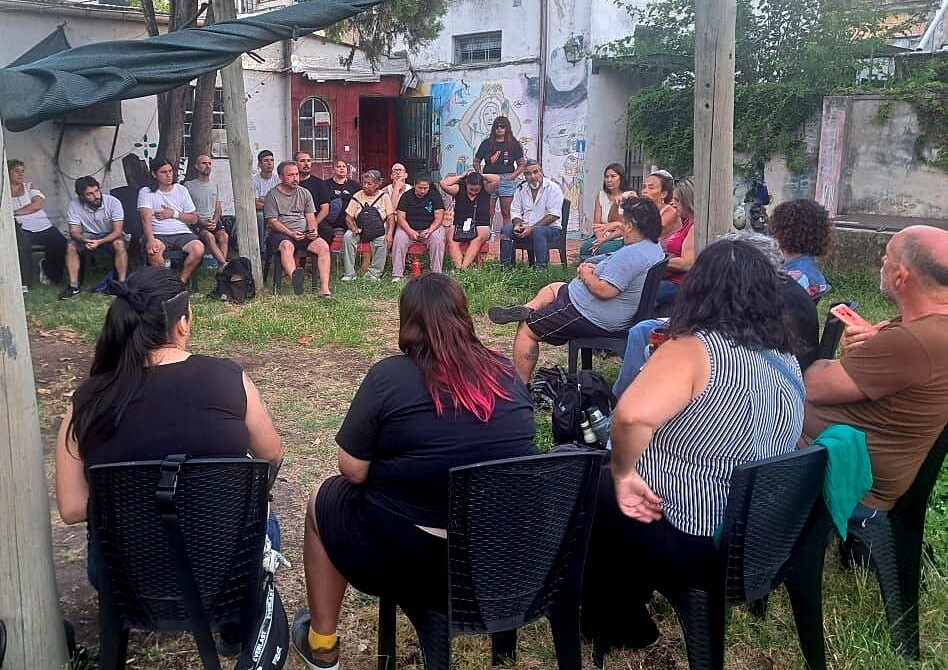
The meeting brought together representatives from various organizations, including La Bordó Docente de Moreno, Víctor Choque (ATE Moreno), Agrupación 1° de Mayo Verde Roja (ATE), Movimiento por la Unidad Latinoamericana y el Cambio Social (MULCS), Emancipación Sur, Marabunta, FOL Conurbanas, Asamblea de Rodríguez, Caracolas, Subversión, OLP, as well as political forces such as MST, PTS e Izquierda Socialista. While FOB Autónoma and Asociación Sindical de Profesionales de la Salud de la Provincia de Buenos Aires (CICOP) could not attend, they committed to participating in future activities.
This meeting is part of a growing phenomenon in recent weeks: the multiplication of union coordinators and articulation spaces by zone, in response to a government offensive that seeks to cheapen dismissals, flexify labor conditions, weaken collective bargaining, and reinforce discipline over the labor organization, while the leadership of the CGT maintains a line of passivity and negotiation.
In this context, the West Zone Coordinator decided to move forward with concrete tasks and a first public intervention in the face of the mobilization and actions planned for February 11, a date that will coincide with the start of the legislative treatment of the project in the Senate, as confirmed by the government. It was also agreed to maintain coordination beyond that date, with the aim of intervening in local conflicts, supporting concrete struggles, and strengthening organization from below against the government's attempt to advance not only with the vote on the reform, but also with its "day-to-day" application in the workplace.
Among the resolutions voted on, it was agreed to form a WhatsApp coordination group; prepare a flyer to disseminate the call; carry out a leafleting campaign next Monday, the 9th, in stations, mainly in Moreno, and also with the possibility of extending it to Merlo and Luján; call for a mobilization and the "trainazo" on the 11th, if the law is treated that day, or for when it is treated; meet on the Thursday after the mobilization to make a balance and define continuity; maintain coordination in the future to resist not only the vote but the concrete application of the reform; and coordinate intervention and support in local conflicts, accompanying struggles and claims that may arise.
Thus, the first meeting of the West Zone Coordinator becomes a new piece on an expanding map: from north to south, from northwest to La Plata, and now also the west, the construction of articulation spaces that seek to break isolation, face the adjustment, and respond to the government's labor offensive from the base organization. Meanwhile, the leadership of the CGT again chooses passivity – if not negotiation from above – while in the territories, coordinators like the one in the west grow, in the same line as those already being promoted in the north, northwest, south, and La Plata zones: spaces that express an increasingly widespread conclusion among base sectors, delegates, and popular organizations, that if there is no real response from below, Milei's labor reform passes and is applied.
Because it is not a "modernization" or "administrative changes": it is a regressive offensive against the Argentine working class, aimed at disciplining, cheapening labor, and breaking union organization in the workplace. With delegations from health, education, municipal, and railway sectors, they decided on actions in stations, leafleting, and a "trainazo" for next Wednesday, the 11th (when the Senate will begin to treat the regressive reform), in addition to maintaining coordination to intervene in local conflicts.
This initiative arises as a response to the paralysis of the CGT's leadership, while the La Libertad Avanza government pushes a reform that seeks to cut rights and discipline the labor movement.
Continuing with the union and territorial coordinators that are already being promoted in the north, northwest, south, and La Plata zones, on Thursday, February 5, in the political-cultural space El Churqui in the town of Moreno, the first meeting of the West Zone Coordinator against labor reform was held, a space that seeks to articulate sectors of workers, social organizations, and political currents to face the advance of the regressive official project.
The meeting brought together about 40 people, with a composition marked by the presence of base union delegations and territorial sectors. According to information, the represented sectors included a strong health delegation—with the presence of the Posadas Hospital, the Moreno Hospital, and the UPA de Cuartel—, as well as teachers from Moreno, Merlo, Ituzaingó, and Luján, municipal workers from Moreno, a railway worker from Morón, students from the University of Moreno, territorial organizations, and expressions of western feminism.
Among its most harmful aspects, the flexibilization and degradation of labor conditions, the easing and cheapening of dismissals, the emptying of collective bargaining, the cutting of stability and protection against labor fraud, the precarization through contractual figures and outsourcing, and the attack on organization and struggle tools stand out.
In this scenario, the proliferation of coordinators is not an isolated fact but a political symptom: in the face of a union bureaucracy that manages defeat, the need for an independent, united, and combative articulation to stop the reform and defend conquered rights begins to open up. At the end of the meeting, H.I.J.O.S. joined.