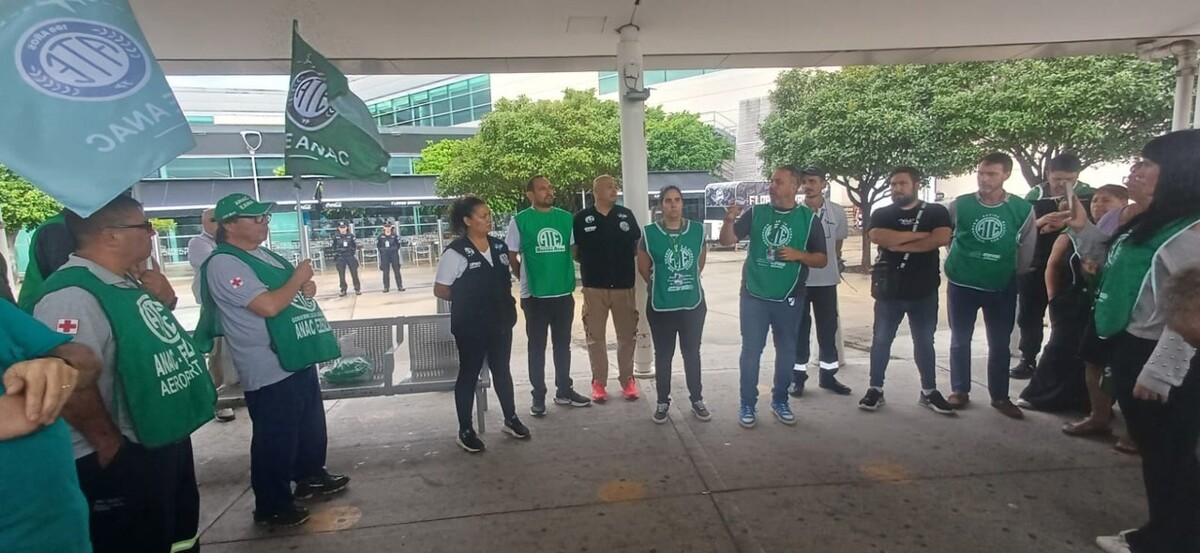
The national airport system is heading towards a federal operational paralysis, as the Association of State Workers (ATE) in the National Civil Aviation Administration (ANAC) has confirmed the execution of a general strike that will take effect from 00:00 hours on Monday, February 9. According to sources from the union, the measure was ratified after an assembly at Ezeiza International Airport and will directly affect control, administration, and supervision services in all terminals in the country managed by Aeropuertos Argentina and the State. The union resolution arises as a response to what the sector calls an 'acephaly of mediation instances.' According to Marcelo Belelli, General Secretary of ATE-ANAC, the absence of official calls from the National Executive has exhausted negotiation deadlines, transferring the conflict directly to the field of union action in the middle of the summer season. Belelli told this medium that they have had 'no type of call from the authorities to any type of dialogue' and therefore 'the strike called for next Monday from 0 hours is maintained, for which we have notified the entire community and airlines so that they can reprogram the flights that will be affected.' Core of the controversy and salary demands The core of the conflict lies in the complaint of compulsory salary cuts applied on already settled salaries, a maneuver that the union qualifies as a violation of previous collective bargaining agreements. The leadership of ATE-ANAC has pointed to an 'extreme intransigence' on the part of the Minister of Deregulation and State Transformation, Federico Sturzenegger, whom they hold responsible for the stagnation of dialogue tables. Among the main demands stand out: The urgent recomposition of the salary scale against accumulated inflation. The annulment of the discounts applied unilaterally on workers' incomes. The establishment of guarantees on operational safety conditions in the terminals. Background of conflict in the sector The measure for next Monday is not an isolated fact, but is part of a history of recurrent tensions in Argentine civil aviation. The protest sector has experienced significant milestones that serve as a framework for understanding the depth of the current crisis: Conflicts of 2024: During the first year of the current administration, the air commercial sector faced multiple partial strikes and assemblies that forced the declaration of the 'essentiality' of the service by the Government, a measure that still generates judicial controversies about the right to strike. The Intercargo crisis (2025): The previous year was marked by surprise strikes in the ramp and baggage service, which led to a restructuring of the ground service system and increased friction between state unions and transport portfolios. The privatization of AR: The persistent uncertainty about the future of Aerolíneas Argentinas acted as a catalyst for unions such as ATE-ANAC to solidify their measures, seeking to protect labor stability throughout the aeronautical ecosystem. Operational impact and recommendations It is expected that the most severe impact will be recorded during the morning slot on Monday, the moment of maximum concentration of domestic and international flights. Faced with the imminence of the cessation of activities, the union has urged airlines to proceed with the preventive reprogramming of their services to avoid the collapse of the boarding rooms and mitigate the harm to passengers. To date, there have been no signs of a last-minute call from the Secretariat of Labor to dictate a mandatory conciliation, which maintains uncertainty about air operations for the beginning of next week.