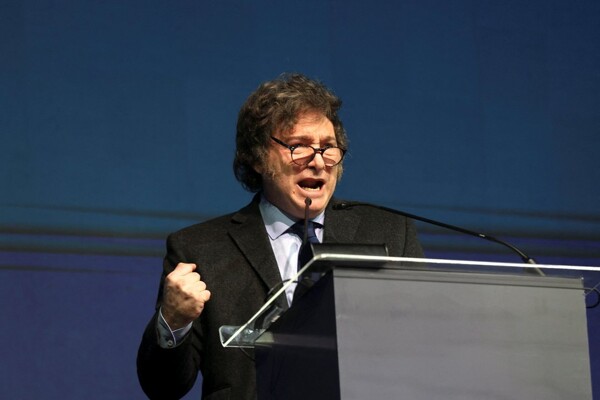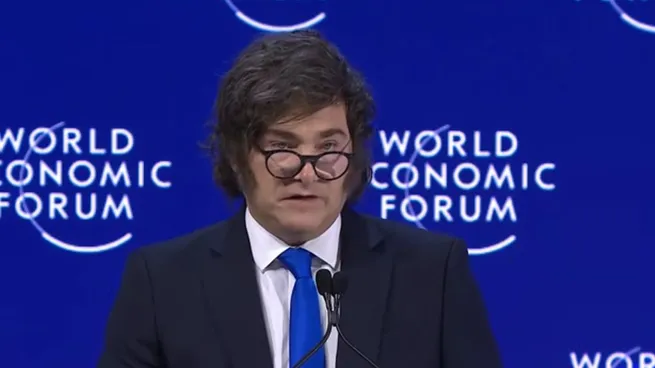
Argentine President Javier Milei once again positioned himself as an outsider to the traditional political system, calling on global leaders to review the economic and moral foundations that, in his view, have led to the structural crisis of Western democracies. During his speech, the head of state stated that 'free-market capitalism is the only just system,' and warned that alternatives based on state intervention invariably end in poverty, loss of freedoms, and concentration of political power. Milei argued that the goal of his government is to create conditions for the most vulnerable sectors to integrate into the productive system and not depend on the state. In his closing remarks, the President once again attacked what he called 'populist and impoverishing' ideas and reaffirmed his commitment to defending freedom, private property, and peace. The head of state maintained that this model not only destroys the economy but also the values that sustain democratic coexistence. In another central part of his intervention, the President harshly questioned the dominant cultural agenda in some Western countries, which he linked to the material and spiritual impoverishment of societies. Davos, January 21, 2026 - Total News Agency - TNA - President Javier Milei defended his program of economic reforms this Wednesday at the World Economic Forum in Davos, asserting that entrepreneurial capitalism is the only system compatible with justice, freedom, and progress, in a speech with strong ideological content aimed at socialism, populism, and what he defined as the cultural degradation of the West. The Argentine leader's address began with a delay of about an hour, following the lengthy intervention of U.S. President Donald Trump, and maintained a markedly theoretical tone, in line with his previous presentations at the forum. In this context, he warned that sacrificing ethical values in the name of political utilitarianism leads to economic and social collapse. However, despite the conceptual density of the message and its continuity with his previous speeches in Davos, Milei's intervention took a backseat to the impact generated by Donald Trump. 'These are elegantly disguised socialist ideas,' he asserts, and warns that when politics relies on identity slogans instead of universal ethical principles, the final effect is the loss of freedom, prosperity, and social cohesion. In the final segment, the Argentine president reaffirmed his diagnosis and political bet: 'Machiavelli is dead. Long live freedom, dammit.' Milei's presentation in Davos once again confirmed his intention to project himself as a global ideological leader of economic liberalism and to use the main international forums as a platform to consolidate his narrative of breaking with the traditional political consensus. Sources consulted: World Economic Forum in Davos, international news agencies, Argentine and international press coverage, official statements from the National Government. Throughout his speech, the President delivered a presentation with a strong theoretical anchor, drawing on authors from the Austrian school such as Jesús Huerta de Soto, Murray Rothbard, Israel Kirzner, and Hans-Hermann Hoppe, and argued that private property, the non-aggression principle, and the entrepreneurial function constitute not only the basis of economic efficiency but also of justice. He cited Thomas Sowell to warn that socialism 'sounds very nice, but always ends badly' and again mentioned Venezuela as an example of economic and institutional collapse. The head of state took the stage with a slogan his team had already anticipated: to establish a defense of capitalism based on ethics and not just economic efficiency. 'I am here before you to say categorically that Machiavelli is dead,' he launched at the start, and posited that for decades a false dilemma had been imposed between political efficacy and moral values. According to Milei, that dichotomy is erroneous: 'What is just cannot be inefficient, nor what is efficient unjust.' The U.S. president dominated the forum's conversation, set the agenda, and concentrated the repercussions. Milei also resumed his criticism of the agendas promoted by international organizations and multilateral forums, which he defined as 'elegantly disguised socialist policies.' According to Milei, the role of the state should be limited to guaranteeing clear rules and protecting individual freedom. The president also dedicated part of his speech to highlighting the results of his administration in Argentina. In this vein, he insisted that the West is going through a moral crisis due to having abandoned its philosophical and cultural roots. In this context, Milei once again attacked what he defines as the 'woke' agenda, holding it responsible for displacing the traditional values of the West. With an epic tone, he affirmed that America will be 'the beacon of light that reignites the West,' and concluded his address with a phrase that summarizes his political ideology: 'Machiavelli is dead. It is time to bury him,' he stated, and called for a 'rebirth of the West' based on Greek philosophy, Roman law, and Judeo-Christian values. He even resorted to a biblical allegory to warn about the risks of denying individual freedom. The message was coherent with the narrative that Milei has been building since coming to power and with his previous presentations in Davos. In particular, he highlighted the work of the Ministry of Deregulation and State Transformation, led by Federico Sturzenegger, which he defined as the 'ministry of increasing returns,' and stated that the more than 13,500 structural reforms driven by his administration have made it possible to remove barriers that were hindering economic growth. He also praised the work of the Ministry of Human Capital, led by Sandra Pettovello, and advocated for an approach based on promoting autonomy and employment, as opposed to schemes of permanent assistance. But this time, the context was not in his favor. In this sense, he called for a return to Judeo-Christian values as the moral foundation of the West and asked that politics stop 'bothering' those who produce, invest, and generate wealth.