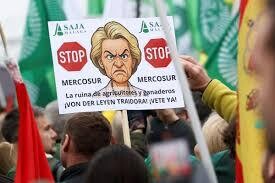
The European Parliament resolved this Wednesday to elevate the agreement between the European Union and Mercosur to the Court of Justice of the European Union to rule on its compatibility with the community treaties, a decision that freezes the ratification process for several months and opens a new focus of political and commercial uncertainty between the two blocs.
The motion was approved by a very narrow margin: 334 votes in favor, 324 against, and 11 abstentions. Officials and diplomats from the South American bloc admit that the judicial process can extend for months, and even over a year, depending on the complexity of the analysis carried out by the European court.
The vote does not imply a definitive rejection of the agreement, but it does introduce a significant brake on its implementation. According to the community procedure, the mere referral of the agreement to the Justice implies the automatic suspension of its ratification until the judges issue a ruling.
The EU-Mercosur agreement is composed of two instruments: one of political association and cooperation and another strictly commercial, which provides for the progressive reduction of tariffs and the liberalization of trade in goods and services between the European Union and the countries of Mercosur — Argentina, Brazil, Paraguay, and Uruguay.
If the ruling endorses its compatibility with the treaties, ratification can be resumed. The result reflected the deep internal division in the European Parliament around an agreement that was signed last weekend after more than 25 years of intermittent negotiations, and which aspired to create one of the largest free trade areas in the world.
The request to the Court of Justice of the European Union seeks to determine whether the legal architecture of the agreement fully respects the founding treaties of the EU, particularly regarding the regulatory autonomy of the bloc, the dispute resolution mechanisms, and the scope of the rebalancing clauses included in the text.
Some European parliamentarians argued that halting the agreement weakens the geopolitical position of the European Union against the United States and China in Latin America, while others argued that advancing without legal certainty could generate long-term legal conflicts and erode the coherence of community law.
From Mercosur, the decision was received with concern, as the agreement was considered a key piece to expand exports, attract investments, and consolidate a strategic relationship with Europe. Its entry into force required the approval of the European Parliament and the Member States, a process that is now on hold.
The parliamentary debate was marked by strong political and social tensions. Otherwise, the agreement could require substantial modifications or be politically weakened, reopening a negotiation that many considered closed.
Once the Justice of the European Union issues its opinion, the Parliament must resume the treatment of the text.