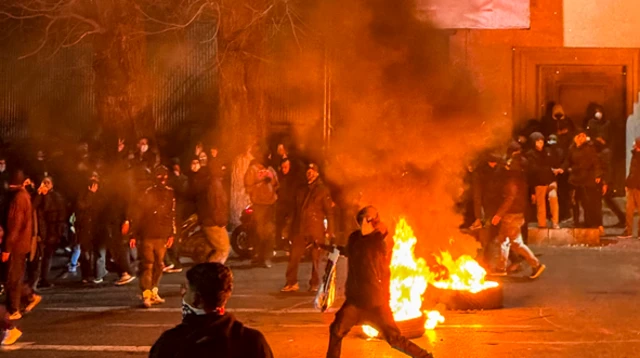
A wave of spontaneous protests is sweeping the globe, movements without clear leadership, amplified and organized through social networks and word of mouth. Among Latin Americans, clear exceptions to these global manifestations—Cuba, Nicaragua, and Venezuela—are due exclusively to the fact that the youth of these tyrannized nations have been expelled or have emigrated en masse, risking their lives in the Darien jungles, the Caribbean Sea, or at clandestine border crossings. Perhaps this is the origin of the prudence with which Donald Trump is moving regarding Venezuela and Cuba. The pragmatism of the US President is evident in his contradictory positions regarding the criminal ayatollahs, his diplomatic behavior towards Interim President Delcy Rodríguez, and also in the subtle snub he has afforded María Corina Machado. After the removal of Nicolás Maduro, Trump has focused his interest on Venezuelan oil but, undoubtedly, also on cutting the strong ties that linked Caracas with Moscow, Tehran, and Beijing, with a view to securing its sphere of influence. What is happening in Iran is merely the most recent and, for it, most lethal manifestation (more than 3,800 dead and 10,000 detained) of the reaction of 'Generation Z'—those born between 1995 and 2010—due to their frustration with societies incapable of meeting their daily needs or desires. The same reasoning is motivating their belligerent conduct towards Greenland (invoking a supposed 'living space for defense'), which puts them in direct confrontation with NATO, of which the US itself is the main member. Returning to Argentina, and aside from celebrating the unprecedented political and social tranquility that characterizes this summer, and especially celebrating the signing of the Mercosur-European Union agreement that will be finalized today in Asunción, I cannot help but express my alarm and concern over the DNU (Decree of Necessity and Urgency) signed by Javier Milei in December, which inexplicably grants intelligence agents the power to detain anyone they catch in the act. The question we should ask ourselves is how the 'Z' generation will react when the increasing militarization and the astonishing proliferation of armed conflicts force them to fight in wars they do not feel are their own; the most immediate answer is being given to us by Russia, which finds it increasingly difficult to recruit its own troops and must resort to soldiers from North Korea, Belarus, and even China, but also Europe, where Brussels and governments heading towards geopolitical insignificance are on the verge of calling them up. Because while it is true that enormous technological advances (especially with drones) have made attacks and battles much less costly in civilian lives, infantry will always be needed to occupy conquered territories, and that requires the physical presence of many men and women. In other latitudes, the causes were as disparate as the blocking of internet access, widespread corruption, the deterioration of the socio-economic situation, prevailing violence, the loss of a future, or the retirement age. It appears it is no longer possible to curb these discontented youths using the fear of prison, kidnapping, torture, or murder, the usual tools of those in power, whether they are authoritarian regimes of the right or left. That is why both Moscow and Kiev are bleeding to death, losing millions of young people, yes millions, dead or wounded in the infernal battlefields of that war. For example, is it conceivable that those who set Paris on fire with their yellow vests to oppose a pension reform would meekly obey a call to serve on the current or future border between Ukraine and Russia? We had already foreseen its global expansion when the revolt in Laos broke out, motivated by the lack of civil liberties imposed by the communist regime, which led to the burning of the Prime Minister's residence, who ended up being thrown into the river. What will American young people do if they are ordered to defend Taiwan with their weapons? After the costly disasters of Vietnam, Iraq, and Afghanistan, how many would volunteer to serve in a war-ravaged Iran? While it is redundant, as current legislation allows any citizen to do the same, the twenty years during which Kirchnerism violated legality so much have left us with very bad memories, and as the popular saying goes, 'he who is burned with milk, cries at the sight of a cow.' I conclude this note with my usual demand on the State to definitively put an end to the ignominy of keeping more than a thousand elderly people (some over a hundred years old), military, police, and civilians, most without a final sentence, in prison for over twenty years for events allegedly committed half a century ago; to the national shame, 959 have already died in the dungeons of this hypocritical society.