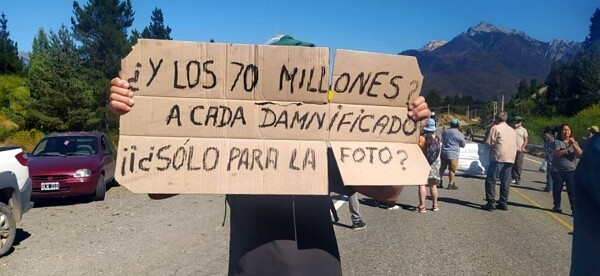
In a global context marked by tensions over water and energy, allowing foreign expansion in these areas reduces the Argentine state's ability to respond to its population's needs sovereignly. The push to repeal the Lands Law occurs in an international climate of growing disputes over strategic resources. The recent corollary to Trump's Monroe Doctrine signals a shift in U.S. regional strategy, aimed at securing access to natural resources in Latin America. In this context, these decisions can be read as a redefinition of who will control key territories going forward. Defining what can and cannot be sold, and under what rules, is not merely an administrative matter; it governs access to resources central to daily life and any development project. At the national level, about 5% of Argentina's territory is in foreign hands. Meanwhile, Iguazú (Misiones), Ituzaingó and Berón de Astrada (Corrientes), and Campana (Buenos Aires)—all located on the country's main navigable waterway, the Paraná River—far exceed the 30% mark. The pattern is clear: the most critical situations occur in border zones—both in the north and the Andes—and in territories with water resources, minerals, or logistical advantages like ports. Although the national government claims no province has exceeded the 15% limit, Americans own a land area larger than the province of Tucumán. The repeal aims to enable purchases in areas of exceptional natural and strategic value, including Patagonian freshwater lakes, native forests, Andean regions with critical minerals, sensitive border areas, regions along major rivers, or areas situated over aquifers that supply millions of people. Nearly 5% of the national territory belongs to foreign powers. To understand the stakes, it is necessary to review the context in which this law was enacted. A turning point in the contemporary process of land foreignization occurred in the late 1990s. In this scenario, the Lands Law was passed in 2011, setting a 15% limit on foreign ownership at the provincial and departmental levels and strengthening control mechanisms to prevent unmonitored triangulations. In 2016, during the Macri administration, Decree 820/2016 modified the application of the Lands Law. In practice, these changes facilitated operations previously subject to control and, fundamentally, altered how foreign ownership was measured in cases of corporations, inheritances, condominiums, or indirect holdings. Consequently, between the first official survey in 2015 and the 2022 survey, a decrease in the percentage of foreign-owned land is observed, which does not reflect a real reduction but rather the impact of this new methodology. In 2023, with the rise of La Libertad Avanza, DNU 70/2023 repealed the Lands Law via its Article 154. In surface area, this exceeds thirteen million hectares: the equivalent of England. However, the national data, while striking, is not the most relevant. The true dimension of the phenomenon appears when we zoom down to the departmental level or cross-reference the data with the location of watercourses, aquifers, or areas with mining potential. There are 36 departments that already exceed the limit set by the law. And in four cases—Lácar (Neuquén), General Lamadrid (La Rioja), and Molinos and San Carlos (Salta)—foreignization exceeds 50%. All of these concentrate strategic assets such as freshwater or mineral resources.