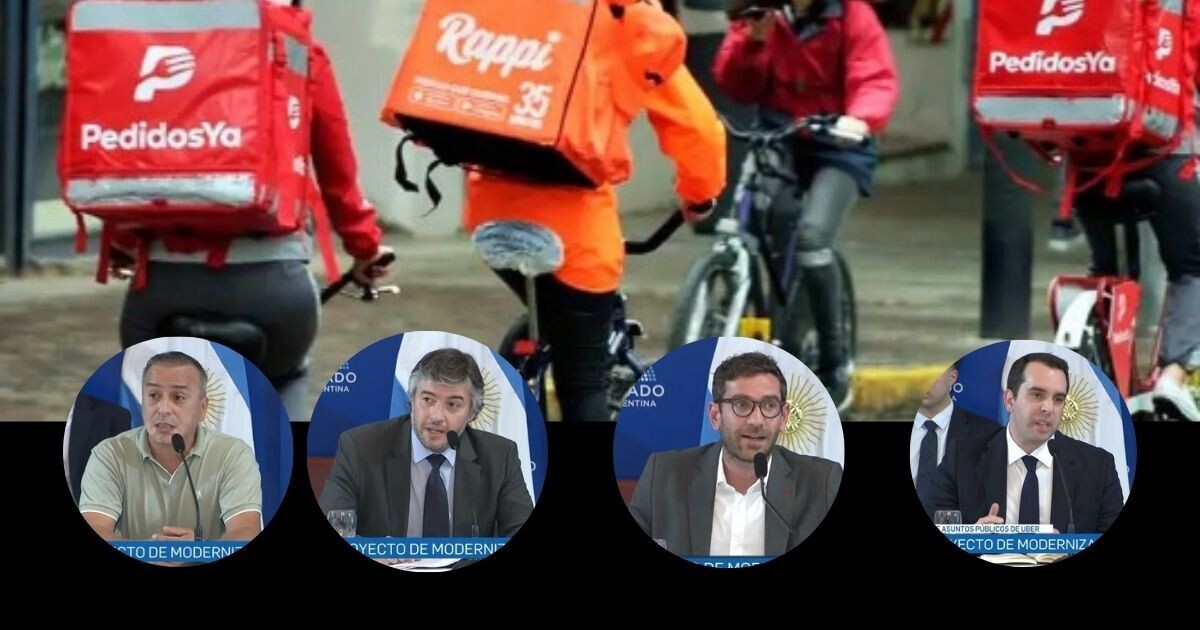
During the debate in the Senate's Working and Budget Plenary, where yesterday there were massive mobilizations across the country, the Labor Reform promoted by the ruling party was discussed, with a focus on the article affecting app delivery workers. All this without paying salaries or social security contributions, and without complying with the collective bargaining agreement for messengers, as denounced by Marcelo Pariente. “The algorithm conditions you. Because, on average, most people spend less than 20 hours a week on app work. This is not enough. You cannot regulate all activity through one tool. Because ‘while it is true that the platforms have generated more sources of work, in terms of rights, they have been violated. Therefore, it gives us the possibility to represent all those boys and girls who are on the street today, working through this tool which is an app.’” He argued that “the platform is a communication tool that our activity uses. When we started working, we used the cell phone, the bipper, the handy. Our colleagues, almost entirely, do not enjoy the same labor rights as the rest of the workers in the messenger activity.” He added that they should not vote for this project, as it “legalizes the condition of vulnerability and labor fraud in which our colleagues are immersed today” and erodes “the dignity of workers and their families.” Pariente emphasized that the delivery and messenger activity has been developing in the country for many years. And fundamentally, because they celebrate that the bill recognizes the independence of the delivery workers. What do they mean by this independence? Basically, that there is no labor relationship between the delivery workers and the platforms. Marcelo Pariente, in this sense, argued that “while it is true that there are workers, some, those who can, who prefer to manage their time, it is not true that they do not want rights.” “These are million-dollar businesses, the managers admit it,” he said. Nicolás Bevarati of Pedidos Ya mentioned that “today Pedidos Ya in Argentina has 45,000 businesses selling their products through the platform. Its union obtained legal personality in 2009 and clarified that ‘we represent all those workers who carry out the activity of delivery and distribution of small and medium-sized parcels, who use a motorcycle or bicycle as a tool and who also deliver food substances.’ Because it is done in a way that categorizes you in such a way that you lose the possibility of working again, or even it lowers your ranking. And we have more than 60,000 active delivery workers.” A way to legalize the concealed labor relationship between delivery workers and platforms like Rappi, Uber, and Pedidos Ya. Exposed were Gabriel Buenos, representative of Rappi; Nicolás Bevarati, Director of Government Relations for Pedidos Ya; Pedro Martino, Manager of Public Affairs for Uber; and Marcelo Pariente from the Union of Motorcyclist Messengers and Services. It is clear where this reform is aimed just by hearing those almost 30 minutes dedicated to the topic in the legislative palace. The three managers of the platforms praised the bill, considering that there is still a lot to be developed in the platform economy. ‘You cannot throw out everything that is good.’ The argument of the company managers who presented their point of view is that, both Uber drivers and delivery workers on motorcycles or bicycles, use the platforms to generate extra income to a main salary. He compared this situation to the invention of the pneumatic hammer: ‘they did not regulate all activities again because a tool appeared that facilitated work.’ Pariente rejected the approval of the Labor Reform and asked the senators to vote against. This argument basically is to recognize the precariousness of the working class, which cannot make ends meet with a single job. After the digital platform arrived, but the activity remains the same. One is forced to be permanently connected. We have more than 70 of our own supermarkets.