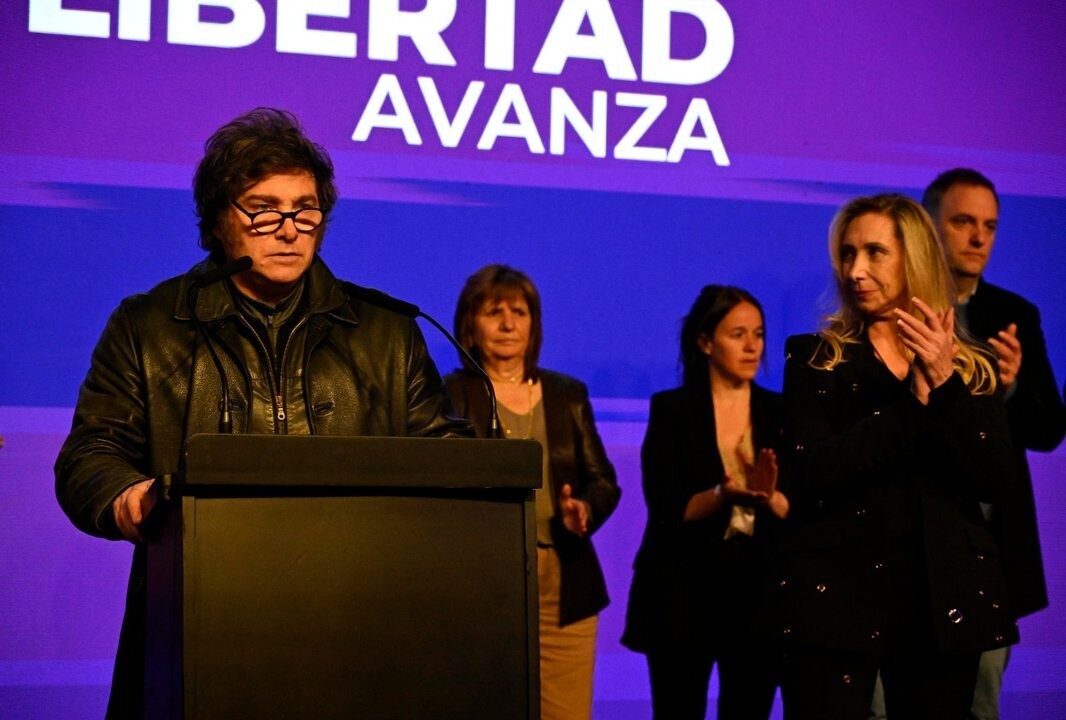
The National Congress of Argentina will begin extraordinary sessions tomorrow to debate a package of laws, with a focus on sanctioning the first budget of Javier Milei's administration and labor modernization. The start of the extraordinary sessions coincides with the beginning of the work of legislators elected on October 26, and the ruling coalition will have a more favorable context in the Chamber of Deputies, and it will almost triple its representation in the Senate, increasing from 7 to 20 legislators.
In the second stage of Javier Milei's administration, there will be joint work within the ruling coalition in Congress, as the main leaders of LLA, the President of the Chamber of Deputies, Martín Menem, and the head of the libertarian bloc in the Senate, Patricia Bullrich, will work as "one team".
The Government called for extraordinary sessions to be held from this Wednesday until December 30 to debate the projects of Budget, Fiscal Innocence, National Commitment for Fiscal and Monetary Stability, Modernization and Reform of the Penal Code to be sent by the National Executive Power, and the preservation of Glaciers and Periglacial Environment. However, the ruling coalition decided to prioritize the treatment of the 2026 Budget in the thirteen business days, which seeks to be approved next Wednesday, December 17, in the Chamber of Deputies and before December 30 in the Senate.
For two years, Milei had extended the budget passed during the Alberto Fernández government, but now with a new, more favorable composition of the Parliament for the ruling coalition, he seeks to sanction the law of expenses and resources that will apply for the next year.
Martín Menem will lead the negotiations to secure the votes to sanction the laws promoted by the Government. The scheme designed by the ruling coalition is that this Wednesday, the President of the Chamber of Deputies, Martín Menem, will define the composition of the Budget and Finance Committee and the Penal Legislation Committee, in order to issue an opinion on the Budget and the Fiscal Innocence Law between Monday and Tuesday.
In this context, the negotiations that Libertad Avanza must carry out in the deputies to vote on the Government's laws will be key, as it will need the support of at least 34 legislators given that it has 95 deputies. For this reason, the first conversations will be with its allies from the UCR.PRO, MID inter-block and Santa Cruz, which have 22 deputies, and with Innovación Federal, Independencia, Producción y Trabajo and Elijo Catamarca, which can provide another 15 legislators.
If it manages to close agreements with these dialogue blocks, it will ensure the sanction of this law, although it is optimistic that it can also have the approval of the majority of Provincias Unidas, especially from the deputies who respond to the governors of Santa Fe, Maximiliano Pullaro, and Córdoba, Martín Llaryora. However, the support of several governors will be linked to the Government's response on pension funds, the guarantees to be able to take on debt for infrastructure works, and the demands for the Government to advance with the works on the national routes.
Alberto "Bertie" Benegas Lynch will head the strategic Budget Committee.
The budget project under discussion proposes an increase in the economy of 5% of GDP, inflation of 10.1%; a dollar from 1423 to December 2026, and projects increases of 10.6% in exports and 11% in imports. It also sets that total expenses will be 148 trillion pesos, with resources of 148.2 trillion pesos, projecting a primary surplus of 2.7 trillion pesos. 85 percent of those resources are destined for social expenses, which covers health, education, social plans, pensions, among others. As for resources, the Government contemplates an expense of 8 trillion for the Government Administration, 7 trillion for Defense and Security, 106 trillion for social expenses, and 14 trillion for the public debt.
Patricia Bullrich, head of the libertarian senators' bloc, seeks agreements to sanction the labor law.
The Senate is preparing to open this Thursday in committee the debate on the labor reform project, which the Government will send in the coming hours to that legislative body, according to legislative sources to the Argentine News Agency. The Libertad Avanza block was yesterday finalizing the details of the battle that the ruling coalition will face to get the labor reform sanctioned, with which the Executive Power will seek to promote job creation.
To achieve its goal of advancing with the labor project, Vice President Victoria Villarruel must form the Labor and Social Security Commission, where the first battle to get the sanction of this initiative, which is rejected by Peronism, the CTA and the CGT, will be fought. The idea of the ruling coalition is that while they advance with the negotiations to approve the 2026 Budget in the deputies, the Senate begins the discussion of the labor reform in the Labor and Social Security Commission, although for that first the Government must send the project to Congress.
The Labor and Social Security Commission will have 17 members and it is estimated that Peronism would have 6 members, between 4 and 5 Libertad Avanza, and the rest will be distributed among the UCR, PRO and provincial blocs. In this way, the ruling coalition will need to close agreements to have the majority opinion and to achieve its approval in the session room, since it has twenty of the 37 it needs to obtain the quorum and sanction this initiative. The ruling coalition has 20 senators - although now it has 19 since the swearing-in of Enzo Fullone is pending, who will replace Lorena Villaverde - with which it needs that the project be supported by the ten radical senators, 5 from PRO, and at least two provincial ones.
In that legislative body, agreements with the dialogue blocks will be key, since the ruling coalition has 20 legislators, and needs 17 senators to approve the Budget, for which the level of agreement reached with the governors will be key.