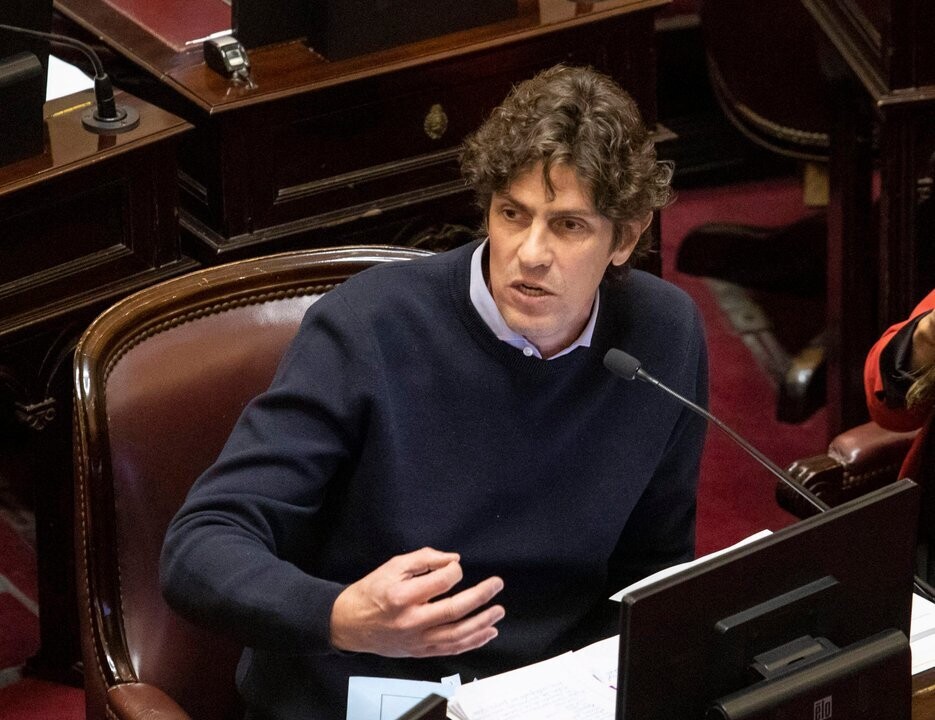
The centrist forces that escaped the polarization machine in the last elections are living through crucial moments in the Chamber of Deputies, on the eve of the preparatory session on December 3rd, where the blocs that will be the balance of power in the new Congress must be configured. The political wheeling and dealing is in full swing. The Radicalism is exploring a steep path to reunify its two blocs. In case of a merger, it would result in a bloc of a dozen legislators, a number that would, in any case, tie the historical floor of the centenary party. Negotiations are hanging by a thread and pivot around the political orientation of the bloc (closer or further from the ruling party), a debate that ultimately boils down to the tug-of-war for the leadership of the bloc. The 'cornejismo' faction seeks to impose as president Pamela Verasay, a 'violet' radical deputy who renewed her seat through the La Libertad Avanza (LLA) list. In no way does the Mendoza deputy meet the acceptable conditions for the more opposition-leaning radical deputies, as they would never accept being dragged into a position of submission to the national government. Nevertheless, they offer a guarantee for the negotiation that Martín Lousteau, one of the most confrontational figures with the Javier Milei administration, will step back from the discussion and will not seek to stay on as president. 'The idea is that the president is not someone 'extreme.' Valdés already runs the Senate and could preside over the National Committee. The problem is the 'cornejismo.' No one swears eternal love,' a source consulted by the Argentine News Agency confessed, referring to the pragmatism that should prevail as a criterion for reunification. If they do not agree, there will be six national deputies left in a state of limbo: the aforementioned Lousteau, Rizzotti, and Zigarán, as well as the Buenos Aires-based Pablo Juliano, the porteña Mariela Coletta, and the Correntino Diógenes González. How the negotiation continues These moderate opposition radical deputies are being sounded out by Miguel Pichetto and Nicolás Massot, who want to absorb them into the new non-Mileist, non-Kirchnerist center inter-bloc that is being formed on the basis of the current structure of Encuentro Federal, with additions from Provincias Unidas and possibly the Coalición Cívica. 'We will see if the discussion crystallizes in the center inter-bloc, which is Massot's idea, but it should not be called Provincias Unidas because with that name you push people away, instead of adding,' they stated from the more opposition-leaning radicalism to the Argentine News Agency. If the Río Negro native and the former president of the PRO bloc during the Cambiemos era succeed in their efforts, the UCR bloc would be reduced to the humiliating number of six national legislators, a minuscule size for a political party with the history of Radicalism. These six 'violet' radical deputies are the aforementioned Verasay; her fellow provincial Lisandro Nieri; the Buenos Aires-based Karina Banfi; the Chaco-based Gerardo Cipollini and Guillermo Agüero; and the Entre Ríos-based Darío Schneider. 'Audacious': former UCR Defense Minister on Presti It is also not entirely ruled out the hypothesis that Radicalism, within the framework of the negotiations, reaches a tolerable balance for the different parties that allows it to reunify its blocs, and that these 12 deputies form an inter-bloc with Encuentro Federal and other minority center forces. 'The reality is that with 12 deputies you don't get into any bicameral. If they elect a 'violet' one, it breaks,' warned 'dissident' parliamentary sources from Radicalism in dialogue with the Argentine News Agency. As a counter-proposal, the names of the Jujuy-based Jorge 'Colo' Rizzotti and María Inés Zigarán emerge as an alternative, who would not respond to a specific extreme, although it is clear that the former sided with Democracia para Siempre when the UCR bloc broke, and the latter arrived at the Lower House thanks to Governor Carlos Sadir of Provincias Unidas, with an ambivalent relationship with the Government. 'For me, the candidate is a Jujuyan. The choice is only for the purpose of being 12 and being able to apply the D'Hondt method. Lousteau is not interested, that is not the problem.'