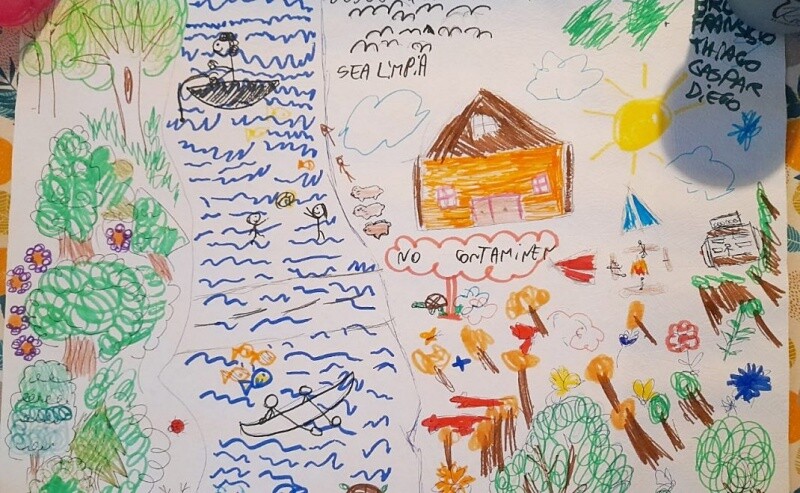
To recover access to the river and work on biodiversity restoration, the Forum for the Return to the Reconquista was formed in December 2022. It is a plural and diverse space made up of self-organized citizens and environmental, political, and social organizations. The Reconquista River crosses 18 municipalities and, in San Martín, covers seven kilometers of coastline. San Martín is the only district in the first cord of the conurbation without green spaces that protect biodiversity. Therefore, the Forum's main objective is to achieve the creation of an Urban Natural Reserve. In October 2024, the Forum obtained the approval of a municipal ordinance for the rezoning of 150 hectares. However, members of the Forum report that since last November, they have not been able to access these lands. "We need access to information, and they are not letting us in, not even to take samples and carry out research work," denounced Yanucci. Members of the Forum for the Return to the Reconquista, along with researchers from 3iA at UNSAM, have developed an educational proposal for primary and secondary school students in the area. This is "The Capybara's Suitcase," a didactic sequence that started in a very artisanal way and aims to invite children and young people to explore and build meanings from the territory. The presentation of the suitcase, which has a physical and a digital version, took place on Thursday, October 30, at the Tornavías Building of UNSAM and was attended by the teachers Valeria Becker, Flavia Yanucci, and Claudia López, from the Forum's Educational Commission, and Mariana Totino and Gabriel De Luca, from 3iA, belonging to the School of Habitat and Sustainability (EHyS). During the presentation, López used her teaching skills to narrate the story that begins the game and captivated everyone present. In the following stations, photos of the river are compared, timelines are explored, and various audiovisual materials are proposed to learn about the history of CEAMSE and understand why the Reconquista is so polluted. One of the most special stations is number 6: "We are not all here, we are missing Diego Duarte!" There, the children learn the story of the young man from José León Suárez who disappeared under a mountain of garbage at CEAMSE in 2004 when he went to look for sneakers for his brother. "Diego is a disappeared person under democracy and has a lot to do with the history of the kids living in this part of the Reconquista," emphasized López. The last post aims for the children to make a future projection. In this idea, they can think about how they would like the first Urban Natural Reserve of San Martín to be and portray it on a collective poster. "We want the river to be public and we believe that education is the bridge between desire and possibility," concluded Becker. The game begins when elementary and secondary school students listen to a story about the adventures of Grandfather Robustiano on the Reconquista River —the fish he caught, his encounters with giant turtles, and his canoe rides. "We want the river to be public and we believe that education is the bridge between desire and possibility," concluded Becker. "The suitcase is a trigger to stop seeing the environment as something external and to understand that we are part of it," said Becker. "The suitcase is a trigger to stop seeing the environment as something external and to understand that we are part of it," said Becker. "We want the river to be public and we believe that education is the bridge between desire and possibility," concluded Becker. "We want the river to be public and we believe that education is the bridge between desire and possibility," concluded Becker.