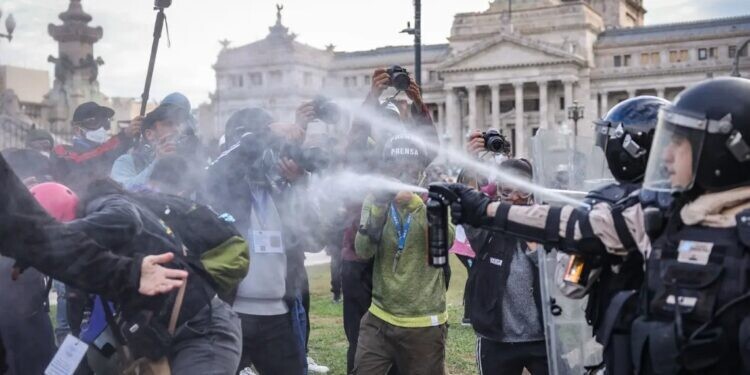
The Buenos Aires Press Workers' Union (SiPreBA) and the Argentine Federation of Press Workers (FATPREN) will appear before the Inter-American Commission on Human Rights (IACHR) on November 19 at 6:15 PM (Argentine time) to ratify a complaint against the national government. The organizations allege that for two years, the government has been carrying out a systematic and planned policy of attacks against journalists and press workers.
The objective is to foster a space for dialogue so that the state adopts measures to stop the attacks on press workers and critical voices. The hearing will be held on November 19 at the University of Miami, United States, as part of the IACHR's 194th Period of Sessions. It unifies the requests presented by Amnesty International Argentina, the Center for Legal and Social Studies (CELS), the Buenos Aires Press Union (SiPreBA), the Argentine Forum of Journalism (FOPEA), and others.
Recently, the IACHR's Special Rapporteur on Freedom of Expression expressed concern about the worrying situation of freedom of expression in Argentina, the low tolerance of the executive branch to criticism, and a public debate environment that has become more hostile and risky for journalists.
The organizations will present to the Commission the delegitimization of critical journalism in official discourse, as well as the growing attacks, threats, and stigmatizing speeches against journalists and media outlets, many of them promoted from the highest authorities of the state. Representing our union will be “Paco” Rabini, who will speak during the session along with other representatives of the applicant collectives.
The government's attacks, which include judicial lawsuits to limit the exercise of freedom of expression and the press or repression of journalists doing their work, also extended to the reduction of the role of public media, the attempt to close the Télam agency, the prolonged intervention of ENACOM, the paralysis of FOMECA funds, and the emptying of the Public Defender's Office, affecting informational pluralism and the diversity of voices.
In the last year, President Milei has denounced at least eight journalists and communicators for defamation and slander: Carlos Pagni, Viviana Canosa, Jorge Rial, Fabián Doman, Mauro Federico, Nicolás Lantos, Ari Lijalad, and Julia Mengolini. Likewise, his Minister of Justice, Mariano Cúneo Libarona, denounced Nancy Pazos and Darío Villarruel in 2024.
“In the mobilizations and protests, more than a hundred journalists and press workers were injured or detained, as happened with photographers Leandro Cruzado, Tomás Cuesta, and Javier Iglesias, among others,” added our general secretary of SiPreBA, Agustín Lecchi.
One of the most dramatic cases is that of photographer Pablo Grillo, who was on the verge of death when he was shot with a gas projectile and hit in the head,” explained the elected deputy secretary of SiPreBA and treasurer of FATPREN, Francisco “Paco” Rabini.
The hearing can be followed live on the IACHR's YouTube channel, the networks of the participating organizations, and will have special coverage from Tiempo Argentino.
October 20, 2025
Argentina will have to explain itself before the IACHR for the deterioration of freedom of expression
The Inter-American Commission on Human Rights has convened a hearing on the situation of freedom of expression in Argentina, after receiving requests from a broad set of journalistic, union, human rights, and academic referents who denounce a sustained and alarming deterioration in the exercise of freedom of expression and the press in the country.
This is a direct attack on freedom of expression and the press, as well as the right to information, with concrete effects such as digital violence and repression against those who carry out their work covering protests. They will also warn about the abusive judicialization of journalists, the intensification of police violence against press workers in public demonstrations, restrictions on access to public information, and the emptying of public and community media.
The hearing before the IACHR will be a key opportunity to highlight the seriousness of the situation, demand effective guarantees of protection for journalists and media, and reaffirm the commitment to the right to freedom of expression as an essential pillar of the rule of law.