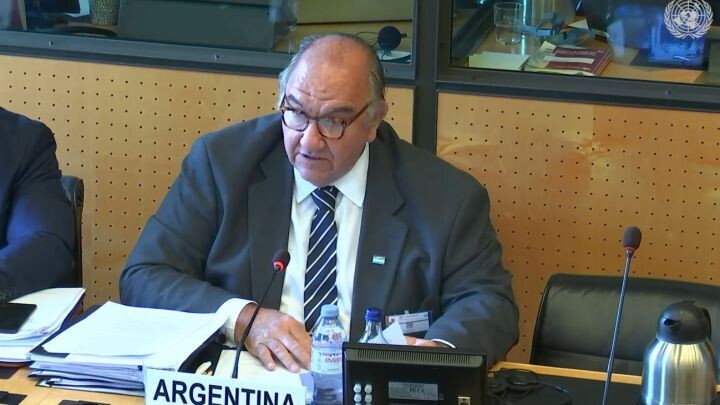
Meanwhile, the clash between those who demand maintaining focus on state crimes and those who demand incorporating the victims of 1970s terrorism on the same plane once again demonstrates that the battle for the meaning of Argentine memory is far from over. This climate was exacerbated by the 1976 attack against the dining room of the Federal Police's Superintendence of Federal Security, when a bomb placed by Montoneros killed more than twenty people and left dozens injured, in the bloodiest guerrilla attack in Argentine history. To these events are added numerous attacks with explosives, kidnappings, selective assassinations of political, business, and union leaders, and indiscriminate attacks that caused civilian casualties, such as the car bomb in front of the University of Belgrano in 1975 that killed student Laura Ferrari. In his intervention, he sought to shift the focus: he downplayed critical reports from human rights organizations and questioned their statistics, while insisting that Argentina 'strictly complies with legal norms and current constitutional principles.' The political axis of his speech was the vindication of the so-called 'full memory.' Various historical investigations and records from the period estimate the number of deaths caused by left-wing guerrilla organizations in the 70s at around a thousand. The terrorist actions of Montoneros, ERP, FAP, and other armed bands – which operated before and during the military regime – produced innocent victims, conscripted soldiers, police, civilians, and leaders, who cannot be erased from collective memory or relativized for ideological reasons. Geneva, November 15, 2025 – Total News Agency-TNA– The Undersecretary of Human Rights, Alberto Baños, took the most sensitive discussion in recent Argentine history to the United Nations: he demanded 'full memory,' questioned the symbolic figure of 30,000 disappeared, and denounced 'false reports' from non-governmental organizations to the Committee against Torture, the body that examines the human rights situation in the country. Baños headed the Argentine delegation in Geneva and responded to experts' questions about complaints of repression of protests, prison conditions, and the use of force by the State. To this was added the assassination of union leader José Ignacio Rucci in 1973, attributed to and claimed by Montoneros, which deepened the spiral of political violence even under a constitutional government. As early as 1975, the so-called Operation Primicia – the attack by Montoneros on the Infantry Regiment of Monte 29 in Formosa – left a balance of twelve dead soldiers (including ten conscripts), one police officer, and several civilians, in a large-scale guerrilla action against an army barracks during the constitutional government of María Estela Martínez de Perón. Official reports from CONADEP collected 8,961 reported cases. The appeal to 'full memory' also reactivated the debate on crimes committed by armed organizations. With this formula, he demanded that the victims of the left-wing armed organizations that operated from the 60s and strengthened in the 70s, such as Montoneros, ERP, and FAP, also be recognized, which, with support, training, or logistics linked to the Cuban-Soviet sphere, committed thousands of attacks and hundreds of murders in their attempt to seize power by force. In parallel, Baños once again brought into question the figure of 30,000 disappeared, which he considered part of a 'narrative' installed in democracy. Recognizing the existence of these victims does not imply equating legal responsibilities between the State and the armed organizations, but it does prevent a selective reading of the past. Now it will be up to the Committee against Torture to issue its final observations on the human rights situation in the country, in a context of growing internal political tension around the interpretation of the recent past. Among the most emblematic events is the kidnapping and murder of de facto President Pedro Eugenio Aramburu, perpetrated by Montoneros in 1970, which marked the public entry of the organization and shook the country. He did so in open tension with the consensus built fictitiously for decades that vindicates that number as an open and symbolic figure.