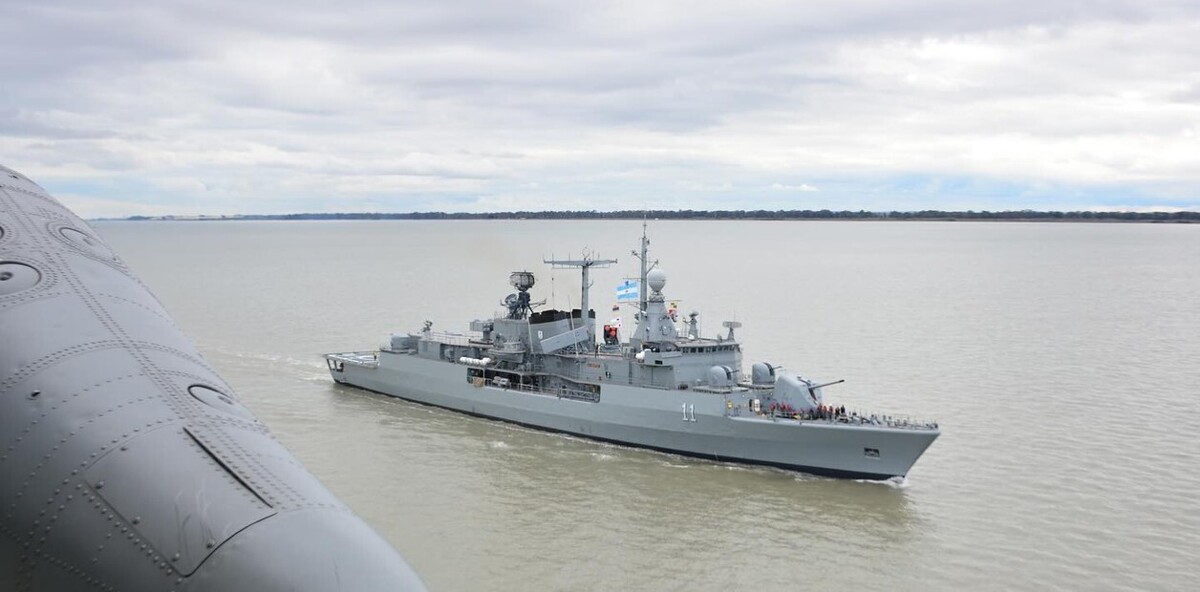
The ARA “La Argentina” destroyer returned to Puerto Belgrano port after participating in the UNITAS exercise in the USA. There were reports of plans to include it in the anti-narcotics operation in Venezuela. The ARA “La Argentina” destroyer arrived at the Puerto Belgrano Naval Base a little over a week ago, after spending 80 days at sea, participating in the UNITAS exercise on the east coast of the United States. Argentina not only dispatched a naval vessel to American waters for the first time in 20 years for the continent's oldest naval exercise, in which it has a regular participation, but also routinely takes part. Navy spokesmen confirm that the destroyer returned to Puerto Belgrano as scheduled, with no known changes to the plans. However, in military circles, versions circulated that the idea was on the table. While the destroyer was still at UNITAS, a military source attributed to retired Admiral Luis González Day (a naval officer who was Naval Secretary General in 2012) the information that they were “working” to have the vessel remain in the U.S. action in the Caribbean. The reasoning was that with the government of Javier Milei in the role of an unconditional ally of the United States, and after receiving financial aid that allowed it to successfully navigate the midterm elections, the warship's participation in the Washington-led operation would have been a concrete gesture of that alignment. However, the “La Argentina” destroyer, a MEKO 360 class frigate under the command of Frigate Captain Juan Cruz Granja, returned to Puerto Belgrano on November 3 with its 229 crew members. Quote: “The level of operational readiness is disastrous, that is the reality,” military sources state. They argue that the operation was discarded because one thing is to participate in a naval exercise, and another is to be in conflicts where a ship is supposed to be able to defend itself. “The destroyer only has a 40 mm cannon, but it lacks anti-aircraft missiles for its defense, Exocet anti-ship missiles, on-board torpedoes, or depth charges. Sending a ship in these conditions is a politically unacceptable risk,” they maintain. Official sources firmly deny that the United States requested the inclusion of a ship in an “anti-narcotics” naval coalition. They recall that there is a legal framework, the law on the entry and exit of troops from the country, by which Congress must annually authorize military exercises, whether bilateral (with another country) or combined (with several countries), as was the case with the recent UNITAS alongside the United States and a dozen other navies. In this context, they remember that in the early 90s, during the “carnal relations” of the Carlos Menem government with the United States, Argentina joined the international coalition led by the United States - under the UN umbrella - in the First Gulf War. Official sources also deny reports of government discontent, specifically from the president's sister, Karina Milei, with the head of the Navy, Admiral Carlos Allievi, for supposedly advising against the operation. They dismiss this as an “operetta” aimed at discrediting Allievi.