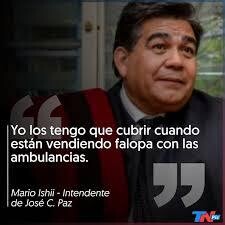
The appointment of José C. Paz Mayor Mario Ishii as vice-regional president of the UNESCO Learning Cities Network has caused an unexpected stir in the political and social circles of the Buenos Aires conurbation. However, this international award sharply contrasts with Ishii's dark legacy, marked by accusations of covering up drug trafficking activities that have permeated his administration. The epicenter of the controversy is a devastating phrase uttered by Ishii: 'When they fuck up, they sell falopa [cocaine], I have to cover for them, I haven't ratted them out yet when they are selling falopa with the ambulances.' The term 'falopa,' slang for cocaine, directly alludes to the alleged protection that Ishii provided to municipal drivers involved in the transport of narcotics, using sanitary vehicles to evade controls. The Federal Prosecutor's Office No. 9 for Complex Crimes in San Martín, led by Miguel Ángel Vieira Miño, opened a case for obstruction of justice, notifying the mayor to appear. In José C. Paz, where ambulances once served as a shield for drug trafficking, the educational future depends less on UNESCO diplomas and more on a justice system that awakens from its slumber. How can an educational municipality coexist with narco-traffickers who kidnap Paraguayan immigrants to enslave them in drug sales, as revealed by raids in July 2025? The 'Kukas' use ambulances to sell falopa. Ishii, a heavyweight in local Peronism who has headed the municipality for over two decades, celebrated the news as a 'pride' that validates the 'educational path' of his management, highlighting the role of 'institutions such as the National University of José C. Paz in social inclusion and community development.' The Learning Cities Network, which Ishii will now co-chair for Latin America, seeks to promote lifelong learning, but awarding a leader with this profile sends the wrong message. In an aggressive and intransigent tone, the mayor warns that if they do not accept the imposed rules, he will pay them only the minimum and release them from their posts. This time, he did not speak of the 'falopa' in his ambulances. In just the last few months of 2025, police raids have dismantled organizations selling cocaine by delivery, seizing thousands of doses, weapons, and cash, while double homicides in burned-out cars have been linked to disputes between clans. 'He is the king of the conurbation, but his crown is stained with impunity,' a local councilor quipped off the record. UNESCO, in its eagerness to promote inclusive cities, seems to have overlooked this context. Organizations such as Chequeado and Amnesty International have questioned the designation, recalling that true learning passes through transparency and justice, not through selective forgetting. Ishii, elected senator for the Frente Patria in the last elections, thus consolidates his Peronist influence while the conurbation burns in silent complicity. His hegemony in José C. Paz, where he has governed since 1999 with brief interruptions, is based on clientelism that, according to analysts, has facilitated coexistence with organized crime. José C. Paz, with its 280,000 inhabitants crammed into humble neighborhoods in the northwest of the Greater Buenos Aires area, has long suffered from a plague of narco-violence that includes brutal settle-scores, drug bunkers, and distribution networks that operate with impunity. Opponents such as the Left Front and Massist sectors have demanded his suspension in deliberative councils, to no avail. The Federal Prosecutor's Office No. 9 for Complex Crimes in San Martín, led by Miguel Ángel Vieira Miño, opened a case for obstruction of justice, notifying the mayor to appear. In José C. Paz, where ambulances once served as a shield for drug trafficking, the educational future depends less on UNESCO diplomas and more on a justice system that awakens from its slumber. How can an educational municipality coexist with narco-traffickers who kidnap Paraguayan immigrants to enslave them in drug sales, as revealed by raids in July 2025? The 'Kukas' use ambulances to sell falopa. Ishii, a heavyweight in local Peronism who has headed the municipality for over two decades, celebrated the news as a 'pride' that validates the 'educational path' of his management, highlighting the role of 'institutions such as the National University of José C. Paz in social inclusion and community development.' The Learning Cities Network, which Ishii will now co-chair for Latin America, seeks to promote lifelong learning, but awarding a leader with this profile sends the wrong message. In an aggressive and intransigent tone, the mayor warns that if they do not accept the imposed rules, he will pay them only the minimum and release them from their posts. This time, he did not speak of the 'falopa' in his ambulances. In just the last few months of 2025, police raids have dismantled organizations selling cocaine by delivery, seizing thousands of doses, weapons, and cash, while double homicides in burned-out cars have been linked to disputes between clans. 'He is the king of the conurbation, but his crown is stained with impunity,' a local councilor quipped off the record. UNESCO, in its eagerness to promote inclusive cities, seems to have overlooked this context. Organizations such as Chequeado and Amnesty International have questioned the designation, recalling that true learning passes through transparency and justice, not through selective forgetting. Ishii, elected senator for the Frente Patria in the last elections, thus consolidates his Peronist influence while the conurbation burns in silent complicity. His hegemony in José C. Paz, where he has governed since 1999 with brief interruptions, is based on clientelism that, according to analysts, has facilitated coexistence with organized crime. José C. Paz, with its 280,000 inhabitants crammed into humble neighborhoods in the northwest of the Greater Buenos Aires area, has long suffered from a plague of narco-violence that includes brutal settle-scores, drug bunkers, and distribution networks that operate with impunity. Opponents such as the Left Front and Massist sectors have demanded his suspension in deliberative councils, to no avail. The center of the dispute lies in a 2020 video, filmed at the peak of the coronavirus pandemic, that recently resurfaced and reignited demands for accountability. In 2021, he faced allegations of illicit enrichment through a dozen family companies, some linked to dubious municipal contracts. In a district where the streets remain under the control of criminal gangs, the UNESCO award seems like a folly that exposes the cracks in the Argentine judicial system and the opacity of international organizations. Judicial sources from the time confirmed that the file sought to clarify whether Ishii, in his capacity as an authority, had obstructed investigations or protected corrupt employees. This judicial inaction, criticized by opponents and civil society organizations, allows figures like Ishii to navigate impervious between local power and the global spotlight. This is not an isolated case in Ishii's biography, who has accumulated a string of scandals linked to narco and corruption. In 2014, as a provincial senator, he admitted that one of his advisors had been arrested for drug trafficking, accusing the SIDE of 'political persecution.' That same year, an investigation for fraud in social plans splashed him with testimonies of irregularities in his management. 'I intervene in a bunch of things within the municipality,' he defended himself, downplaying the impact. However, this international award sharply contrasts with Ishii's dark legacy, marked by accusations of covering up drug trafficking activities that have permeated his administration. The epicenter of the controversy is a devastating phrase uttered by Ishii: 'When they fuck up, they sell falopa [cocaine], I have to cover for them, I haven't ratted them out yet when they are selling falopa with the ambulances.' The term 'falopa,' slang for cocaine, directly alludes to the alleged protection that Ishii provided to municipal drivers involved in the transport of narcotics, using sanitary vehicles to evade controls. The Federal Prosecutor's Office No. 9 for Complex Crimes in San Martín, led by Miguel Ángel Vieira Miño, opened a case for obstruction of justice, notifying the mayor to appear. In José C. Paz, where ambulances once served as a shield for drug trafficking, the educational future depends less on UNESCO diplomas and more on a justice system that awakens from its slumber. How can an educational municipality coexist with narco-traffickers who kidnap Paraguayan immigrants to enslave them in drug sales, as revealed by raids in July 2025? The 'Kukas' use ambulances to sell falopa. Ishii, a heavyweight in local Peronism who has headed the municipality for over two decades, celebrated the news as a 'pride' that validates the 'educational path' of his management, highlighting the role of 'institutions such as the National University of José C. Paz in social inclusion and community development.' The Learning Cities Network, which Ishii will now co-chair for Latin America, seeks to promote lifelong learning, but awarding a leader with this profile sends the wrong message. In an aggressive and intransigent tone, the mayor warns that if they do not accept the imposed rules, he will pay them only the minimum and release them from their posts. This time, he did not speak of the 'falopa' in his ambulances. In just the last few months of 2025, police raids have dismantled organizations selling cocaine by delivery, seizing thousands of doses, weapons, and cash, while double homicides in burned-out cars have been linked to disputes between clans. 'He is the king of the conurbation, but his crown is stained with impunity,' a local councilor quipped off the record. UNESCO, in its eagerness to promote inclusive cities, seems to have overlooked this context. Organizations such as Chequeado and Amnesty International have questioned the designation, recalling that true learning passes through transparency and justice, not through selective forgetting. Ishii, elected senator for the Frente Patria in the last elections, thus consolidates his Peronist influence while the conurbation burns in silent complicity. His hegemony in José C. Paz, where he has governed since 1999 with brief interruptions, is based on clientelism that, according to analysts, has facilitated coexistence with organized crime. José C. Paz, with its 280,000 inhabitants crammed into humble neighborhoods in the northwest of the Greater Buenos Aires area, has long suffered from a plague of narco-violence that includes brutal settle-scores, drug bunkers, and distribution networks that operate with impunity. Opponents such as the Left Front and Massist sectors have demanded his suspension in deliberative councils, to no avail. The center of the dispute lies in a 2020 video, filmed at the peak of the coronavirus pandemic, that recently resurfaced and reignited demands for accountability. In 2021, he faced allegations of illicit enrichment through a dozen family companies, some linked to dubious municipal contracts. In a district where the streets remain under the control of criminal gangs, the UNESCO award seems like a folly that exposes the cracks in the Argentine judicial system and the opacity of international organizations. Judicial sources from the time confirmed that the file sought to clarify whether Ishii, in his capacity as an authority, had obstructed investigations or protected corrupt employees. This judicial inaction, criticized by opponents and civil society organizations, allows figures like Ishii to navigate impervious between local power and the global spotlight. This is not an isolated case in Ishii's biography, who has accumulated a string of scandals linked to narco and corruption. In 2014, as a provincial senator, he admitted that one of his advisors had been arrested for drug trafficking, accusing the SIDE of 'political persecution.' That same year, an investigation for fraud in social plans splashed him with testimonies of irregularities in his management. 'I intervene in a bunch of things within the municipality,' he defended himself, downplaying the impact. Although the initial charge was brought, the case has since languished in some dusty office with no significant advances or prosecutions. In the images, originally disseminated by producer Gastón Cavanagh on the social network X (formerly Twitter), Ishii confronts a group of ambulance employees demanding better working conditions. 'I don't protect the sale of falopa. Many media took the information from the award and forgot about the ambulances.' Ishii, in a radio clearance on Radio Mitre, claimed that the clip was 'taken out of context' and that his reference to 'cover' was limited to preserving jobs during the health crisis, not tolerating crimes. This guy is Kicillof's right hand in the province. The main directive!