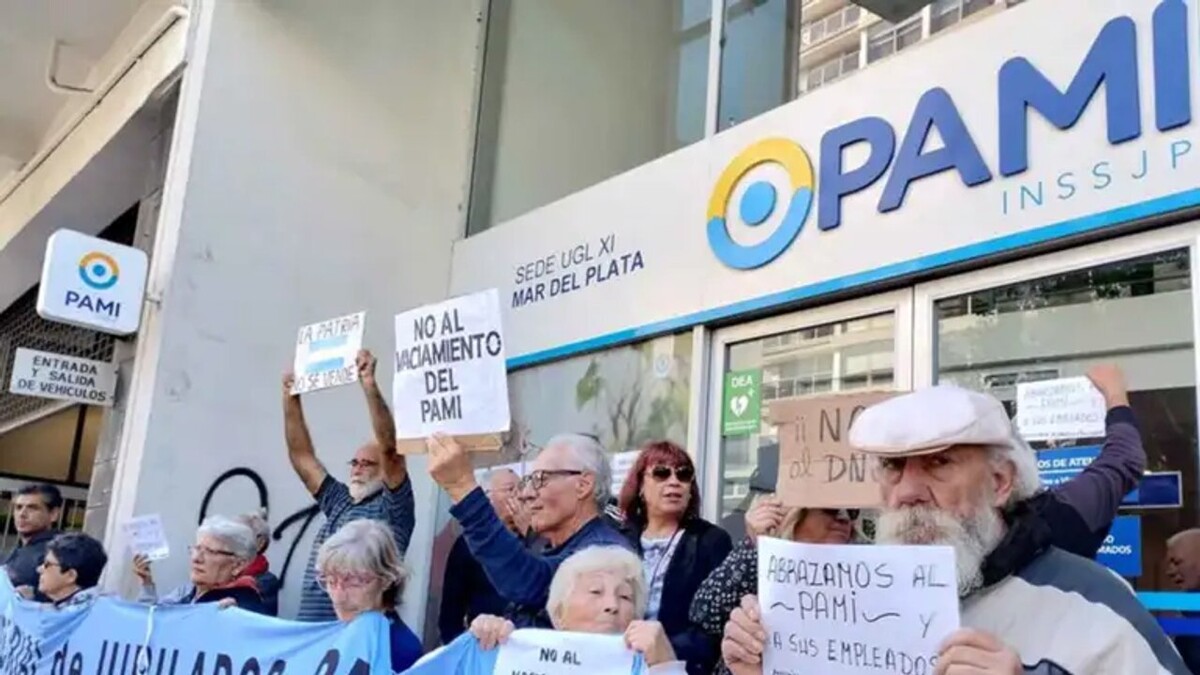
Retirees in Olavarría, Azul, and Bolívar must pay for consultations when they see their primary care physician at PAMI, while in Córdoba, those from Marcos Juárez have to travel 120 km to Villa María due to the closure of the Sudeste Sanatorium. In the Mediterranean province, the healthcare system has simply collapsed, in all cases due to the financial strangulation of the country's largest public social security organization, with 5,405,216 members nationwide. Since the end of last year, the system has stopped paying providers—clinics, sanatoriums, and private hospitals—regularly. As a result, quotas have been imposed for diagnostic studies, and appointments are scheduled four months in advance, as confirmed by the Argentine News Agency. Faced with a lack of official responses and the urgent need to cover operational costs in their offices, doctors grouped in these regions have informed that until PAMI regularizes its pending debt, members will be attended to as private patients. The chain of events a retiree endures is precise: the primary care physician prescribes a study, the patient schedules an appointment at the corresponding institution, arrives on the day of the consultation, and finds that the quota for that clinic is already exhausted. 'Don't even mention the clinics,' he stated, pointing to the head of the body, Esteban Leguízamo, as the collector. The same policy regarding private institutes with which it has agreements is replicated in the Province of Buenos Aires, and even this fragmentation has been applied in the delivery of flu vaccine doses to public health establishments in Buenos Aires. The Debt The debt that the entity maintains with private providers amounts to about $500 million and is attributed to the fact that as the National Treasury stopped transferring funds to the Ministry of Health, it was left unfunded. Consequently, some of those whose transfers for services provided were interrupted are now demanding copayments from patients. The issue becomes more complex for any understanding because, before the deferrals, there was an unresolved claim from providers over the tariffs that PAMI pays for services, which have been frozen for three years while salaries, medical fees, and supplies continue to rise. ATE stated that in the current administration's term, no physical therapy elements (canes, chairs, beds, mattresses, among others) have been purchased, and the illegal charging of 'additional fees and differentiated tariffs' for certain services has begun. The meeting between Leguizamo and the chambers grouping private clinics, sanatoriums, and hospitals (Adecra, Fecliba, Confeclisa, Salud Federal and Capres) did not advance at all, as it will depend on the outcome of next Friday's meeting between the Ministers of Economy, Luis Caputo, and Health, Mario Lugones. Previously, the head of the Treasury met with Lugones' technicians, who threatened to resign, and they reviewed the numbers, which do not add up, because of the $8.85 trillion budgeted last year, 20% came from National Treasury Contributions, which are now interrupted. Private estimates indicate that Economy would owe PAMI about $1.4 trillion, almost 14% of the organization's $10.17 trillion budget for 2026. Operational resources felt the pinch in revenue through the pension system and withholdings from retirees and workers. Audits with Water to the Neck In this context marked by internal audits and complaints for alleged irregularities, President Javier Milei appointed María Florencia Zicavo as the new syndic of the National Institute of Social Services for Retirees and Pensioners (INSSJP), better known as PAMI, as published this Tuesday in the Official Gazette. But as the thread is cut by the thinnest part, since January, both the national structure and the UGL (local management units, offices located in each locality that attend to the affiliates' complaints) have suffered from the indiscriminate dismissal of personnel, both professional and administrative. Without prior notice, employees were blocked from accessing their work posts, about 230 in various points in the country, according to the first count by the unions. From the PAMI leadership, they tried to justify the dismissal of these employees, stating that it responds to 'an attempt to optimize the organization's resources, arguing duplication of functions and non-compliance with tasks.' But for ATE it is part of the chainsaw that seeks to leave the entity without operational capacity. The layoffs came together with about 1,400 throughout the Ministry of Health structure, which puts the health system in checkmate. 'The retiree has to come to PAMI to get an order for a service so that it can be authorized,' detailed Susana Núñez, secretary of Finance of the PAMI section 6 of the UTI union (Union of Workers of the Institute). In this new filter, priority is given to preoperative and oncological cases, while the rest remains in an indefinite waiting list. Corruption The main cause of the red in the accounts is corruption, according to the former official of the entity, Viviana Aguirre, a libertarian and Mileist from the first hour. She had then denounced that it was through 'overpricing in everything,' and although she affirmed that the returns came 'from a long time ago,' she assured that 'this government tripled them.' 'Four, five, ten times more expensive, in nursing homes, in the medical part, in human resources, in wheelchairs, in mattresses, in diapers, in everything that is pharmacy.'