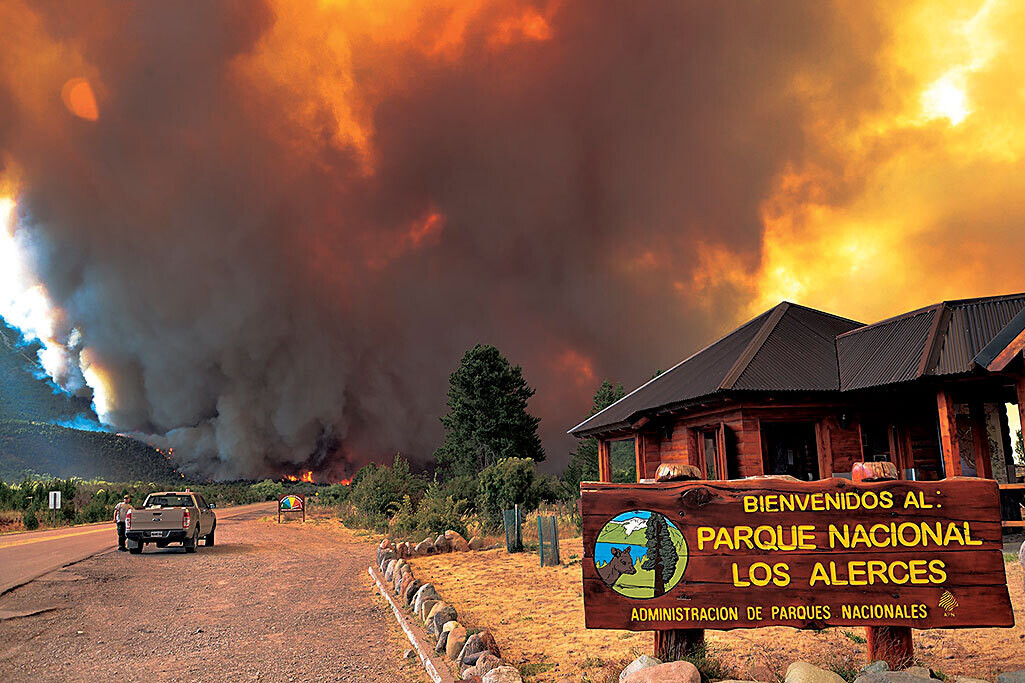
The global advance of sixth-generation fires and their increasing impact on Argentina have once again highlighted deep structural deficiencies in the fire prevention and combat system, warn specialists in the field. This reality is already observed in regions that historically did not record large-scale fires, such as areas of the Arctic or wetlands in Europe, which are now under permanent alerts. One of the most critical points is the so-called Wildland-Urban Interface, the space where human constructions mix with wild vegetation. In the face of large-scale fires, classic strategies are no longer applicable, and teams are forced to work on a small scale, trying to prevent the fire from reaching towns, routes, or critical infrastructure, rather than stopping it. Specialists also question the lack of development of technical fire use as a combat tool, as well as the non-existence of helicopter brigades specifically trained for initial intervention. These events are directly associated with climate change, prolonged megadroughts, and extreme heat waves, which minimize vegetation moisture and allow fires to release so much energy that they can modify the local atmosphere. It is no longer a matter of conventional forest fires, but of ultra-high-energy phenomena known as sixth-generation fires. To the influence of climate change is added the impact of El Niño and La Niña phenomena, which generate water stress, decrease in river flows and basins, and an accumulation of dry biomass that burns violently. They also emphasize that, from the national direction downwards, a large part of the personnel has accumulated more than two presidential terms in office without having achieved successful results in large-scale fires, which in most cases ended up being controlled only by a change in the weather. For specialists, the persistence of fires that last for days or weeks, as happened in Los Alerces National Park, reveals a conceptual failure: events that should be addressed as disasters are managed as emergencies, which delays the arrival of reinforcements and perpetuates the damage. The diagnosis is forceful: the country faces increasingly violent and predictable fires with a system that 'applies, but does not comply.' The expansion of housing, cabins, and tourism ventures in wooded areas worsens the problem, in a context where 99.9% of fires have an anthropogenic origin. From an operational point of view, it is pointed out that the system collapses quickly because burning implies a sudden release of the energy accumulated over years by photosynthesis. In these scenarios, emergency teams face severe operational dilemmas: they must decide between fighting the forest fire or defending homes and infrastructure, often without sufficient resources for both tasks. In addition, it is warned that most homes are not lost due to the direct advance of flames, but due to the effect of embers carried by the wind for kilometers, which enter through roofs or ventilation grilles and generate uncontrollable secondary foci. Internationally, the strategy is migrating from total fire suppression to comprehensive management. This means that even with the massive deployment of firefighters and aircraft, the fire cannot be controlled by traditional means and only stops when weather conditions change or the fuel is exhausted. International cooperation schemes have also been strengthened to mobilize firefighters and large aircraft between countries and hemispheres. In Patagonia, specialists describe an especially delicate picture. In this context, they warn that a profound change in leadership and the actors in fire management is essential, with a renewal of authorities, greater professionalization, and a strategy commensurate with a threat that has ceased to be exceptional to become structural. Unordered urban growth towards forested areas has exposed millions of people to an increasing risk. The result is the formation of firestorm clouds, called Pyrocumulonimbus, capable of generating their own winds, lightning, and totally unpredictable behaviors. According to specialists, these fires exceed the so-called 'extinguishing capacity.' This includes rapid initial attack to contain most foci before they exceed two hectares, intensive use of technology such as drones with thermal cameras and simulation software, and a decisive turn towards prevention through prescribed burns, forest management, and the creation of resilient landscapes. In this context, criticisms point directly to the current leadership of the National Fire Management System (SNMF), whose director —according to consulted experts— would not be up to the circumstances, a situation that is aggravated by the permanence in key positions of most agents appointed during the management of former Minister Juan Cabandié. The current scenario differs radically from the one that predominated for decades. In practice, they warn, helicopters are usually limited to transporting personnel without an integral strategy, while an excessive expectation is placed on large aircraft that, without ground guidance or fire direction, will hardly achieve decisive results. In this framework, they emphasize that the Nation does not exert the necessary pressure for the provinces to develop their own contingency plans, when only a handful have consolidated brigades and strategic schemes. That is where the greatest losses of lives and assets are concentrated.