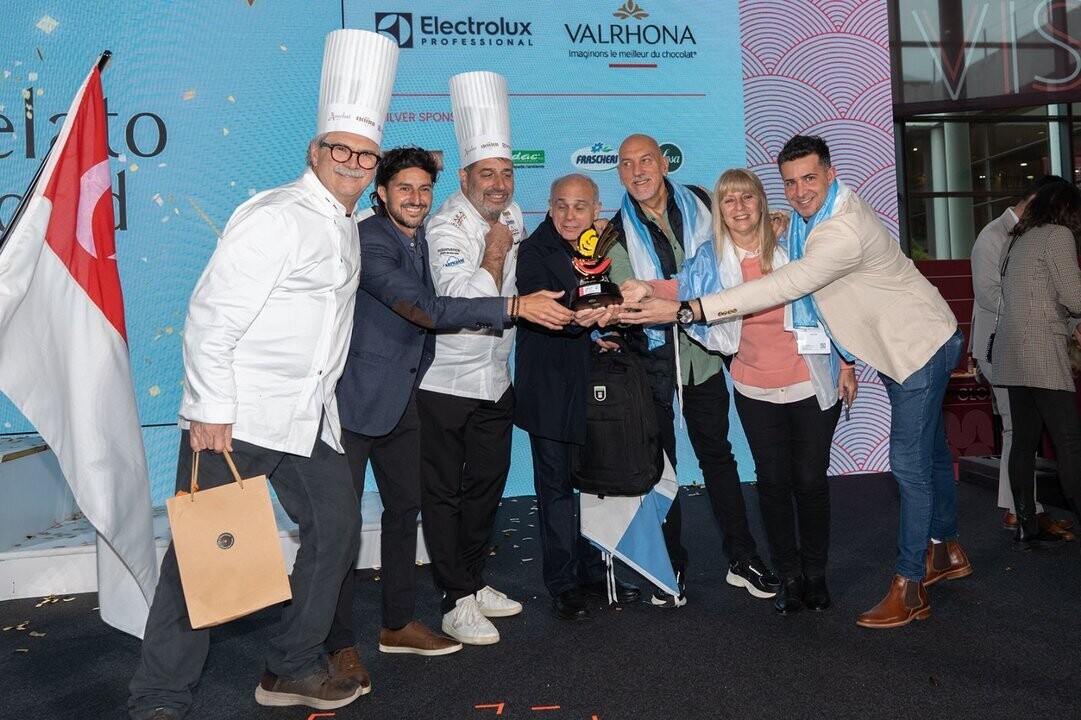
The National Artisanal Ice Cream Team won third place in the most important international competition in the sector, the Gelato World Cup, held every two years on the Adriatic coast of the Emilia-Romagna region. This was reported by the Argentine News Agency. In the competitions, held within the framework of the 46th SIGEP edition, the Argentine team, representing the Association of Artisan Ice Cream Makers and Related Products (AFADHYA) and the Federation of Pastry Workers, competed against 11 countries from all five continents. Singapore and France finished first and second, respectively. The team was composed of captain Eduardo Zacaría, gelato artist Diego Colaneri, pastry chef Diego Calculli, and chocolatier Sergio Mercado. AFADHYA President and Master Ice Cream Maker Maximiliano Maccarrone, who promoted Argentina's participation in this event and organized the international competitions, was elected president of the GWC 2026 jury, a position held for the first time by an American, alongside the French MOF, Emmanuel Ryon. Maccarrone stated, "Artisanal Ice Cream is an ambassador of our gastronomy to the rest of the nations." He added, "Argentina is recognized for its meat, its wine, and its tourism." The national team, the current American Champion, was composed of Eduardo Zacaría (56, from Coronel Brandsen, PBA) as captain; Diego Colaneri, gelato artist (45, Villa Luzurriaga, PBA); Diego Calculli, pastry chef (31, CABA); and Sergio Federico Mercado, chocolatier (45, Caseros, PBA). In the last edition, the Argentine group achieved 4th place.
The competitions featured eight different challenges, ranging from savory ice cream for haute cuisine to ice cream cakes, single-serve portions in glasses, chocolate mignons, the assembly of a "Vassoio Tronquetto," glazed popsicles, and "mystery box" surprise tests. Also presented were artistic pieces, such as a chocolate sculpture, and the final buffet presentation. To score, the judges took into account the following items: mise en place, hygiene (good manufacturing practices), teamwork, technique, organoleptic quality (taste, color, texture, cold sensation), and creativity – innovation and final presentation.
The first test was the "Mystery Box," where a surprise ingredient was drawn to create an ice cream. The Argentine team received raspberry as the main fruit base for their preparation. In this regard, Eduardo Zacaría, Diego Colaneri, Diego Calculli, and Sergio Mercado created a delicious raspberry and rosemary sorbet that aroused great interest due to the intensity of its flavor, color, and texture. In the Vassoio Tronquetto challenge, the Argentine team presented a cylindrical creation featuring an outer layer of chocolate sponge cake, a crispy base with brown glacé ice cream coating, along with a decoration of brown glacé gelatin and candied chestnuts. Inside, a second layer of chocolate sponge cake, gianduia latte ice cream, and a heart of sabayon and raspberry gelatin; they dazzled the jury.
For the popsicle test, the Argentine team developed two presentations in the shape of butterfly wings. One popsicle had a heart of strawberry jam, along with citrus cream ice cream and pistachio ice cream inside; with a raspberry-inspired chocolate glaze and a decoration of hibiscus and raspberry glaze, coconut and lime gelatin, and black Tuille. Another popsicle had a heart of caramel sauce, along with toasted peanut ice cream and milk chocolate ice cream inside; with a passion fruit and mango glaze, and decorated with passion fruit and mango gelatin, a white chocolate and passion fruit glaze, and Tuille. In their "Single portion in glass or 'ice cream cup'," mango and lime ice cream was the protagonist, combined with a lime sponge cake with a crispy element. On top, a vanilla and ylang-ylang sorbet (aromatic essence of the Coco Channel perfume) with a center of raspberry gelatin, passion fruit gelatin, and raspberry sauce; they completed the presentation.
The ice cream cake challenge was the star of the competition. The most difficult of all, where the goal is to define well-marked layers of different preparations that combine perfectly. The Argentine presentation sought to show a butterfly in the center. A base of lime sponge cake with lime pistacho crunch was made first; an outer layer of citrus and cedron semifreddo, decorated on the outside with raspberry, passion fruit, pistachio, and vigna and hibiscus gelatin. Inside, a layer of lime sponge cake, followed by another layer of vanilla yogurt ice cream, and in its center; a butterfly composed of vigna raspberry and yuzu sorbet, passion fruit gelatin, pistachio gelatin, and blackcurrant gelatin. For the Mignons test, where they had to present 3 chocolate-based creations, the National Ice Cream Selection presented: a white chocolate mignon: with a passion fruit sponge cake base with crunch, white chocolate ice cream inside, a wasabi glaze coating, and a heart of raspberry and lime sauce. A milk chocolate mignon: with a chocolate sponge cake base with crunch and an interior with milk chocolate ice cream and semifreddo of cranberry with ginger. In the coating, a raspberry glaze with decoration of raspberry and passion fruit gelatin; and in the heart, a blackberry sauce. And a dulce de leche mignon: with a panettone base of dulce de leche with coffee and lemoncello; dulce de leche coffee ice cream inside with a semifreddo banana coating and a glaze coating of mandarin and mango with decoration of mandarin, vanilla, and lime sauce and raspberry sauce. Finally, for the savory or "gastronomic" ice cream test, Argentina brought ice cream to the realm of haute cuisine with a sophisticated and bold proposal: cheese tartlet with tomato chutney, bagna cauda foam, caper leaf, chili powder, and lime; tomato sorbet with basil brioche bread; spice bread with duck flan, demiglace glaze, and chicken pâté; and a fish forcemeat with lime gel, beurre blanc of verjus, and parmesan Tuille.