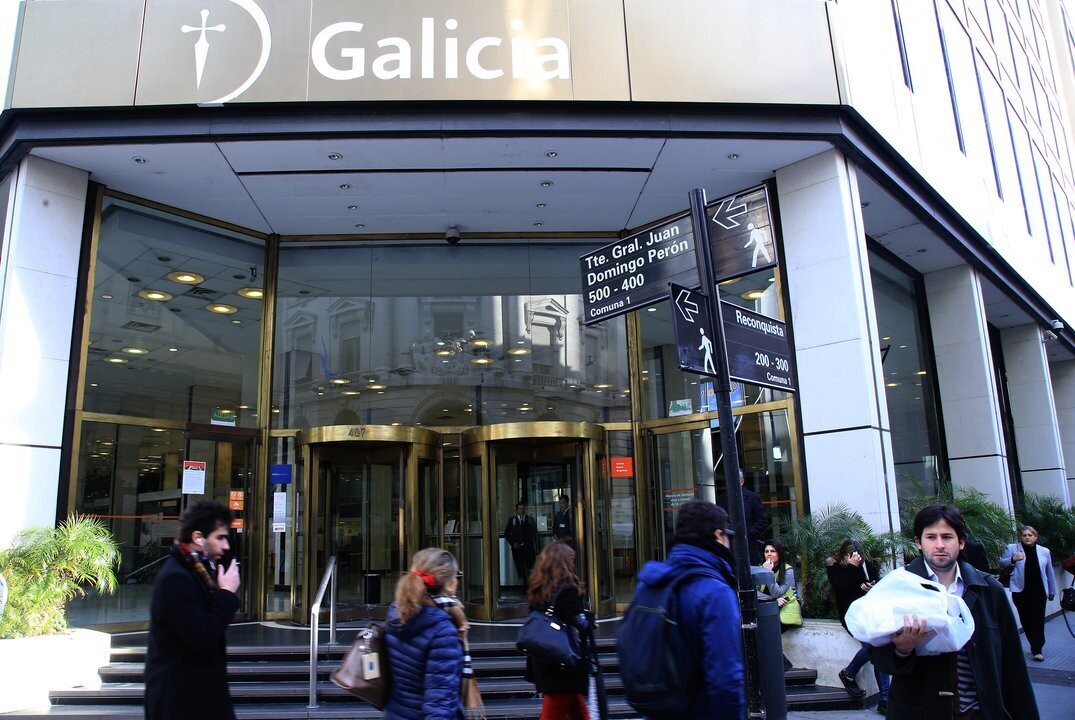
Buenos Aires, March 17 (NA) — Hit by recession, a surge in delinquency, and a string of losses, Grupo Financiero Galicia closed 2025 with a net equity that remains positive but has clearly deteriorated in real terms and is forced to maintain an increasingly risky asset portfolio. Capital is growing much slower than the balance sheet size, the return on that equity has plummeted, and the market is already starting to look with distrust at the largest private financial holding's ability to restructure its numbers without a deeper adjustment. Grupo Financiero Galicia (GGAL), the country's largest private financial holding, reported a net attributable loss of $83,544 million in the fourth quarter of 2025, well above the $23,053 million loss projected by analysts. According to various analyses, the entity has accumulated about $776,187 million in uncollectible credits, a volume that erodes the financial result and forces it to provision more and more. In the same period, the interest result hovered around $1.56 trillion, but the charge for uncollectibility took over 65% of that line, turning what should be the heart of the business into a source of losses. At the system level, delinquency on credit cards is around 9.3%, personal loans at 12%, and pawn loans at around 5.8%, but Galicia's ratios are worse, showing a bank more exposed to the fragility of consumption than several of its competitors. According to market information, the irregular portfolio over the group's total loans, which includes Banco Galicia and Naranja X, rose from 6.8% to 8.2% between the third and fourth quarters, with a year-on-year jump of 580 basis points. A year earlier, in the same period, the group had reported a profit of $731,065 million, which exposes the sharp turn in its balances in just twelve months. For the accumulated 2025, Galicia barely managed to show a profit of $196,046 million, which implies a drop of almost 91% compared to the $2.1 trillion it had earned in 2024, with an annual ROE of only 2.5% and a fourth quarter directly in negative territory. Far from stabilizing, the subsidiary consolidated itself as the weakest link in the group, contributing growing losses in a segment, consumer credit, today hit by the collapse in household purchasing power. The main bank also did not escape the deterioration. Banco Galicia closed the fourth quarter with a loss of $105,053 million, after a red of $112,055 million in the previous quarter, and an ROE of -6.9%, worse than the market's projections that expected a loss of $72,479 million. The reading of the year-end balances is overwhelming: instead of cushioning the shock of the recession and the rise in real rates, the bank ended up amplifying the deterioration of its credit portfolio. Within the group, the most worrying signal is in Naranja X, the non-bank arm oriented to consumption, which deepened its red and worsened its quality indicators even further. So far this year, Banco Galicia's stock has accumulated falls close to 14% and is trading around $41.5 on Wall Street, after being one of the most solid papers on the local market. Specialists point out that Galicia's delinquency level is the highest among Argentine banks listed on the stock exchange, a data point that the market closely follows in a context of positive real rates and volatility. Analysts consulted described the numbers as an expected bad quarterly result and the closure of a very lackluster 2025, pointing out that the improvement in the net interest margin is not enough to neutralize the impact of delinquency and inflation on the final result. In parallel, they warn that the acquisition of HSBC Argentina, which in 2024 had contributed an extraordinary profit, today coexists with a structure that still has a lot to be streamlined, which adds weight to an expense scheme that has not adjusted with the speed that the new scenario demanded. The impact of the balances was also reflected in the quotation. In the fourth quarter of 2025, Naranja X registered a loss of $48,836 million, against a negative result of $6,815 million in the third quarter of the same year, as learned by the Argentine News Agency. The delinquency of its portfolio rose from 11.7% to 13.2%, even with a coverage of 106%, while the loan stock fell 1% in the quarter, a combination that shoots up the cost of risk and leaves less margin to compensate for the fall in credit quality. In recent reports, it is warned that delinquency is sinking profits and pressuring the valuations of the main banks, with Galicia at the head of the most affected group. Although part of the market still sees a potential for recovery linked to future cash flows, the current picture is that of a bank facing recurring losses, a growing volume of uncollectibles, and the need to adjust its structure to prevent the next balances from repeating the same alert tone. The behavior of delinquency in the coming months and the signals that the entity provides for 2026 will be key to defining whether the slump was circumstantial or if it represents a deeper change in the group's risk profile.