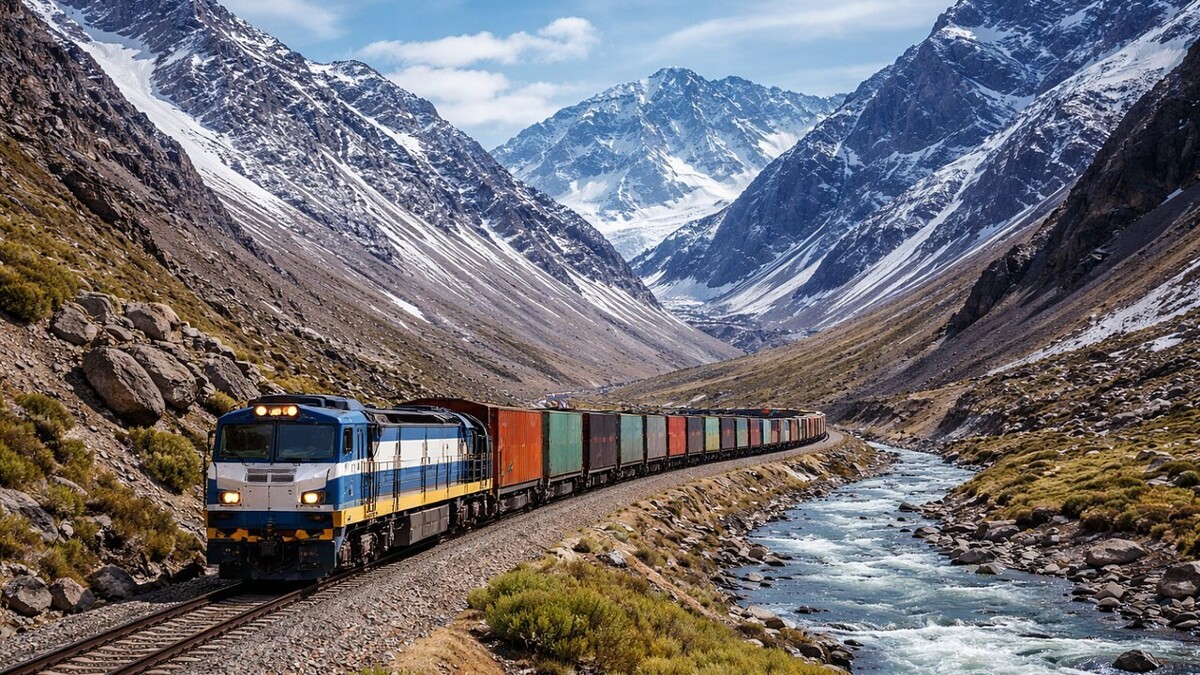
With a multi-billion dollar investment, a layout designed for year-round operation, and an impact that far exceeds Argentina and Chile, the return of the trans-Andean train is once again shaping up to be a project capable of reordering the economic map of South America. In Paraguay: a direct outlet to the Pacific, unprecedented for its foreign trade. According to information obtained by the Argentine News Agency, the initiative is driven by the national government together with the Cuyo provinces and contemplates a bi-oceanic corridor connecting the Atlantic with the Pacific. The project aims to restore the railway connection between Argentina and Chile through Mendoza, with an estimated investment of USD 4,000 million, and promises to fundamentally change logistics, foreign trade, and productive integration of the Southern Cone. This railway connection would lower costs, ease pressure on routes, and provide greater predictability for the export of strategic resources. The main objective is to offer a faster and cheaper route to Asian markets, using Chile's port infrastructure as an export platform. A NETWORK THAT INTEGRATES PROVINCES AND PORTS
The plan is not limited to a simple international crossing. It includes the modernization and connection of Argentina's internal railway networks, creating a single logistics system that will link the northern provinces with the Atlantic and Pacific ports. This will not only improve domestic trade but also strengthen regional connectivity, turning Argentina into a logistics hub for South America. FINANCING AND NEXT STEPS
While the political backing from governors and regional authorities is broad, the major point to resolve is financing. On the table are public-private partnership schemes with the participation of international capitals interested in infrastructure, energy, and logistics. Now, the challenge is for the project to stop being a promise and finally get on the tracks. REGIONAL ECONOMIC IMPACT
The projections handled by the technical teams are ambitious. In a five-year horizon, the corridor could generate: In Argentina: an increase in exports of between 15% and 25%, with an annual impact of up to 0.6% of GDP; In Chile: consolidation as a bi-oceanic port hub with export increases of up to 18%; In Paraguay: an unprecedented direct outlet to the Pacific for its foreign trade. A STRATEGIC CROSSING IN MALARGÜE
Unlike the historic railway inaugurated in the early 20th century, the new route would not pass through the highest mountain passes. The choice is not casual: it is a pass of lower altitude, with better winter weather conditions. This would allow for constant operation, avoiding the prolonged closures due to snow that historically affected other Andean crossings and were one of the causes of the decline of the old Transandino. A BRIDGE TO VACA MUERTA AND LITHIUM
One of the most disruptive aspects of the project is the incorporation of a strategic branch to Vaca Muerta. This section would connect General Alvear with the country's main energy formation and would be designed for the massive transport of key cargoes for the Argentine economy. HISTORICAL PRECEDENT AND A MODERN CHALLENGE
The Trans-Andean Railway, inaugurated in 1910, ceased to operate in 1984 after decades marked by weather problems, lack of investment, and political tensions. This precedent today serves as a warning and, at the same time, an opportunity not to repeat mistakes. MAIN USES
Among the main intended uses are: Industrial inputs, such as the sand used in fracking; Hydrocarbons, with efficient exit of gas and oil; Mining and lithium, fundamental for the global energy transition.