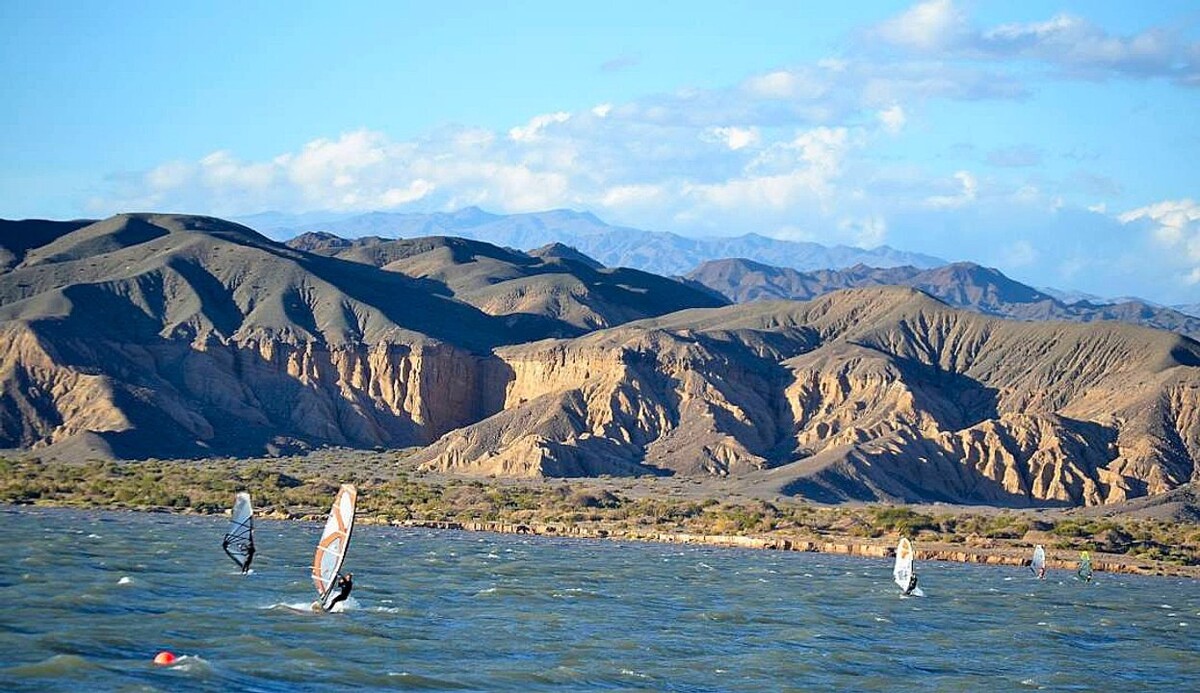
Far from being an absolute disadvantage, this characteristic has made San Juan a unique case in the country: a province that learned to organize around water and make the most of every available drop.
Why it rains so little in San Juan The explanation lies in its geographical location. Rivers fed by meltwater, such as the San Juan and Jáchal, are fundamental for human, agricultural, and industrial supply. Since pre-Hispanic times, and with greater development during the colonial period and the 20th century, an extensive network of irrigation canals was built, allowing desert areas to be transformed into productive zones.
The birthplace and museum of Domingo Sarmiento in San Juan, a must-see. In San Juan, cloudy days are scarce, and the sun is present most of the year, something valued by many residents and visitors.
The dry climate also influences architecture, responsible water use, and a strong awareness of its care. The result is a predominantly arid climate, with scarce rainfall concentrated in a few episodes per year.
Despite the little rain, San Juan is one of the most important wine-producing provinces in the country.
In some areas, especially in the Andean valleys and pre-mountainous zones, it can go entire months without a single drop of rain, something uncommon for most of the Argentine territory.
Water as the axis of life and production In San Juan, water does not fall from the sky: it comes down from the mountains. San Juan is located in western Argentina, at the foot of the Andes mountain range, which creates a barrier effect that prevents moisture from the Pacific from entering. This is compounded by the distance from the Atlantic and the influence of dry winds, which further reduce the chances of frequent precipitation.
It is part of the San Juan geographical and productive identity, marked by a desert climate, clear skies most of the year, and a thermal amplitude that conditions daily life.
Provincial Ischigualasto Park, known as the Valley of the Moon, an icon of San Juan. This fact, which often surprises, explains much of its arid landscape, its strong dependence on Andean meltwater, and the historical importance of irrigation systems. According to the Argentine News Agency, the scarcity of rainfall is not a recent phenomenon.
Buenos Aires, December 18 (NA) – San Juan is considered the driest province in Argentina, with areas where annual rainfall barely reaches between 80 and 120 millimeters, far below the national average. It is no coincidence that the province has historical policies related to water management.
At the same time, low humidity reduces certain common problems in other regions, such as the proliferation of fungi or the accelerated deterioration of constructions, although it poses constant challenges in the face of prolonged droughts.
Thanks to this system, the province has managed to develop key activities such as:
Viticulture Olive cultivation Fruit and vegetable production Hydroelectric generation
Without artificial irrigation, most of the territory would be practically uninhabitable.
How the dry climate impacts daily life Living in a province where it rarely rains changes habits and perceptions.