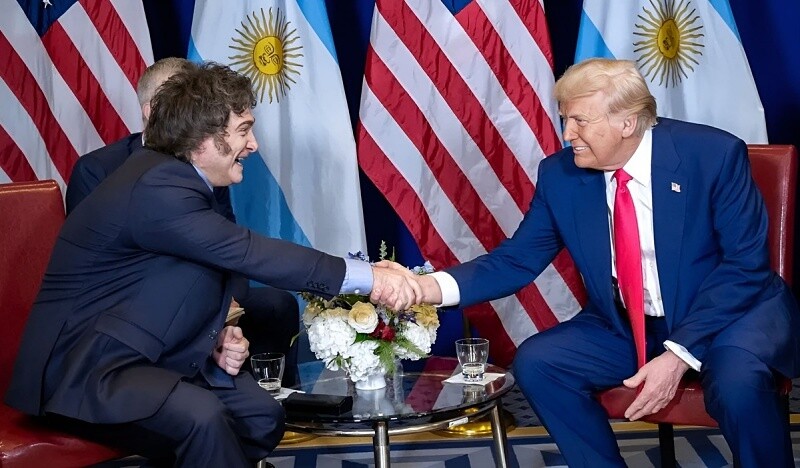
Argentinian beef is just one piece on a larger board: securing reliable suppliers, gaining ground in strategic sectors, and limiting China's maneuverability in the Southern Cone. This is not an isolated trade deal; it is part of the new global competition for influence and resources.
The losers: primary producers, regional economies, and local consumers. While the meatpacking plants celebrate, the other side of the deal appears in the sectors that are being left behind.
-
Displaced Argentine Consumers With a weakened domestic market and local prices pressured by exports, a known trend solidifies: more premium beef abroad, more restrictions at home.
-
In this context, the new agreement that facilitates the entry of Argentine beef into the United States appears, celebrated as a diplomatic victory and a source of fresh dollars. It is an extractive model, not a development model.
The underlying risk: depending on a single buyer Betting heavily on the US market may seem attractive in the short term, but it entails a risk that Argentine history knows well: no one controls a monopolistic buyer. The United States can impose sanitary criteria, quotas, commercial conditions, or political restrictions that would immediately affect exports. The decision is in Washington.
The grand prize for the United States: strategic influence in the dispute with China INDEC data shows that in September, Argentine exports to the United States grew by 44.5%, with a trade surplus favorable to Argentina. In an economic context that the government tries to present as auspicious, Argentina's trade balance offers a misleading picture.
The question is another, deeper one: what country project is this agreement inserted into, and who are the actual beneficiaries? Today, the data allow a clear answer: the exporting corporations and Washington's geopolitical strategy win; the producer, the consumer, and an economy that continues to sell raw materials while buying foreign technology lose.
Exporting more does not mean the producer earns more: the one who sets the price is the exporting meatpacking plant, not the cattle rancher.
- The country: more primary, less industrial The agreement strengthens the export of primary goods without generating local added value.
However, the American move has a clear logic: to strengthen its economic presence in a key country and prevent China from continuing to consolidate itself as a dominant partner. In a region where Beijing invests in energy, lithium, infrastructure, and food, the United States responds with selective agreements designed to strengthen economic and political ties.
Atomized Producers The small and medium-sized cattle rancher, who bears all the costs (feed, genetics, health, replacement), continues to receive stagnant prices.
But beneath these numbers lies a worrying dynamic: imports are growing more than four times faster than exports.
But a detailed analysis shows something different: the opening benefits a handful of concentrated actors, deepens commercial dependence, and fits into Washington's geopolitical strategy to compete with China for influence in the Southern Cone.
The winners: concentration at the top and a powerful ally Expanded access to the US market strengthens the big players in the beef sector, who for years have controlled exports and relations with premium markets: Swift Argentina (Minerva Foods, Brazil): absolute leader, with more than 397,000 heads slaughtered and maximum Hilton quota. Frigorífico Rioplatense (Constantini family): 257,000 heads; authorized to export to the US. Arre Beef (Borrell family): 196,000 heads; another of the big ones authorized. Bernal (Solassi–Borrell–Riusech): 173,000 heads. Friar (BAF Capital): 169,000. Lequio: 237,000. Patagonia (Braun/La Anónima family): 166,000.
But for the country as a whole, the agreement consolidates a model that has already shown its limits: concentration, primarization, and external dependence. The question that should be at the center of the debate is not whether it is good or bad to export to the United States. The question is what development model we choose.
A profitable but unbalanced agreement The entry of Argentine beef into the US market will generate dollars and strengthen the large companies in the sector. September left a surplus of US$ 921 million, and the annual accumulated amount reaches US$ 6,030 million.
Suffocating cost structure The trade balance anticipates it: imports—machinery, technology, critical inputs—are growing at a much faster rate. This implies a structural increase that erodes the profitability of the productive interior.
In other words, the surplus is not sustained by a structural improvement, but by an exceptional and fragile situation.
But the real beneficiary of the agreement is not in Buenos Aires or Santa Fe. Dependence on a single market never strengthens an economy; it makes it vulnerable.
*Juan Alberto Pérez (juanalperez23@outlook.com) is a Licentiate in Social Communication, works as an independent journalist, and has been part of alternative media such as the ANCAP News Agency and community radio stations Radio Compartiendo (of the Padre Farinello Foundation) and FM LA Riachuelo in Lanús. Currently, he directs the journalistic space "El Búho", with a presence on Instagram and X.