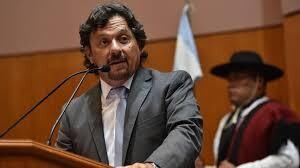
The governor of Salta, Gustavo Sáenz, publicly denounced the existence of pressures and threats directed at Peronist legislators to prevent them from supporting the labor reform bill promoted by the government of Javier Milei. This incident occurred just hours before the key debate in the Senate. Sáenz accused dialogue-seeking senators of prioritizing provincial interests over the national Peronist strategy, while governors responded that they are not willing to bear the economic and social costs of a permanent confrontation with the nation. In parallel, the government has deployed a political offensive to consolidate support. The Peronist sector aligned with Kirchnerism is attempting to rally to block a law it considers a political limit for the president. According to party sources, internal pressure has already had concrete consequences in districts such as Misiones, Salta, and Jujuy. The Salta governor stated that governors, deputies, and senators from his space received direct warnings not to support the labor reform, under the threat of losing control of party structures in their provinces. 'What is being defended here are the privileges of politics and some representatives of workers,' he said, in a criticism that targeted both the party leadership and union sectors resistant to any change to the status quo. The vote on the labor reform thus presents a multiple test: for Milei, a test of leadership in a fragmented Congress; for Peronism, an exam of cohesion; and for governors and legislators, a decision with costs and consequences that far exceed this law. While avoiding announcing a general strike, the labor confederation seeks to condition undecided legislators and set a symbolic limit to the advance of the reform. In this scenario, Sáenz openly questioned the internal leadership model of Peronism. According to him, the national leadership of the Justicialist Party (PJ) would be using the possibility of intervening in provincial parties as a mechanism for political discipline against those evaluating voting in favor of the official initiative. Sáenz's statements brutally exposed the internal rift running through Peronism on the eve of a vote that the Executive considers strategic. According to the same sources, there are warnings that similar measures could be replicated in provinces like Tucumán or La Rioja if their representatives accompany the labor reform. For the members of Federal Conviction, the discussion exceeds ideological logic. 'They have been threatened with having their party intervened,' he stated, while recalling recent precedents that, he said, serve as exemplary punishments. The axis of the dispute is concentrated in the Federal Conviction block, made up of five senators who maintain a tense relationship with the leadership of the majority Peronist bloc, composed of 28 legislators. This group, linked to governors from the interior, has become a decisive actor for the outcome of the vote, as its eventual support for the ruling party could tip the balance in a scenario of a tight parity. Sáenz's warning came at the most delicate moment of the negotiations, when the Casa Rosada intensified dialogue with provincial governors to secure the necessary votes in the Senate, where the reform will be debated this Wednesday from 11 a.m. They are mostly senators representing provinces with a high dependence on national resources and regional economies battered by the recession. In turn, the Minister of the Interior, Diego Santilli, will meet with the governor of Chaco, Leandro Zdero, with an agenda focused on provincial resources and legislative support. The ruling party admits that without the support of the provinces, the reform 'does not pass.' To the political dispute is added union pressure. In the latter case, the support of Senator Carolina Moisés for official initiatives led to the intervention of the provincial PJ. In this context, the labor reform is seen as a possible tool to attract investment, improve the business climate, and sustain employment, rather than as a symbol of political alignment. This pragmatic approach clashes with the Kirchnerist strategy, which promotes a frontal opposition to any initiative that could strengthen the government in Congress. The Minister of Economy, Luis Caputo, has a scheduled meeting with the governor of Corrientes, Juan Pablo Valdés, focused on financing and fiscal assistance. The CGT called for a mobilization for the day of the session and anticipated a climate of high tension in the vicinity of the Congress.