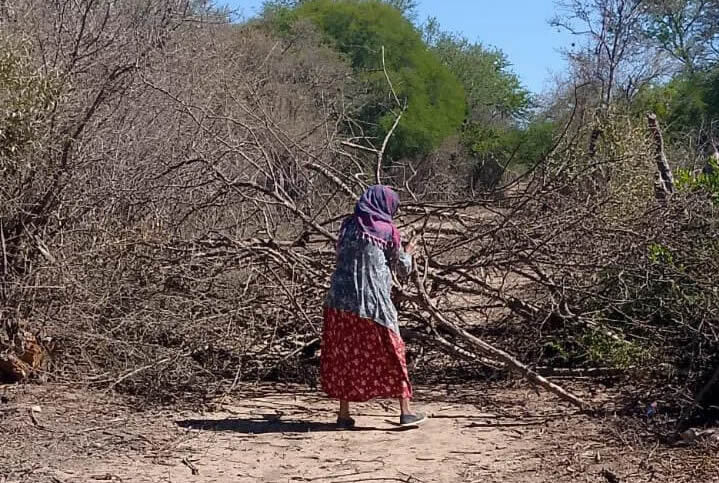
A long time ago, throughout the Argentine Nation, the lands of indigenous communities were plundered and distributed according to the oligarchies of each province. Moreover, the territories of indigenous populations are the richest, because all the peoples settled in the mountain range have lithium, gold, all the minerals together,” emphasizes the lawyer. While alarms grow about the interference of the United States, Israel, and other powers in Latin America, amidst nationalist speeches and calls to protect the country's sovereignty and 'natural resources,' few seem to remember that indigenous peoples are perhaps the biggest obstacle to land appropriation and the destruction of nature, and to the same extent, they are criminalized. But the violence comes from the State,” summarizes Mara Puntano. The lawyer also points to how the State fails in its mandate to protect communities: “With businessmen, you have a clear enemy: the capitalist, the only thing that interests them is profit.” In Salta, the lands—which they call state lands but are actually indigenous community lands—were also distributed,” points out Puntano and adds that in the Province's Real Estate Registry, it is recorded that the territory of Misión Chaqueña and Carboncito was purchased in the 70s, triggering a series of transfers from one buyer to another that led to the current conflict. In November 2006, Law 26.160 was enacted, declaring “the emergency in matters of possession and ownership of lands traditionally occupied by the country's indigenous and original communities,” which was extended year after year until the end of 2024, when the government of Javier Milei put a stop to it. “The community's claim is legitimate: to oppose deforestation and fires in their territory,” says Mara Puntano, a lawyer defending the wichí community of Misión Chaqueña in Salta. The National State, in the Constitution, only recognizes them in 94, and from there it proceeds to the territorial survey of indigenous communities, but these surveys are poorly done,” continues the lawyer. “In the province of Salta there are more than 300 communities of the wichí ethnicity alone, and there are two communities that share a common space, which is precisely the strip occupied by Ferrari,” she indicates, referring to the Misión Chaqueña and Carboncito communities. Three years ago, businessman Claudio Ferrari began to fence off and cut down trees on lands that ancestrally belong to the community, where its members obtain food and supplies for their crafts in peaceful and careful coexistence with the native forest. “Here, the main responsibility for the systematic violation of the rights of indigenous peoples in all the Argentine Republic lies with the National, Provincial, and Municipal States,” sentences Puntano. “The lands, ancestrally, belong in legitimate property to all the original peoples of the Argentine Republic. Now—explains Puntano—they are advancing as they are here in Salta and in the South with the Mapuche: they are evicting them, and when they cannot evict them, they set fire to the land.” Indigenous communities do not trust the State. Currently, amidst the criminal case against members of Misión Chaqueña, Mara Puntano denounces that the State's goal, in collusion with the businessman, is “to pressure the community so that, concerned about the release of the people (who were prosecuted), they sign an agreement in favor” of Ferrari. To take away their territories, which is the most valuable thing that exists anywhere on the planet. Here they are starving them and dehydrating them, dividing them among themselves and playing with the most peaceful peoples. By Sol Tobía for ANRed. Two weeks ago, Marta Herrera and Leonardo Pantoja, members of Misión Chaqueña, went to a police station to report that Claudio Ferrari had threatened to kill them and their children. How does a piece of land that ancestrally belonged to an indigenous people end up in the hands of a businessman? The same thing is happening here. The State should, as the Constitution says, guarantee the rights of citizens, (but) there are first-class, second-class, third-class, and last-class citizens.” The government's proposal was for the provincial State itself to buy the lands from the businessman to supposedly later “deliver them to the community,” something that immediately generated distrust among the leaders and their lawyer. “Indigenous communities do not trust the authorities of Indigenous Affairs, because if they did their job, all communities would already have the regularization of their territory with community property titles, and they don't have it precisely because it doesn't work: the State systematically violates the rights of all indigenous peoples,” denounces Puntano. To set fires, criminalize, and starve to death: indigenous peoples as an obstacle to plunder. While in the North, Ferrari advances with the deforestation of the native forest, in the South the trees burn in a known scene: it is probably the prelude to the appropriation of those lands by private agents, who already concentrate more than 13 million hectares within Argentina, as recently denounced by the “Map of land foreignization” prepared by Conicet and UBA scientists. “When they cannot divide them, when they cannot defeat them in that way, what they do is directly set fires as in the South. But the State should defend. Finally, thanks to the intervention of Mara Puntano, the wichí leaders were released, and a mediation was set for Tuesday, January 13th. “We do not submit to mediation, because that means accepting guilt for a crime that did not exist,” explains Puntano in dialogue with ANRed. The mediation, as expected, failed without any kind of agreement being reached between the businessman and the community. “Title of ownership”: a story of plunder and invisibilization. Claudio Ferrari claims he purchased the territory he intends to deforest. That is why, when it is said that a people is violent, one must read it twice.” On the contrary, (the community members) are always attacked by Ferrari. And when the indigenous community denounces it, the police do not take the complaints to the Prosecutor's Office,” she adds immediately. It is Venezuela, and even Greenland. This year again, although with ever-decreasing credibility, the government attributed the fires in the South without evidence to “Mapuche terrorist groups,” and similarly Ferrari accuses the wichí in Salta of being “violent.” Taking her complaint to a global scale, Mara Puntano warns: “It is not just Argentina. In the same vein, she states that there is no real separation of powers and that all—the Legislative, the Judicial, and the Executive—respond to the “same order” to attack indigenous peoples. “Why? Because they are rich in natural resources. They are all rich original peoples. Africa, a very rich continent, is destroyed. And it is not that it is poor, it is plundered. And Palestine.”