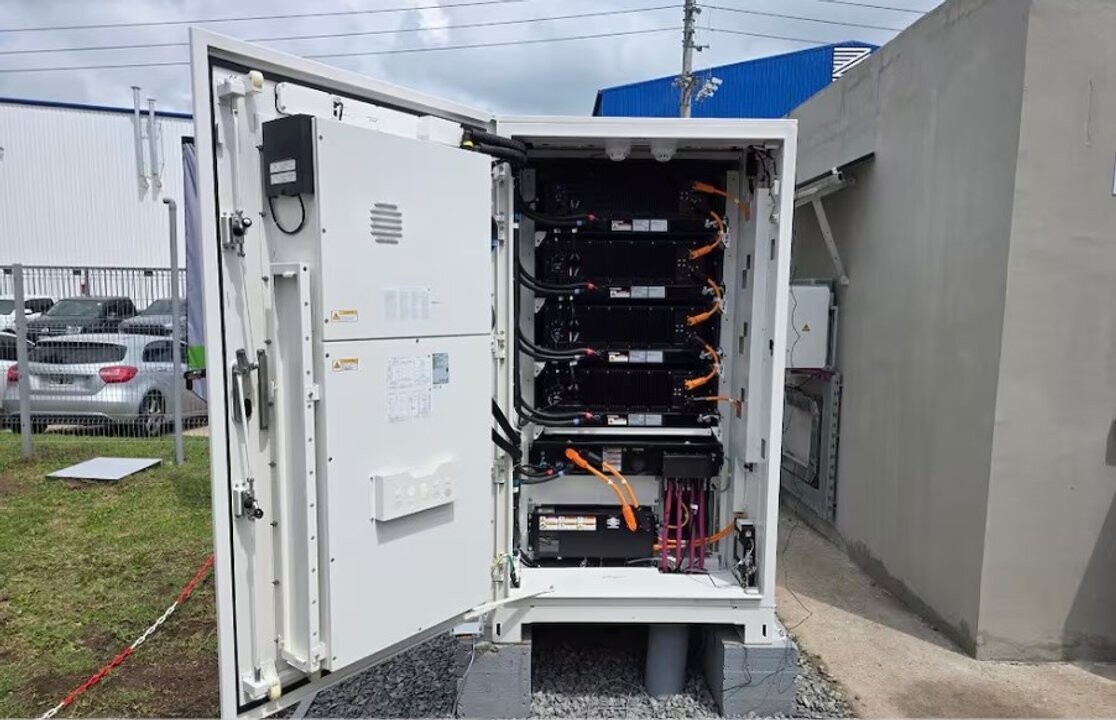
The Chinese technology giant Huawei announced in the country an innovative energy storage solution for the commercial and industrial segment, to be implemented at the Ezeiza Industrial Pole. This is the Huawei LUNA2000-215 kWh series, a complete renewable energy system that combines generation, storage, and efficiency, with the objective of reducing energy use, strengthening autonomy against power outages, and improving electrical quality by optimizing demand, power, and cost savings, as listed with the Noticias Argentinas news agency. The news was presented in Ezeiza to suppliers, clients, and invited media by Huawei's Vice President and head of Institutional Relations, Juan Bonora; Ignacio Dapena, Director of Digital Energy for Argentina, Paraguay, and Uruguay; and Javier Cortés, head of press, along with Yamil Haye, CEO of Unimers. "Argentina has great potential for the adoption of renewable energy in industry, and with this system, we respond to this need for efficiency. We don't say 100% because we are still connected to the grid, but we could move to 100%." "This is not an experiment, it is a concrete bet on modernization, reliability, and competitiveness," stated Ignacio Dapena, Digital Energy Director for Huawei Argentina, Paraguay, and Uruguay. He added: "It is the first industrial-commercial 215 kWh battery that can store surplus solar energy and allows for self-sufficiency, saving energy, leaving aside old systems and providing operational continuity". He concluded by saying: "The Ezeiza Industrial Pole is an example installation for those companies that seek to manage their consumption, reduce their carbon footprint, and avoid extra costs from demand peaks". For his part, Yamil Haye, president of Unimers, detailed that the new installation with Huawei technology will cover 95% of the plant's energy consumption. "It is already working and we are at 95%. We have started to no longer consume more kilowatts from the grid". In this sense, Haye highlighted the energy cost savings that this type of solution allows by reducing dependence and consumption from the electrical supply network. He also highlighted that -depending on the price of electricity in each location- a company would be able to recover the investment in a system of this kind in between 3 and 5 years. Key element The use of the LUNA2000-215 kWh battery constitutes a key element to add to the project installed in Unimers Argentina S.A., which contemplates a photovoltaic system with active safety technology based on SUN2000 150 MG0 inverters, solar panels on the factory roof, solar panel stations on the parking lots (car-port) that in turn store energy in a system designed for industrial self-consumption. It includes electric car chargers aligned with the trend in electric mobility. The contribution of the Huawei battery is to store energy generated during sunlight hours for nighttime use or power cuts, reduce the contracted power to avoid the penalties of exceeding usage limits, and replace traditional electrical generators (gas or diesel), maximizing efficiency and sustainability. The LUNA2000-215 kWh series is distinguished by its 215 kWh usable capacity and 108 Kw of power, a 91.3% conversion efficiency, and a hybrid cooling system (liquid + air) that reduces the system's cooling energy consumption by up to 30%. The equipment is designed for high-demand spaces such as industries and shopping malls, as it features a scalable architecture of up to 20 units, adding a total capacity of 4 MWh. It has a C2C Thermal Link, a complete active protection system at all levels to guarantee the safety of assets, property, and people. Each battery pack contains an embedded Energy Optimizer 2.0 with an efficient bidirectional balancing topology to improve system efficiency and achieve an active balance in real time, without charge or discharge restrictions. In this way, the short-board effect is overcome and the usable energy is increased by 2% during its lifecycle.