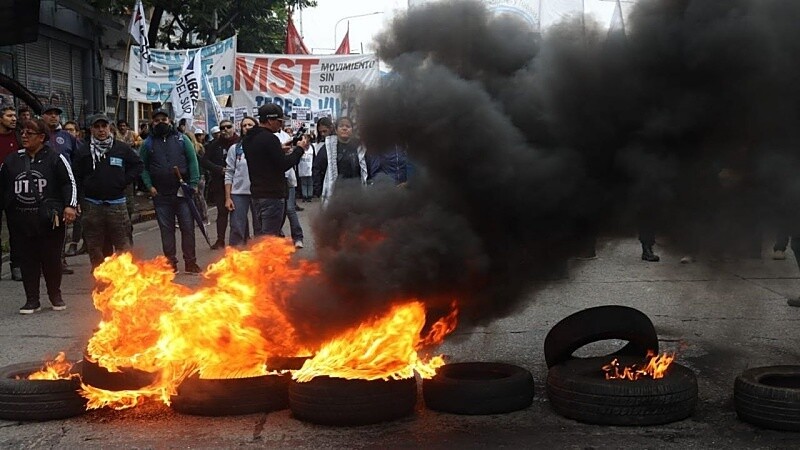
Protest activities took place in all provinces of the country. In the Greater Buenos Aires area, six blockades of the city had been announced, which were carried out, at least partially, as they did not result in total road closures: at Puente Pueyrredón (where the organizations set up their 'headquarters'), Puente La Noria, Puente Saavedra, Gral. Paz and Avda. General Paz. On the off-ramp from the Buenos Aires-La Plata highway, a picket line with burning tires, under the control of demonstrators, was set up more freely, completely cutting off access to La Plata due to the absence of federal forces; this occurred after a very large mobilization that some participants estimate at around 3,000 people. It was only after more than an hour of the protest with burning tires that the Gendarmerie arrived, guaranteeing the action of the firefighters. There was also a roadblock at the roundabout in Vapor, in Burzaco. In Buenos Aires province, protests also took place in Mar del Plata, Bahía Blanca, San Nicolás, and Pergamino. Peaks of tension The most tense moments occurred mainly during the protests in the Conurbano. 'Now, when there's trouble, fewer and fewer people go out'. Continuation The organizations have not yet set a date for the next day of struggle; some militants believe it could be around the payment date, when people see that the money will not be deposited. The 'picketers' are regaining strength and are announcing that the conditions for the fight are returning to the neighborhoods. The protest The National Government eliminated the 'Return to Work' program, which compensated workers in neighborhood soup kitchens, recyclers, and projects in the popular economy. Although militants cannot provide specifics for security reasons, the idea is reinforced to resort to forceful but creative forms of struggle that manage to attract attention and surprise the most polished repressive devices, which are those deployed by the government in the usual places for pickets (in the city of Buenos Aires and on the access roads). For this, the norm was the presence of militants with covered faces, sticks as security elements, drums of gasoline, and a basic organization scheme for self-defense, in the old picketer style. In that same highway, but at the height of Sarandí, however, there were stones thrown at the security forces when they advanced against the demonstrators to put out the fire, a situation that was maintained in an organized manner for several minutes. As in other marches, the police deployment ended up complementing the demonstration and the final effect was, in several blockades, the total impossibility of circulation. However, this time the federal forces did not make arrests or direct attacks on the demonstrators (except for the shoves and pepper spray mentioned). Assessments A relevant event occurred in the days leading up to the day of struggle, where some base assemblies were recovered to which members of the organizations that had stopped participating returned. The points on Avda. Paz and Ruta 3 and Puente La Noria, where the Federal Police, the National Prefecture, and in some cases the City Police (leaving its jurisdiction) proceeded to support the personnel of the Federal Fire Department. Those points will continue to be part of the days, just like the governorships and municipalities, which allows the movements to generate pressure on local leaders in search of partial achievements that can cushion the effects of the adjustment. The possibility of marching again in CABA is currently being evaluated as a possible 'crowning of the struggle plan', as this would imply measuring forces with the most concentrated repressive operation. Some sectors do not rule it out; on the contrary, they believe that is a scenario that will have to happen. There were marches and blockades in Neuquén, Río Negro, Chaco, Santiago del Estero, Corrientes, Tucumán, Santa Cruz, Formosa, Misiones, Salta, Entre Ríos, Chubut, and Tierra del Fuego, and minor actions in different localities. During the entire previous period, a group of young people organized the preparation of cobblestones and showed tire burners in a confrontational attitude, although that possibility did not materialize in the end. With a registry of more than 900,000 people and a payment of $78,000, it is the most massive blow in terms of simultaneous cuts in the history of employment programs. Methodology In many points of struggle, the burning of tires on the asphalt was resorted to, mainly on the access roads to the capital and the off-ramps from highways or routes. The institutionalization of the 'social movements' and the deflation they suffered in recent years had caused a lack of participation, not only in quantity but also due to the absence of decision-making spaces in assemblies. The escrache against Adorni, which had been carried out a week before the national day of struggle, had been preceded by assemblies where the militants found better rapport with their social base than on previous occasions, because now, those who received the employment program assume that the government is no longer going to pay. The combination of determined militancy and a base willing to struggle results in a strength that has not yet translated into massiveness, but does translate into greater firmness in the protest. What follows are testimonies from militants from different organizations who protagonized the pickets yesterday: 'We know that opening some type of negotiation is impossible, even so, there was a fighting spirit'. 'The discontent in the neighborhoods is felt more now than 6 months ago'. 'This [the elimination of the Return to Work program] is going to imply a process of even more shrinkage', although 'new people are approaching asking for the basics, food'. 'We believe that decentralization takes away massiveness, but it opens up participation at the local level, in what doesn't reach the city'. 'Yesterday all the movements were present, which coexisted harmoniously'. 'The blockades are less massive than before, due to the sector's own demobilization and the intimidating police deployments that have been coming'. 'The combative spirit has a basic objective: to break the matrix of fear'. There, shoves, scuffles occurred, and in one case, the Federal Police used pepper spray, although it did not come to worse. In some provinces, concentrations were held in front of the governorship, in a more traditional style. National scope The largest mobilizations took place in Rosario, Jujuy, and also in Córdoba, where massiveness is not usually so common in this type of event. On April 7, a day of struggle with road cuts took place, the most extensive and tense called by the organizations of the Popular Economy in what has gone of the government of Javier Milei. On Avda. Paz and Rivadavia, to which was added the Buenos Aires-La Plata highway, with two cuts that had their particularity, at the roundabout of access to La Plata and at the height of Sarandí (see more below). In La Rioja, the mobilization was carried out in front of the house of the Menem family, repeating the method of the escrache against officials at their homes that the MTE (UTEP) had carried out a week earlier in the country club where Adorni has his house, combining the factor of surprise and effectiveness. The factor of conflict was the burning of tires. The federal security forces sought to put out the fire and remove the tires without causing violent scenes of repression or capturing demonstrators (except for the brief detention of a militant at Puente Saavedra, who was immediately released). In general, they managed to do so at Puente Pueyrredón, Gral. Paz and Ruta 3. But they know that for them, they will not only have to have the capacity to resist, but also greater massiveness. This base is usually associated with the 'picketers', but many rural producer cooperatives, as well as inhabitants of remote localities and people who carry out community work in churches and social centers, are also being harmed.