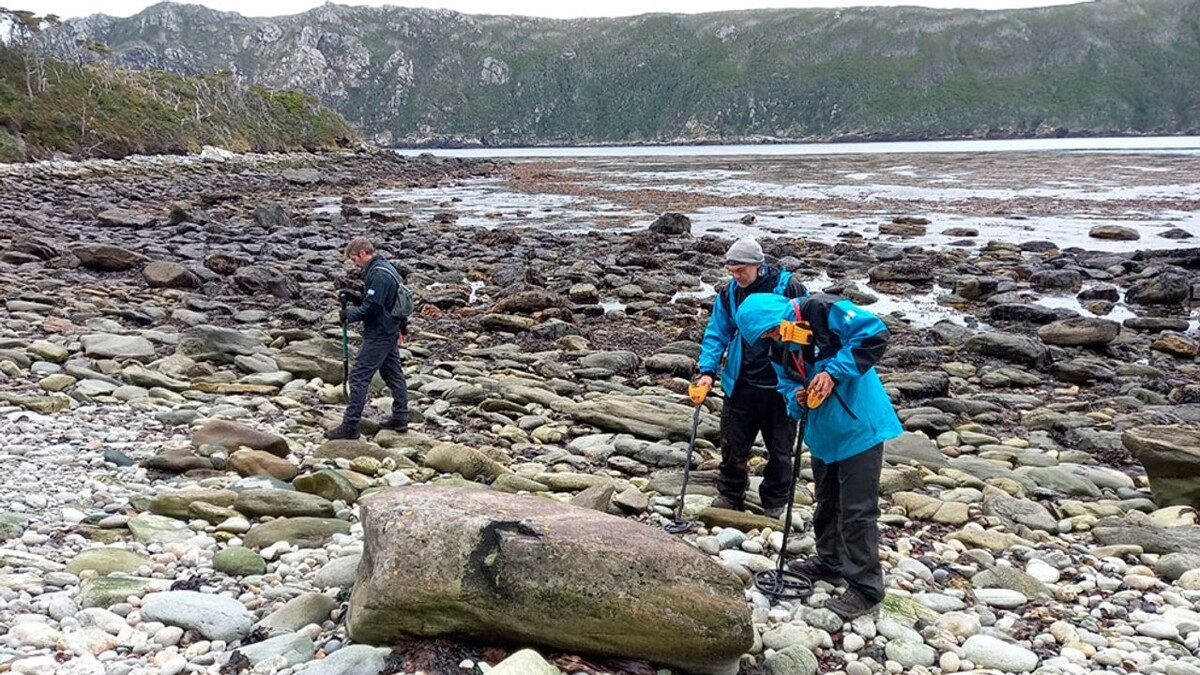
Specialists from the National Council for Scientific and Technical Research (CONICET), the University of Buenos Aires (UBA), and other institutions, with the support of the Argentine Navy (ARA), carried out the first systematic historical archaeological campaign in one of Argentina's most remote and challenging territories: Isla de los Estados, which is only accessible by sea through the stormy waters of the Le Maire Strait.
This territory, located 24 kilometers from Tierra del Fuego and 63 km long, contains material remains that tell the story of those who consolidated the sovereignty of our country in the 19th century through their presence, according to CONICET.
«This campaign, carried out within the framework of the 'Here Be Dragons' expedition and led by the naval officer and Malvinas War Veteran Roberto Ulloa, not only aims to produce scientific knowledge but also to enhance the island's historical heritage, raise awareness about the importance of caring for its sites, reflect on our maritime history, and strengthen memory and sovereignty in the territory,» explains Carlos Landa, an independent CONICET researcher and leader of the Border Historical Archaeology Studies Group (GEAHF, IA, FFyL-UBA).
According to Agencia Noticias Argentinas, the main objective of this scientific mission was to expand information about the island, which played a key strategic and economic role in the 19th century and served as a supply base for wood for the Malvinas during Luis Vernet's governorship in Argentina.
Although archaeological work on the island began in the early 1980s and allowed for the dating of the presence of canoeing peoples three thousand years ago, this is the first campaign focused on the human experience after the arrival of Europeans on the continent.
Isla de los Estados: a strategic enclave for the Malvinas
In the 19th century, Isla de los Estados played a key strategic and economic role, serving as a supply base for the first Argentine population commanded by Luis Vernet (1791-1871) in the Malvinas.
«At the site, we found multiple materials, glass, metallic, some related to food, that speak to the daily life of those people,» states Ávila.
«In particular, we found a very interesting object, a davit, which is an iron structure that functions to lift boats so they don't stay in the water and don't hit the rocks in case of a storm or simply to repair them,» notes Landa.
They also surveyed the remains of the Subprefecture, a prison, and a meteorological station that existed there between 1884 and 1898.
After making measurements and calculations based on original blueprints, the researchers were able to confirm the original site of the lighthouse and, based on that, also determine the location where the lighthouse keepers' vegetable garden and pen were set up.
«At this site, we surveyed structures of the prison that housed over a hundred prisoners and other sites linked to the 19th century, documenting evidence of daily life, work, and human presence in an extreme environment,» indicates Landa.
In that area, they also found the structures of the first prison and a barracks for the crew.
Additionally, the research team also conducted sondages in Puerto Cook, the site where the first prison was moved.
Vernet was the first Argentine political and military commander in the Malvinas, and both islands acted as a node of Argentine connectivity in the South Atlantic.
The motivation for carrying out this campaign has to do with the historical past and the human experience on the Malvinas in the 19th century, particularly between the Argentine governorship and the British incursion, especially during Vernet's governorship, as explained by Landa.
Isla de los Estados functioned as an enclave from which wood was extracted for the Malvinas.
«For this reason, this island became an interesting point to work from an archaeological perspective, since we have historical documentation that allows us to locate sites of interest such as houses, sawmills, and several sea lion rookeries,» pointed out Sebastián Ávila, a CONICET doctoral fellow at the IA and a member of the team that carried out the archaeological expedition.
The findings on Isla de los Estados
The archaeological expedition led by Landa, Ávila, Raies, and Ciarlo aimed precisely to identify and recover objects such as house remains, navigation materials, daily utensils, and possible evidence of commercial exchange that would provide concrete information on how life was organized on Isla de los Estados and its articulation with the Malvinas during the 19th century.
«From the cross-referencing of the material findings with the historical documentation about the Luis Vernet colony and other archives, we are interested in reconstructing supply circuits, labor dynamics, and circulation networks of people and goods in the South Atlantic, and in particular, to help understand the operational link between the two islands, Estados and Malvinas, as a strategic connectivity node, at a stage of sovereign consolidation in that southern region of our country,» Ávila summarizes.
During the archaeological expedition, the researchers visited the San Juan de Salvamento Lighthouse, an emblematic site in Argentine maritime history inaugurated in 1884, where they recorded structures and remains associated with the life of the lighthouse keepers and the functioning of the so-called 'Lighthouse at the End of the World' that inspired Jules Verne's novel (1905).