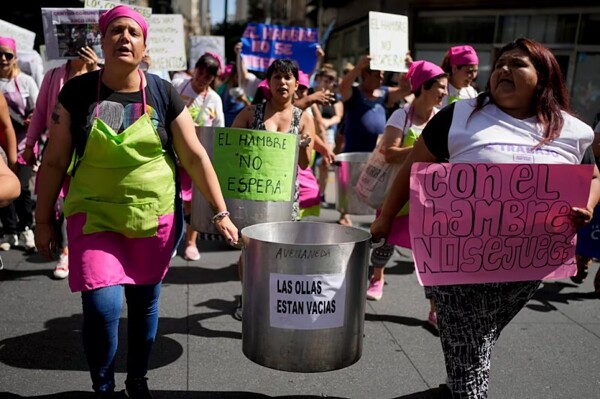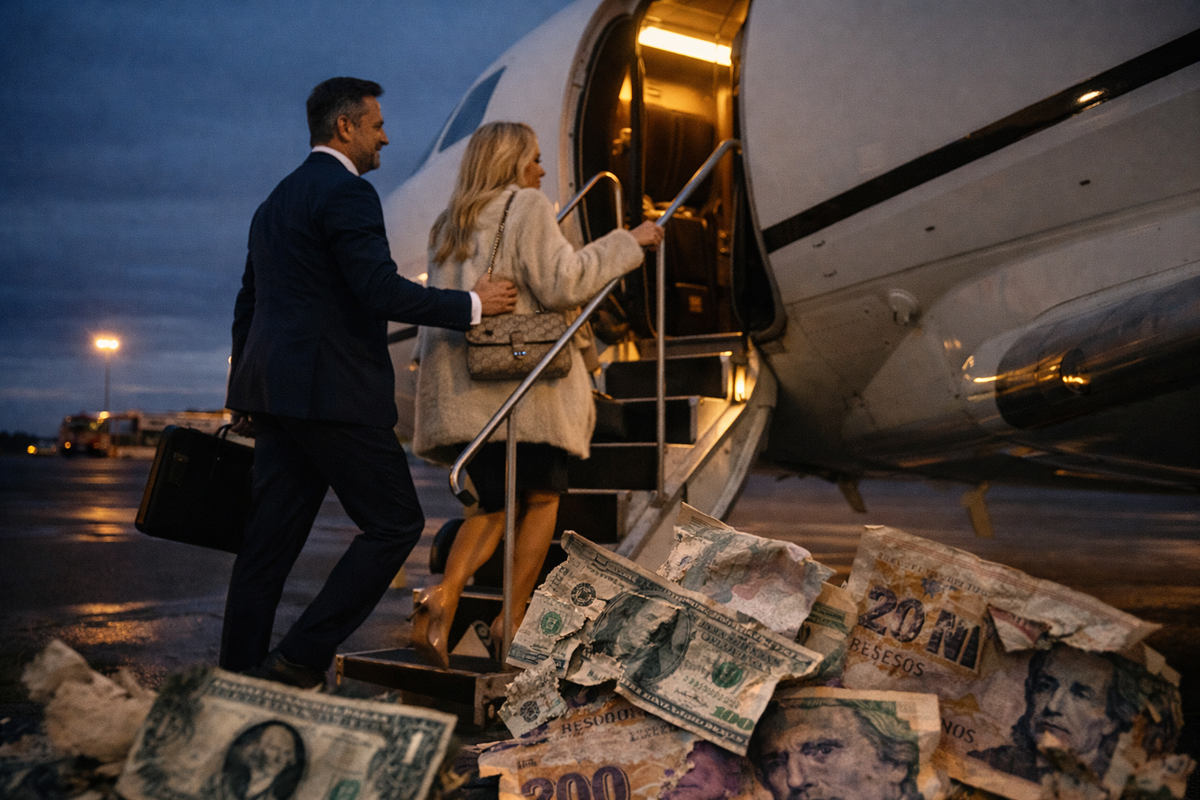
Fourteen days of leave to catch a breath, while the leadership enjoys a permanent sabbatical year funded by the 'effort of all'. The genesis of the problem is that in Argentina, equality before the law is a piece of fantasy literature. We have gone from the opulence of a strong currency to the misery of infinite zeros. The President 'earns less' (I can only use one pair of quotation marks) than his ministers, and lawmakers raise their hands to index their well-being at lightning speed when the camera is not on them. A Closing Tournament that today sounds like a lost civilization, a time when Argentina was still on a 'first-name basis' with the world. That is, in almost three decades, the floor of dignity has risen by only 43 dollars. A per diem for a coffee at Barajas Airport. The Average Salary drags along at 1,172 dollars (1,700,000 devalued pesos at the market exchange rate). This is where irony turns sour, almost corrosive: the nominal figure of that historic 1999 revenue (776,420) today represents only 45.6% of a single average salary. What was the fortune of an entire stadium in Argentina's Convertibility era, today is not enough to pay a moderately educated administrative assistant for a month. Attributes that, curiously, are always financed with the VAT from the pasta eaten by the type who travels in the train's wagon. To understand the silent fury of the citizen who today looks at their paycheck with the same resignation as one looks at a sentence, one must descend to the morgue of our economy with the scalpel of historical precision. Let's remember. By: Nicolás J. Portino González. The debate that agitates social networks and the hallways of the 'red circle' — that circle that is getting smaller and redder with shame — revolves around the ubiquity of the official. A genre that politics masters with skill. How do we explain to the person earning the average salary of 1,172 dollars that it is 'strategic' for a minister's family to fly with public funds? There is no explanation, only resignation. Someday we will have to get serious. That impulse of the vernacular politician, after asking for our hand for the heroic feat of saving us from the abyss, ends up leaning heavily on our back to avoid walking so far to the official jet's ladder. While Adorni and the 'student minstrels' of power decide if the job's attributes include catering for relatives, the country continues searching in the memory of a 1999 goal for the trace of a currency and a nation that escaped through the skylight of an official jet. To be continued… (if the next devaluation leaves us ink in the inkwell). Because the problem is not what they earn, but the gap in rights. While politics has perfected the art of getting rich with paid-for comforts — planes, bodyguards, secretariats of nothing itself — the rest of the population lives out in the open. We are talking about educated professionals, people with more titles than those in the national organizational chart, who are still fighting for a rigid 14 days of vacation after five years of flawless work. But seriously, for real. The degradation of the currency has been the most effective method of politics to subject us to cultural and mental poverty. In this context of shipwreck, the ruling class plays the 'Kingdom of Upside Down'. It's a trap for the masses. It is the paradox of demagoguery: they pretend a monkish austerity on their pay slip while appropriating the 'attributes' of the crown. Is it okay for the President to 'earn little'? Is the Chief of Staff a public servant 24 hours a day or does he have the right to retreat into his private life? The argument is as tender as it is terrifying: security, the integrity of the family, the attribute of the office. Not with the cardboard seriousness of televised debates, but with the seriousness of exemplarity. The panorama is of a precariousness that nominality tries to unsuccessfully mask: The Minimum Vital and Mobile Salary was recently set at 243 dollars. Martín Palermo —the goal's optimist— inflated the net of River and the narrative of the era immortalized a figure: 776,420 pesos. At that time, under the rigor of '1 to 1', that figure was exactly 776,420 dollars. That scenario: The average salary oscillated between 1,600 and 1,900 dollars (let's say, 1,750 USD for friends of statistics). It took 3,882 workers with the basic salary to gather what the 'Titan' generated in 90 minutes of sweat. Let's advance 27 years down the state-induced poverty slide to arrive today, March 13, 2026. That single match's revenue was equivalent to the sum of 443 average salaries. The base of the pyramid: The minimum salary was 200 dollars. Adorni, a privileged inhabitant of the state's button panel, is under the microscope for using state resources for the transport of his offspring. It is the old dialectic of the 'shoulder tap'. May 9, 1999.