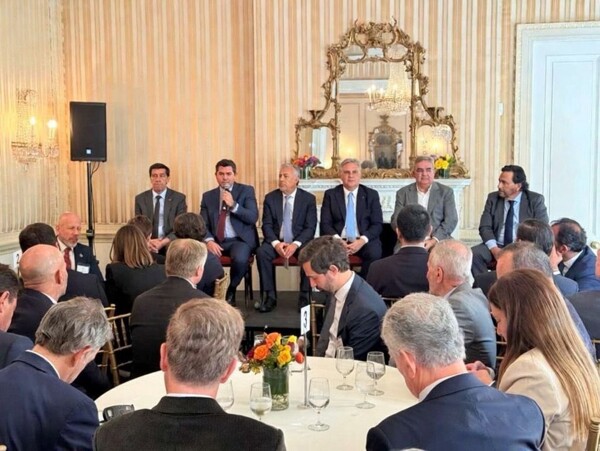
President Javier Milei's speech combined a strong critical tone towards part of the Argentine business community with a reaffirmation of the libertarian economic course, which surprised some attendees but also signals of confidence about the continuity of the reform program. The head of state participated in the central event of the road show organized to attract investment to Argentina, where he spoke for 44 minutes before executives from the financial system, businesspeople, and international market analysts. In this context, he affirmed that his government seeks to put an end to that model and move towards an open economy based on market rules. The president also recounted a recent episode linked to businessman Madanes Quintanilla, whom he accused of pressuring the government to maintain a trade barrier that protected the country's main aluminum producer. The event is part of a broader international agenda for President Milei, which also includes visits to Chile and Spain during the same week. Thus, the president's passage through Wall Street left a double message: a reaffirmation of ideology against what he considers old practices of Argentine capitalism, and at the same time, a promise of continuity of the economic program that seeks to transform the country's rules of the game. There he explicitly mentioned the president of the Techint Group, Paolo Rocca, and the businessman Javier Madanes Quintanilla, whom he defined as representatives of what he calls 'crony capitalism'. During his speech, Milei stated that certain economic groups grew under the protection of trade barriers, regulations, and agreements with politics that ultimately harmed consumers and distorted competition. Before his speech, he held a meeting with JPMorgan CEO Jamie Dimon, a meeting considered key to strengthening the ties of the Argentine government with the global financial system. The most commented moment of his speech was the passage in which he once again questioned Argentine businessmen whom he accuses of having benefited for years from state protection mechanisms. Some investors commented in the bank's corridors that the direct criticism of Argentine businessmen did not seem to be the most usual approach for a forum aimed at attracting international capital. An executive from a US investment fund pointed out that the tone of the message seemed to be aimed mainly at the Argentine political audience rather than the financial public present in the auditorium. According to his interpretation, some of the president's phrases responded more to the logic of the internal political debate than to the usual style of meetings with international investors. Other participants considered that the president could have focused his speech from the beginning on explaining the structural changes that the Argentine government is promoting and the reasons why, in his view, the country's economy is going through a different stage than previous cycles. However, several attendees agreed that the second part of the speech was more relevant for the investor audience. There, Milei emphasized fiscal stability, the commitment to honor the country's debts, economic openness, and the progress of structural reforms that, he stated, will continue to be promoted in the National Congress. In that section, the president sought to convey predictability about the direction of the economic program and the continuity of policies aimed at deregulation, reducing public spending, and liberalizing markets. Analysts present at the event highlighted that, beyond the confrontational tone towards some businessmen, the central message of the president aimed to consolidate the idea that the Argentine government intends to sustain its economic program for several years. For international investors, especially those linked to sectors such as energy, mining, or infrastructure, political and regulatory stability is a determining factor when evaluating long-term projects. Argentina Week brings together in New York representatives of the Argentine government, governors, businessmen, and leaders of the international financial system with the aim of promoting investment opportunities in the country. According to his explanation, the businessman would have warned that if that protection scheme was eliminated, the company would lay off hundreds of workers. That section of the speech generated surprise among several of the event attendees. New York - March 10, 2026 - Total News Agency - TNA - The opening of Argentina Week 2026 at the JPMorgan headquarters in New York left a scenario of mixed reactions among businessmen and international investors.

Milei on Wall Street: Business Criticism and Promise of Economic Reforms
Argentina's President Javier Milei spoke on Wall Street, sharply criticizing part of the local business for 'crony capitalism' and reaffirming his libertarian course. Despite an unexpected sharpness for investors, the second part of his speech, focused on economic stability and reforms, received a positive response. This event is part of his international roadshow to attract investment to Argentina.