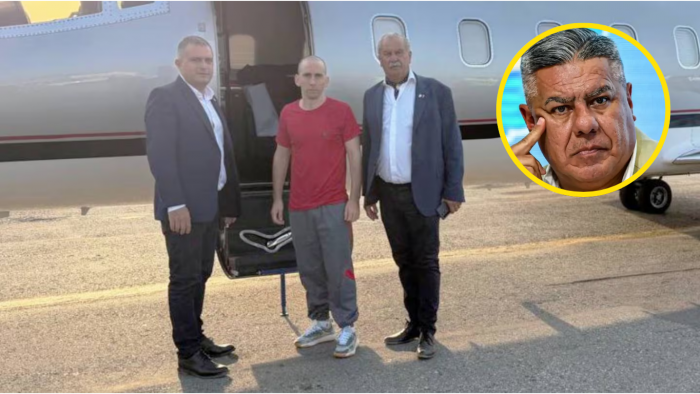
The Casa Rosada let it be known this Monday that it does not rule out advancing judicially against the Argentine Football Association (AFA) under very serious figures such as “treason to the homeland,” “sedition,” or “illegal espionage,” due to the role the entity played in the negotiations that led to the return of the gendarme Nahuel Gall from Venezuela. The problem for the Government is that, according to the plot reported by TNA, it would have first attempted to absorb or at least coordinate with Tapia, and now it is trying the second, to expose the AFA as an institution. Because if the AFA “interfered”—as official voices suggest—then the inevitable question is what was it doing, who was it talking to, and why was it able to operate where the State had difficulties. And those kinds of wounds, in politics and in football, rarely heal without consequences. For now, the only sure thing is that the Government chose to turn up the volume and put on the agenda words that are not spoken lightly: “treason to the homeland,” “sedition,” “espionage.” And when that happens, politics reacts with defensive reflexes: it either absorbs those actors or exposes them to discipline them. The relationship would have ended in a resounding failure due to the excessive ambition of Tapia, who took all the credit before the world, overshadowing the government and destabilizing not the figure of Karina, but that of Javier Milei, President of Argentines. Whether that escalation becomes a real case or remains a warning will define much more than a fight with the AFA: it can reveal if the Casa Rosada is willing to break its own informal understanding with Tapia, or if the threat is, in reality, a curtain to hide the bridge that connects Viamonte with the heart of political power through Karina Milei. The signal, attributed to “official sources,” seeks for the AFA to explain its links with the Venezuelan political web and with actors of the chavist regime. On a board where each actor keeps sensitive information, public gestures—such as a threat of denunciation for “treason”—can be interpreted as pressure, but also as internal betrayal. In other words: if the Casa Rosada is willing to judicialize the role of the AFA in the Gallo case, that decision should, by definition, impact its leadership. But the announcement opens a deep short circuit: an entity like the AFA does not act on its own; any real criminal liability would logically fall on those who lead it. That is the point that does not close with the logic of a preservation pact. In this context, an alternative reading is growing—which is beginning to circulate even among operators who do not sympathize with the AFA—the threat of a complaint could function as a damage control move, a way to cover the Tapia-Government relationship and, especially, the political channel with Karina Milei. And if it impacts its leadership, the line is cut at Tapia. “We are going to try to answer the question who and in what way,” they slipped in the Government, along with the list of possible criminal figures. And there appears the core of the contradiction. On the other hand, the million-dollar question would be: Why didn’t SIDE prevent Tapia’s “foreign intelligence” operation? According to the previous reconstruction published by TNA, the airplane episode would not fit into an improvised adventure, but rather into a roadmap drawn in secret between the presidential environment and the leadership of the AFA to preserve Tapia, isolate Pablo Toviggino, and “manage” the impact of the judicial causes surrounding football power. What was supposed to be an “oblique collaboration” ended with the AFA as the central actor. In the middle remains an element that further complicates the scene: the internal dispute in the AFA and the isolation of Toviggino. And that approach, in turn, would have had conditions: to moderate its tune with Governor Axel Kicillof—a key point—isolate Toviggino, pointed out as the figure to be sacrificed to contain the fire. With these two planes on the table, the question that quietly traverses the political system is as simple as it is explosive: how can the Government suggest a complaint for “treason to the homeland” against the AFA if, at the same time, there are indications of a relationship of convenience with Tapia to sustain the status quo? But something must have broken “the link.” In that same line, the information already published by this medium maintains that the link between Karina Milei and Tapia would have been consolidated from gestures and contacts that took shape around the 2030 World Cup project. In the same sense, from the Casa Rosada they stated that an entity outside the State “cannot intervene” in a country that, in political terms, the ruling coalition defines as a “narco-terrorist dictatorship,” “arrogating itself a public function” role. In terms of political communication, the message seems to seek three simultaneous objectives: to regain control of the narrative on who actually managed the liberation of Gallo; to set limits for private actors moving in high-sensitivity diplomatic scenarios; and, above all, to show muscle before an event that left the Government exposed. It also left exposed that in limit situations, non-state actors can become operational channels that end up conditioning the State. A double game that, if it exists, explains why they talk about “investigating links” and “asking for explanations,” but there is still no concrete definition on immediate actions against the apex of the entity. The tension also reveals something deeper: the fragility of pacts when facts that make them visible appear. That is to say: turn the AFA into the “public suspect,” raise an institutional indignation discourse, and at the same time maintain the real dialogue below the surface. If the Government effectively pushes for the weight to fall on the treasurer and not on the president, it would face a high-precision engineering with high risk: because a cornered leader can decide to talk, to document, to explain circuits and open cracks that will drag everyone along. And that inevitably places the spotlight—on Claudio “Chiqui” Tapia, the same leader who, according to information published by Total News Agency (TNA) based on high-level sources, has been building a reserved understanding with the innermost circle of the Javier Milei government, with Karina Milei as the decisive bridge. The Government’s secret bet to sustain Tapia and leave Toviggino exposed: a truce with a safe-conduct smell that “can fail.” The threat of denunciation arose after it became known that the Gallo return operation was carried out on a private plane linked to the AFA, a fact that set off awkward questions in the State: why would a non-governmental organization get involved in a sensitive negotiation with a country under a power structure repeatedly denounced for human rights violations and with strong diplomatic tensions. The Gallo case not only brought back an Argentine who was detained for 448 days. In that framework, Tapia would have worked to build direct channels with “The Boss,” understanding that in a context of judicial pressure and internal power struggle, his survival does not depend only on the Viamonte wheeling and dealing, but on the real temperature at Balcarce 50. That architecture—according to sources with access to the “small table” of the National Government and the aeronautical sector—would have a central piece: Karina Milei, General Secretary of the Presidency, presented as a hinge and guarantee of the approach with Tapia. “We knew they were there and they were interfering in the negotiations.”