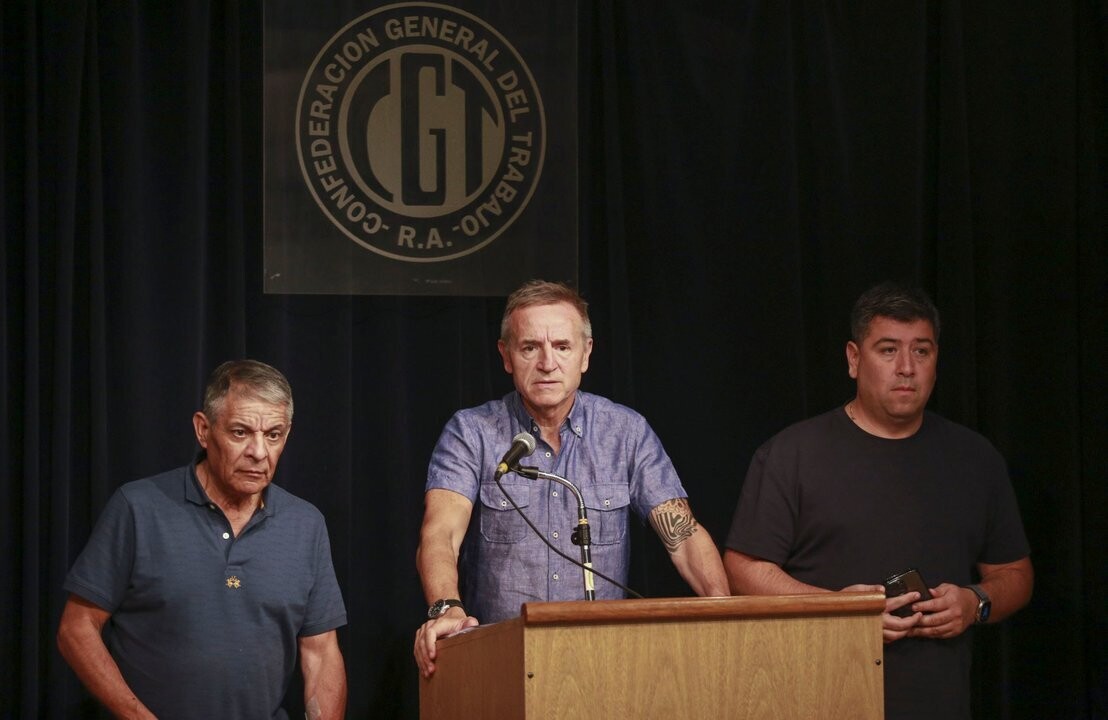
Buenos Aires, Feb 6 (NA) - The historic headquarters of the General Confederation of Labor (CGT), located on Azopardo Street, will this Friday at 11:00 become the epicenter of a decision that will set the political pulse for the coming weeks. The central labor union's board of directors was convened with the urgency dictated by the legislative agenda: the imminent treatment of the labor reform in the National Senate. For these sectors, the parliamentary path is insufficient in the face of what they consider an irreversible advance on the historical conquests of the Argentine labor movement.
A History of Resistance. The possibility of a general strike during the legislative debate is not a new recourse, but a pressure tool that has defined the institutional crises of recent decades. In December 2017, during the Mauricio Macri administration, the attempt to advance with a labor reform after the approval of the pension reform generated days of extreme violence in front of the Congress and national strikes that forced the government of the time to withdraw the project from the parliamentary discussion table. In January 2024, in the most recent stage, the CGT has already demonstrated its capacity for reaction with a national strike just 45 days after the new administration took office, marking a historical record in the speed of a forceful measure against a newly elected government.
Internal Fracture. According to what the Argentine News Agency (NA) was able to learn, the internal discussion reflects a clear strategic fracture. On the one hand, the so-called 'dialogist' or 'Fat' and 'Independent' sector—represented by figures like Héctor Daer (General Secretary and head of Sanitation) and Gerardo Martínez (Secretary of International Relations and head of the UOCRA union)—has prioritized weaving political networks in recent weeks. Their strategy has focused on lobbying with governors and senators, seeking to introduce technical modifications to the project that would mitigate the impact on the collective rights of workers.
On the other side, the more combative wing, led by Pablo Moyano (General Secretary and leader of Truckers) and backed by the transport unions and both branches of the CTA, demands an immediate cessation of activities. In this meeting, the union leadership must decide whether to deepen the struggle plan through a national strike or a massive mobilization on the day of the debate in the chamber. Despite direct efforts, the support from Peronist governors has not been unanimous, creating a climate of uncertainty about the real margin for negotiation.