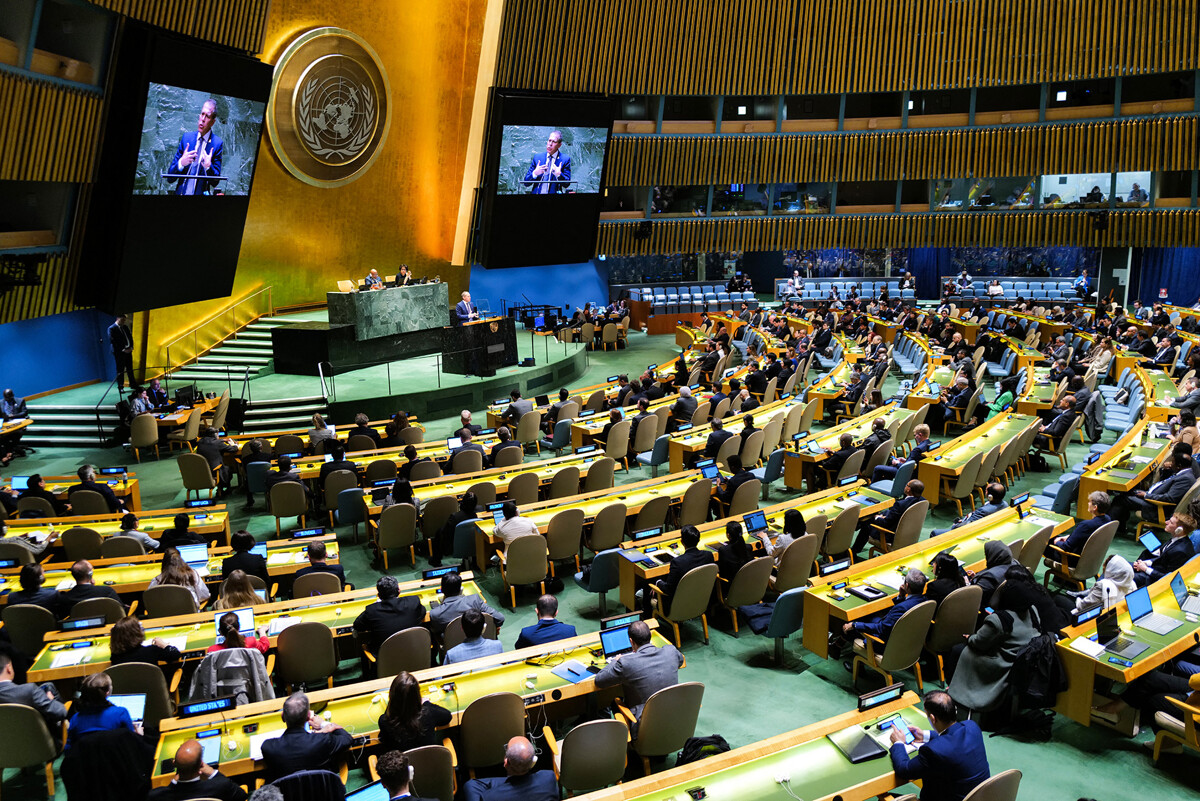
In an international scenario marked by armed conflicts, geopolitical fractures, and a progressive weakening of multilateralism, the United Nations Organization is heading towards a decisive election: the designation of its next Secretary-General.
The government of Javier Milei is explicitly promoting the candidacy of Ambassador Rafael Grossi, current Director General of the International Atomic Energy Agency (IAEA), whom they consider in the Casa Rosada a candidate with international support and affinity with the Donald Trump administration. In public and private meetings, the diplomat has defended his candidacy with an emphatic discourse, based on his trajectory at the head of the IAEA and the international visibility that his role in sensitive nuclear crises gave him.
However, in the corridors of the United Nations, another Argentine option is gaining weight: journalist and diplomat Virginia Gamba, a career official of the organization and current Special Representative of the Secretary-General for Children and Armed Conflict. Gamba's career within the UN, focused on human rights and the protection of children in wartime, has earned her cross-cutting recognition within the multilateral system.
The election will take place in a particularly delicate context for the UN. Almost eight decades after its creation, following the end of World War II, the organization is going through one of its stages of greatest discredit and loss of influence. In fact, several observers consider that she could prevail in an election where two key factors converge: regional rotation towards Latin America and growing pressure for the UN to be led by a woman for the first time in its history.
The result will not only mark the future of the United Nations, but also the place that Argentina aspires to occupy in global diplomacy in the coming years. The distinctive feature for Argentina is that, beyond political alignments, two of the figures with the greatest possibilities come from the same country, with diametrically opposite visions, support, and styles.
The new head will take office on January 1, 2027. Grossi is active in promoting his candidacy and has the political support of the Argentine government. According to the organization's founding Charter, the position is renewed every five years, and following the unwritten criterion of regional rotation, the successor should come from Latin America.
Without the formal support of the Argentine government or the Ministry of Foreign Affairs, his candidacy is profiled as independent, although it has the support of at least three countries willing to formally present her during the lengthy selection process.
For the first time in decades, Latin America appears as the region with the greatest possibilities of providing the new leadership of the organization, and within that framework, two Argentine figures with very different profiles and support emerge. Diplomatic analysts point out that, despite Grossi's visibility, Gamba's chances are no less.
In addition to the two Argentine candidates, other prominent candidates include former Chilean President Michelle Bachelet, with an extensive track record in human rights; Costa Rican Rebeca Grynspan, current Secretary-General of UNCTAD and former Vice President of her country; and the Bolivian David Choquehuanca, backed by indigenous movements.
In a world where the UN is losing ground to unilateral decisions by major powers, the election of the next Secretary-General appears as an opportunity to redefine the organization's direction.