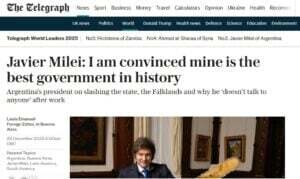
In an extensive interview with the prestigious British media outlet The Telegraph, President Javier Milei confirmed Argentina's official stance on the sovereignty of the Falkland Islands. The head of state described the issue as 'non-negotiable' and firmly stated that his administration will 'never' renounce the historic claim over the South Atlantic archipelago. Milei sought to balance firm diplomacy with a pragmatic view of international relations and global exchange. Since the act of dispossession, Argentina has maintained a permanent diplomatic protest, based on territorial integrity and the legal heritage of Spanish rights, while the United Kingdom has maintained its presence based on de facto control and the colonial administration of the islands. In the interview, the libertarian leader accused the Venezuelan president of 'using state resources to spread communism across the American continent, representing a threat to regional stability.' For the Argentine president, the disappearance of the existing political models in Venezuela and Cuba would result in a direct benefit to the global order. 'The world would be a better place without Venezuelan communism, and, fundamentally, if the Cuban version ended, the world would also be a better place,' he concluded during the interview with the London newspaper. Milei also offered a detailed reading of the current geographical and ideological division. This closeness with the northern country is the central axis of his foreign policy, which, amid great internal controversy, seeks to reinsert Argentina into the bloc of Western liberal democracies. Within this alliance scheme, Milei did not spare criticism towards the authoritarian regimes in the region, focusing his darts on the self-proclaimed government of Nicolás Maduro in Venezuela. While sectors aligned with the Government highlighted Milei's ability to maintain the sovereignty claim without isolating Argentina from international markets, the opposition and various centers of veterans expressed caution about the possibility that commercial pragmatism might ultimately blur the firmness of the territorial demand. In the United Kingdom, the statements were interpreted as a gesture of détente that seeks to normalize the bilateral relationship, although the Foreign Office maintained its historic position that the self-determination of the islanders is a non-negotiable point for the Crown. To understand the depth of the conflict, it is necessary to go back to the history of the British occupation that consolidated in the 19th century. President also mentioned his view of the world, divided into three clearly defined spheres of power: China with its network of satellites; Russia with its respective sphere of influence; and finally, the United States, a nation that seeks to consolidate its predominance throughout the entire American territory. The president's vision unequivocally places Argentina within the bloc led by Washington, moving away from the policies of neutrality or rapprochement with Eastern powers that characterized previous administrations. The Argentine military power, as published by the British newspaper The Telegraph. The repercussions of the president's words were not long in coming, manifesting themselves both in the national political arc and in the foreign press. For the economist, the consistency of his economic plan will allow Argentina to overcome the long-term crisis, positioning the country as a new beacon of free-market capitalism. The relevance of these statements is enhanced by the chosen medium for their dissemination. In this sense, the head of state stated that he will promote all possible measures to improve bilateral trade, always under a strategic look that contemplates the current geopolitical risks facing the contemporary global scenario. The interview also served for the head of state to reaffirm his solid alignment with the United States, highlighting his ideological affinity with the Republican leader Donald Trump. He firmly reaffirmed the economic direction of his administration and did not hesitate to describe his team of work as 'the most efficient' that has passed through the Casa Rosada in decades. 'I am increasingly convinced that we are the best government in history,' Milei emphasized, defending the structural reforms and fiscal adjustment implemented. This strategic definition is presented by Milei as a safeguard against the advance of ideologies that he considers harmful to individual freedom. Milei, beyond the Falklands When referring to domestic management, the president showed an 'unbreakable optimism' regarding the results obtained in his first months in office. In 1820, the United Provinces of the Río de la Plata had taken formal possession of the islands, establishing a government structure and economic activities under the command of Luis Vernet. However, in January 1833, the British frigate HMS Clio arrived at the archipelago and, by the use of force, evicted the Argentine authorities and the local population. In that article, the media highlighted the 'president's courage to face structural problems and his ability to communicate complex ideas in a direct way, considering him a political phenomenon of world interest'. Stay tuned. In his view, the international public debate no longer primarily centers on the phenomenon of globalization, but has 'shifted to a purely geopolitical dispute for control of areas of influence.' In his diagnosis, the world is fragmented into three clearly defined great blocs of power. Founded in 1855, The Telegraph is one of the oldest and most influential newspapers in the United Kingdom, traditionally associated with the values of the Conservative Party and a center-right editorial line that often sets the political and economic agenda in the city of London. Last weekend, this British newspaper dedicated a highly laudatory note to the figure of Milei, describing him as a 'disruptive leader capable of transforming the Argentine reality'.